UN Secretary-General warns of repercussions of conflicts in Ukraine, Sudan and the Middle East
صورة: وكالة الأنباء الكويتية (كونا)
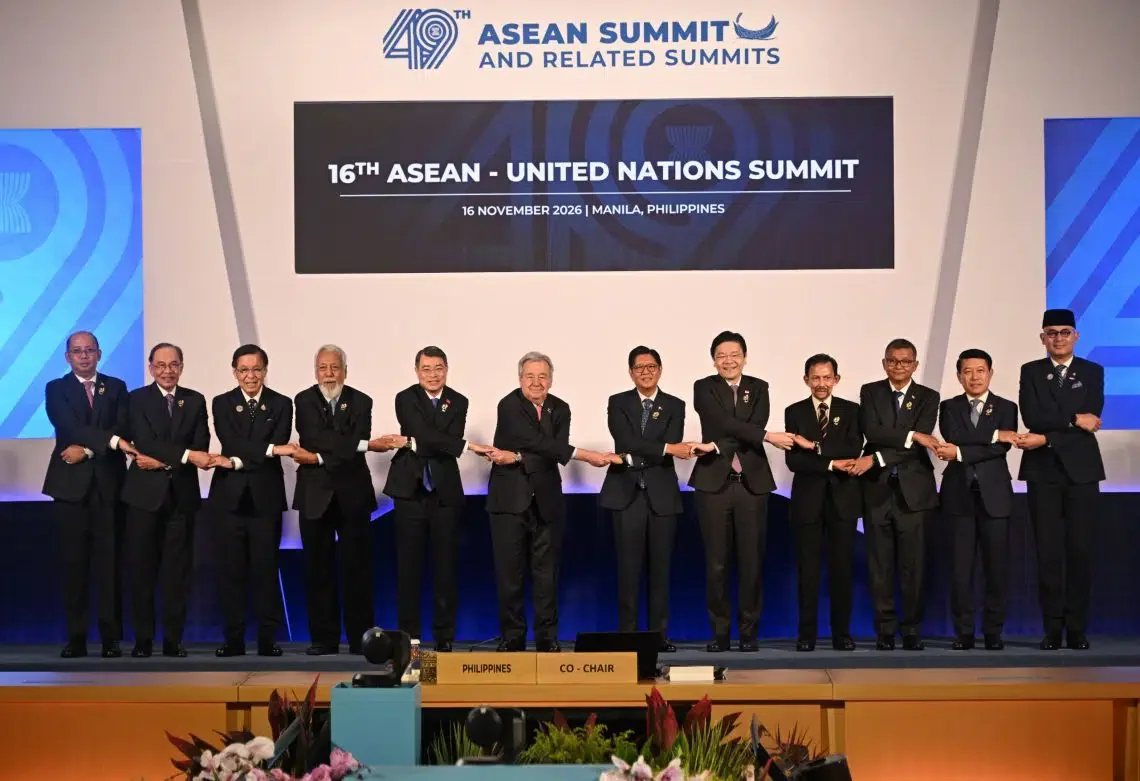
UN Secretary-General Antonio Guterres called during the ASEAN summit in Manila for establishing peace in Ukraine, Sudan and the Middle East, warning of the humanitarian and economic repercussions of conflicts, and stressing the need for nuclear disarmament and reform
Translated by Alqyas from KUNA — Original source
Kuala Lumpur – UN Secretary-General António Guterres called on Monday for the establishment of peace in Ukraine and Sudan, as well as in the Middle East, particularly in the Gaza Strip and Yemen, warning of the humanitarian and economic repercussions of ongoing international conflicts. This came during a speech by Guterres at the 16th ASEAN-United Nations Summit held in Manila, the capital of the Philippines, as part of the 49th ASEAN Summit and its related summits, attended by leaders of member states and dialogue and development partners.
Guterres stated that the world is facing growing challenges, including armed conflicts, uncontrolled climate change, rising humanitarian needs, and a cost-of-living crisis, alongside escalating tariffs and energy prices. He highlighted the regional repercussions of the Russian-Ukrainian war, including the situation in the Black Sea and multiple crises in the Middle East, particularly navigation disruptions in the Strait of Hormuz and the Red Sea, reaffirming the UN’s unconditional commitment to defending the rights and freedoms of maritime navigation under all circumstances.
At a press conference held on the sidelines of the summit, Guterres urged the launch of serious diplomatic negotiations between the United States and Iran to end the state of “neither war nor peace” between them, warning of their devastating economic impacts that have extended beyond the Middle East.
On international security, Guterres affirmed the UN’s readiness to contribute to supporting and ensuring the success of any nuclear disarmament initiative that may emerge from the upcoming meeting in China on Thursday between US President Donald Trump, Russian President Vladimir Putin, and Chinese President Xi Jinping. He noted that a commitment by the three countries to take concrete steps toward nuclear disarmament would constitute a major achievement for the world, while acknowledging that such an outcome is not yet guaranteed. He emphasized that the world will not be fully secure until it is free of nuclear weapons, amid rising risks associated with geopolitical tensions and competition among major powers.
Regarding the international system, Guterres called for reform of the UN Security Council and international financial institutions to reflect global political and economic shifts, granting emerging powers, including ASEAN countries, representation commensurate with their growing influence.
On climate issues, the UN Secretary-General urged political leaders to assume their responsibilities in addressing climate change by drastically reducing emissions and accelerating the transition from fossil fuels to renewable energy sources. He pointed out that nine of the world’s largest oil companies achieved profits totaling $95 billion in the first quarter of this year, while households face rising fuel prices and living costs, calling on developed countries to triple their funding for climate adaptation.
Regarding regional developments, Guterres expressed deep concern over the ongoing crisis in Myanmar and the immense humanitarian suffering there, reaffirming the UN’s support for implementing the Five-Point Consensus adopted by ASEAN to address the crisis. He stressed the need for accountability for serious violations against the Rohingya minority and the creation of conditions necessary for their safe, voluntary, dignified, and sustainable return, nearly a decade after mass displacement operations.
Regarding the South China Sea, Guterres reaffirmed the United Nations’ commitment to the United Nations Convention on the Law of the Sea, despite some countries not recognizing it, and described the convention as a crucial foundation for the success of ongoing negotiations between ASEAN and China on a Code of Conduct aimed at regulating the behavior of parties in the disputed maritime area. He praised ASEAN’s efforts to support regional stability, including its role in helping to sustain the ceasefire between Thailand and Cambodia, and the progress made in negotiations on the Code of Conduct in the South China Sea.
In a separate development, he congratulated the Philippines on holding parliamentary elections in the autonomous Bangsamoro region of Mindanao island in the south, noting that this step represents a significant milestone in consolidating the peace process and could serve as a model that transcends the Philippines and Southeast Asia.
The Philippines, which holds the rotating ASEAN chairmanship, is hosting the 49th ASEAN Summit and related summits from November 15 to 17, with participation from the leaders of member states and dialogue partners, including China, the United States, Japan, South Korea, India, Australia, New Zealand, Russia, Canada, the United Kingdom, and the European Union.
ASEAN, founded in 1967, comprises the Philippines, Indonesia, Malaysia, Singapore, Thailand, Brunei, Vietnam, Laos, Myanmar, Cambodia, and East Timor, which joined in October 2025, bringing the total number of member states to 11. (End) ANP/FS
