Communications Minister: Kuwait Moving Toward Technology Investment and Harnessing AI in Its Sectors
صورة: وكالة الأنباء الكويتية (كونا)
Kuwaiti Communications Minister Omar Al-Omar Confirmed Kuwait is Moving Toward Technology and AI Investment to Support Economic Diversification, During the Opening of the Seventh International Techno Innovation Conference with Gulf, Arab, and Global Participation
Translated by Alqyas from KUNA — Original source
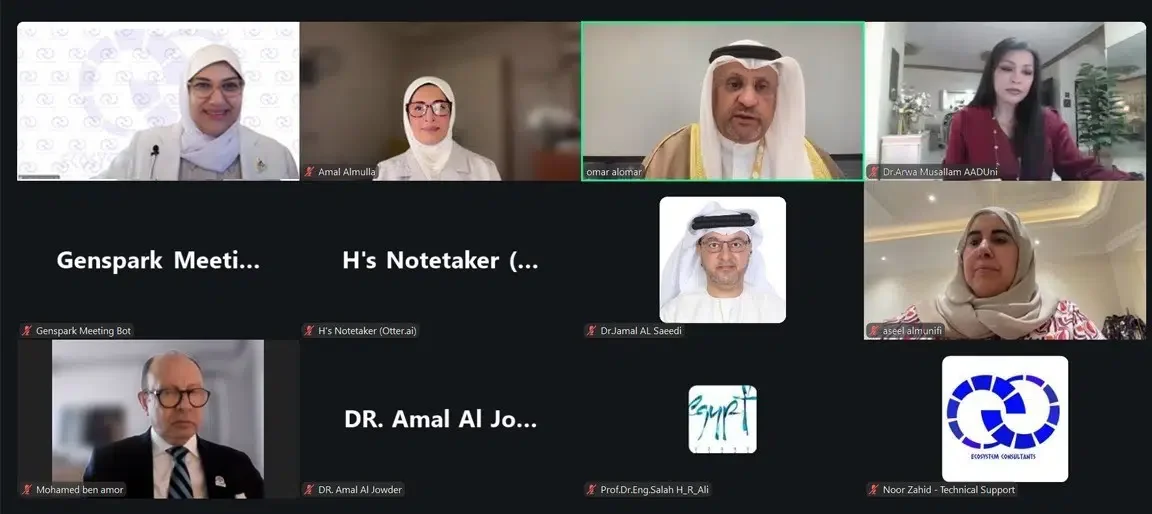
Kuwait – State Minister for Communications and Information Technology and Acting Minister of Media and Culture Omar Al-Omar affirmed on Monday that Kuwait is strategically moving toward investing in technology and data, and harnessing modern technologies supported by artificial intelligence across its government, technological, and economic sectors. This statement was made by Minister Al-Omar at the opening of the Seventh International Virtual Conference, titled “Techno Innovation .. Techno Entrepreneurship .. Techno Artificial Intelligence Toward Economic Diversification,” under the slogan “An Innovative World and a Technological Economy.” The event is organized by Ecosystem Management and Economic Consulting Company and features broad Gulf, Arab, and international participation, lasting for two days.
Al-Omar added that Kuwait has established the Public Authority for Communications and Information Technology, the Central Agency for Information Technology, and the Direct Investment Promotion Authority to develop digital infrastructure, enhance the quality of government services, improve data governance and artificial intelligence, and foster human capital and digital capabilities. He clarified that state efforts also include sovereign investment, supporting global artificial intelligence infrastructure, and building partnerships with major global technology companies.
He stated, “Amid the acceleration witnessed globally in the fields of the digital economy and innovation, we recall the words of His Highness the Amir of Kuwait, Sheikh Meshal Al-Ahmad Al-Jaber Al-Sabah, may God protect him, at the opening of the 45th Gulf Cooperation Council Summit, where he emphasized the importance of diversifying income sources and expanding fields of innovation and entrepreneurship, particularly in artificial intelligence, to enhance the competitiveness of our countries’ economies.”
Minister Al-Omar pointed out that the conference’s objectives and themes align with Kuwait Vision 2035, which focuses on transforming Kuwait into an attractive regional financial and commercial hub for investments and building a sustainable digital economy. He noted that the conference also resonates with the visions of Gulf and Arab states aimed at investing in technology and innovation to build a digital economy that contributes to sustainable development.
He expressed his hope that the conference’s outcomes would contribute to formulating a roadmap that draws on successful global best practices and applications in technology, big data, innovation, and artificial intelligence, thereby supporting economic diversification and strengthening global competitiveness indicators.
For her part, Dr. Hanadi Al-Mubarak, Economic Diversification and Techno Innovation Advisor and Conference Chair, stated in a similar address that the conference brings together 100 experts from 20 countries, coinciding with Global Entrepreneurship Week, with the aim of enabling economic diversification across the Gulf, the Arab world, and globally. She emphasized that the strategic importance of the conference is reflected in the alignment of its objectives and themes with Kuwait Vision 2035 and the visions of Gulf and Arab states toward building diverse, sustainable digital economies based on innovation, entrepreneurship, and artificial intelligence.
She added that international conferences serve as effective engines for progress and prosperity, as they contribute to accelerating innovation and technological development, enhancing global competitiveness, developing infrastructure, speeding up economic diversification, and building strategic partnerships that create digital job opportunities.
For her part, Princess Hind bint Abdulrahman Al Saud, International Ambassador for Corporate Social Responsibility in the Kingdom of Saudi Arabia, emphasized in a similar address that artificial intelligence and technological advancement have become a central force in reshaping global economies. She highlighted the Kingdom’s commitment to building an integrated national system for data and innovation through specialized institutions that support national talent and startups, and transform research and ideas into projects with added economic value.
For his part, Sheikh Salem Al Qasimi, Member of the Executive Council and Head of the General Civil Aviation Authority in Ras Al Khaimah, United Arab Emirates, stated in his speech that building a diversified economy requires investing in technology and developing an advanced digital environment that boosts productivity, improves services, and opens new fields for work and growth. He stressed the importance of providing reliable data, up-to-date regulations, and technological investments that deploy artificial intelligence responsibly and productively.
On her part, former Undersecretary of the Ministry of Finance Asil Al-Munaifi, in a similar address, said that the shift toward an innovation-based economy necessitates redefining government fiscal and investment policies across three pillars: digital financial governance using AI to enhance public spending efficiency and direct investments toward digital infrastructure and cybersecurity; and developing flexible regulations that support financial innovations and the growth of technology enterprises.
For his part, Mohamed Ben Omar, Secretary-General of the Arab Organization for Information and Communication Technology in the Republic of Tunisia, noted in a similar address that studies published by PricewaterhouseCoopers project that artificial intelligence will contribute approximately $15.7 trillion to the global economy by 2030, including around $320 billion for the Middle East region. He affirmed the necessity of strengthening collaboration among universities, research institutions, startups, and investors to transform innovation into tangible economic value.
On her part, Sheikhah Fajar bint Ali Al Khalifa, Founder and President of the Al-Fajr Self-Development Foundation and Vice President of the Arab Advisory Council in the Kingdom of Bahrain, emphasized in her speech that Gulf Cooperation Council (GCC) countries are witnessing continuous progress in digital transformation. She pointed out the importance of further developing Gulf economies by relying on knowledge, technology, innovation, and entrepreneurship to contribute to sustainable development.
For her part, Dr. Arwa Muslim, Dean of the Faculty of Law and Vice President for Legal Affairs at the Arab American Digital University, stated in her address that achieving economic diversification requires, alongside technology and capital, investment in human capital and the development of legislation. She stressed the importance of digital legal education and building trust to attract investments, protect innovation, and enhance partnerships among universities, governments, and the business sector.
On his part, Dr. Jamal Al-Saaidi, Chairman of the Board of Directors of Al-Qaida Holding Group in the United Arab Emirates, said in a similar address that knowledge, technology, and the capacity for innovation have become among the most important pillars of economic strength and international competitiveness. He explained that the significance of the conference lies in linking technological advancement with entrepreneurship and investment, transforming it into real economic projects that provide jobs and sustainable added value.
For his part, Dr. Abdulmajid Bin Ammar, President of the Union of Arab Scientific Research Councils at the Arab League, affirmed in a similar address that economic diversification has become a necessity for achieving sustainable development and facing crises.
Bin Omara pointed out that the real challenge lies in translating scientific research findings into technological applications, startups, investment opportunities, and employment by strengthening collaboration among universities, research centers, and the private sector. For his part, Ahmed Al-Marsadi, Acting Director General of the Patent Office at the General Secretariat of the Gulf Cooperation Council (GCC), in a similar statement, highlighted the GCC member states’ interest in enhancing the innovation ecosystem and protecting intellectual property rights through legislative development and support for inventors. Al-Marsadi noted the General Secretariat’s participation in specialized exhibitions and the awarding of financial prizes to the top three inventions by nationals of GCC member states participating in the event. In his turn, Ahmed Al-Sulaim, President of the Bahrain Association for the Development of Small and Medium Enterprises (SMEs), affirmed that the economic value of innovation is realized when ideas and inventions are transformed into products, services, and projects that create jobs. Al-Sulaim stressed the importance of enabling SMEs and startups to access modern technology, artificial intelligence applications, financing, and local and international markets. The conference is being held via an AI-powered platform, with the participation of more than 100 Gulf, Arab, and global experts, 26 senior figures including sheikhs and ministers, 10 inventors holding patents, and 20 startups. It features 20 dialogue sessions spanning 12 hours daily. (End) A.A.B / A.M.H
