Lebanese President: We are working to address decades of mismanagement and structural imbalances
صورة: وكالة الأنباء الكويتية (كونا)
President Aoun affirms the priority of economic reform and cooperation with the World Bank and the International Monetary Fund to address accumulated corruption and structural imbalances in Lebanon
Translated by Alqyas from KUNA — Original source
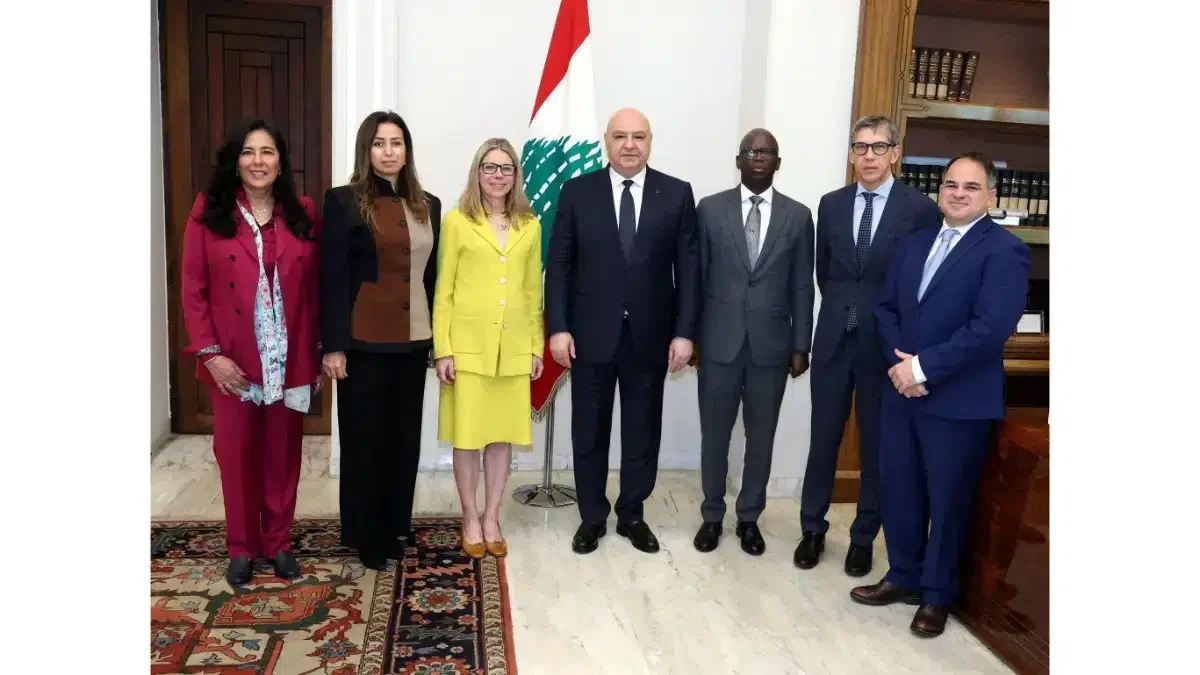
Beirut -- Lebanese President Joseph Aoun affirmed on Monday that Lebanon is working to address the accumulation of “decades of mismanagement, corruption, and structural imbalances,” stressing that reform requires sustained time and effort from Lebanese state institutions. This came in a statement issued by the Presidency following President Aoun’s meeting at Baabda Palace with Anna Bredie, Managing Director for Operations at the World Bank, who led a delegation including Osman Dione, Vice President for the Middle East and North Africa and Afghanistan and Pakistan regions, Dalia Khalifa, Regional Director for the Middle East, and several other World Bank officials.
The statement noted that the meeting covered the trajectory of economic, financial, and administrative reforms in Lebanon, existing cooperation programs with the World Bank Group, and prospects for expanding partnership in areas such as reconstruction, economic recovery, energy, investment, enhancing the role of the private sector, and regional economic integration.
Aoun said that reform has been a fundamental priority since his election as President, noting that tangible progress has been achieved on multiple fronts through cooperation with the government, despite the major setback imposed by the war, which necessitated intensive political and diplomatic efforts to halt it and address its repercussions. He emphasized that Lebanon has returned to focusing on its reform priorities, particularly financial, banking, administrative, and judicial reforms, affirming that the state is proceeding with reforms through cooperation with the World Bank and the International Monetary Fund amid current regional challenges.
Aoun clarified that security and the economy are “interdependent pillars” of stability and growth, pointing to the expected high influx of expatriates and visitors during the annual holiday period, which reflects continued confidence in Lebanon. The Lebanese President highlighted that expatriate financial remittances from abroad, which rank among the highest globally relative to population size, underscore the importance of the diaspora in supporting the national economy and its capacity for recovery, considering the Lebanese private sector a “fundamental pillar” in bolstering the national economy.
Aoun recalled Lebanon’s historical role as a gateway for economic and commercial connectivity between the East and the West, noting the role played by oil transport lines, including the Iraq National Oil Transportation Company pipeline and the Tapline, as well as Lebanese oil refineries and facilities, in linking regional markets. He affirmed that digitalization constitutes a key tool for simplifying administrative procedures, reducing bureaucracy and corruption, and enhancing transparency and the efficiency of public institutions, stressing the necessity of aligning administrative reform with digital transformation and judicial reform.
For her part, Anna Bredie, Managing Director for Operations at the World Bank, affirmed that the reform efforts undertaken by the President and the Lebanese government “have not seen a comparable level of commitment and political will to advance reforms since 2000,” noting her observation of the Lebanese economic file since that year. Bredie stated that the World Bank’s project portfolio in Lebanon amounts to approximately $1.9 billion, adding that work is underway to prepare a new partnership framework between Lebanon and the State of Qatar aimed at expanding cooperation areas and moving to a higher level of engagement with various institutions of the World Bank Group.
She emphasized that progress in financial and banking reforms, particularly the restructuring of the banking sector and addressing capital-related imbalances, constitutes a “critical factor” in enabling World Bank Group institutions to expand their interventions, stimulate private investment, and provide more effective financing and guarantee instruments.
Berdi noted that the Bank is exploring additional mechanisms to support micro, small, and medium-sized enterprises, including guaranteed credit facilities, and emphasized that completing reforms would enable an expansion of the scale and impact of this support on the economy. The international official pointed out that the war and regional developments “have had direct and indirect effects” on the Lebanese economy, with damage to the housing sector constituting the largest share of direct material losses. She confirmed that the Bank’s delegation intends to visit the south to assess the extent of the damage and on-the-ground needs. Berdi reiterated the World Bank’s interest in continuing to support social safety nets and social protection systems, expressing satisfaction with the adoption of the “Aman” program and the importance of building on it to enhance the sustainability of Lebanon’s social protection framework. She affirmed the World Bank Group’s commitment to accompanying Lebanon on its path of reform, recovery, and reconstruction, and to expanding partnership with the country in ways that contribute to restoring growth, stimulating investment, and strengthening economic and social stability. (End) F.Z. / G.A.
