ASEAN and Australia: Enhance cooperation to face global economic challenges and supply chain disruptions
صورة: وكالة الأنباء الكويتية (كونا)
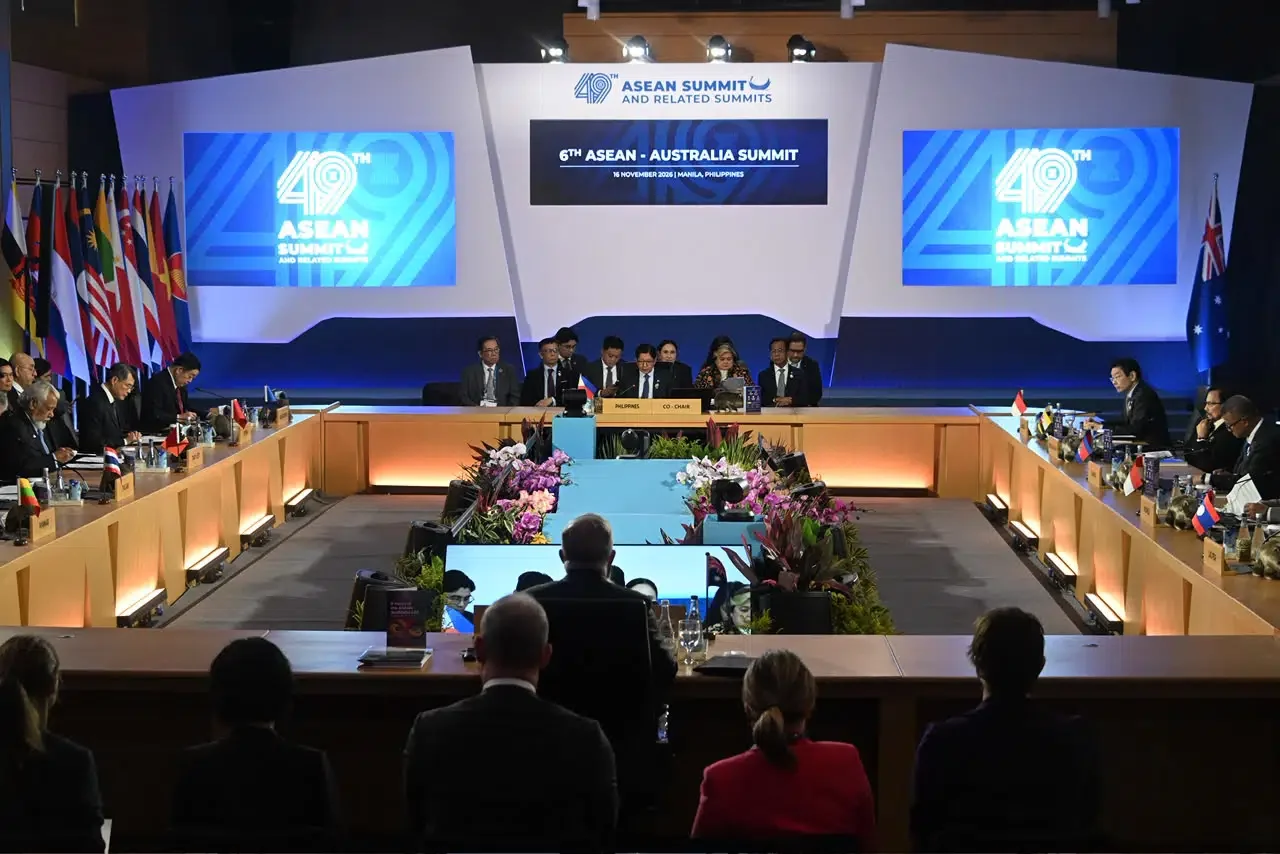
ASEAN and Australian leaders called for enhancing trade, investment, renewable energy, and digital cooperation to address global economic shocks and supply chain disruptions at the sixth summit in Manila.
Translated by Alqyas from KUNA — Original source
Kuala Lumpur – Leaders of the Association of Southeast Asian Nations (ASEAN) and Australia on Monday called for enhanced cooperation “to address global economic shocks, geopolitical challenges, and supply chain disruptions, while upholding a free, fair, and multilateral trading system, alongside reforming the World Trade Organization.”
A joint statement issued at the sixth summit between the two sides, held in the Philippine capital of Manila as part of the 49th ASEAN Summit and related summits, stated that leaders “underscored the necessity of maintaining a transparent, open, inclusive, non-discriminatory multilateral trading system based on clear rules, with the WTO as its central pillar.”
The statement emphasized the importance of deepening trade and investment relations and strengthening practical cooperation in implementing ASEAN’s Community Economic Strategic Plan for 2026–2030 and leveraging Australia’s Economic Strategy towards Southeast Asia to 2040 to confront global economic challenges, in coordination with experts and relevant stakeholders.
In the energy sector, both sides pledged to enhance supply security, diversify energy supply chains, ensure their stability and reliability, and minimize disruptions that could affect core flows, alongside accelerating the transition to renewable, clean, and low-emission energy and expanding investments in regional infrastructure for such energy sources.
On the other hand, leaders welcomed Australia’s announcement of a digital cooperation package aimed at supporting ASEAN’s digital transformation and implementing the Framework Agreement on the Digital Economy, as well as a regional energy security package designed to deepen cooperation in the region’s transition to clean energy sources.
They also stressed the importance of developing and using artificial intelligence safely and responsibly, based on “transparency, accountability, and human-centricity,” while harnessing its applications to boost productivity, stimulate innovation and sustainable development, and mitigate its risks in accordance with international standards and the national priorities of member states.
On the political and security fronts, leaders reaffirmed their commitment to respecting the sovereignty, territorial integrity, and political independence of states, non-interference in internal affairs, and adherence to the United Nations Charter, the ASEAN Charter, the Treaty of Amity and Cooperation in Southeast Asia, the 1982 United Nations Convention on the Law of the Sea, and the principles of mutually beneficial relations endorsed at the 2011 East Asia Summit.
Regarding maritime security, participants emphasized the importance of avoiding the “militarization of maritime areas,” exercising restraint, and refraining from actions that could lead to incidents, misunderstandings, or miscalculations and further complicate the situation, while calling for the peaceful settlement of disputes, the enhancement of mutual trust, and commitment to international law.
The summit was attended by ASEAN leaders, presided over by Philippine President Ferdinand Marcos Jr., who co-chaired the meeting with Australian Prime Minister Anthony Albanes. Indonesian President Prabowo Subianto participated as the representative of the coordinating state for the ASEAN-Australia Dialogue Partnership for 2024–2027.
The Philippines, holding the rotating ASEAN chairmanship, is hosting the 49th ASEAN Summit and related summits from November 15 to 17, with the participation of leaders from member states and dialogue partners (China, the United States, Japan, South Korea, India, Australia, New Zealand, Russia, Canada, the United Kingdom, and the European Union).
The association, founded in 1967, comprises the Philippines, Indonesia, Malaysia, Singapore, Thailand, Brunei, Vietnam, Laos, Myanmar, Cambodia, and East Timor, which joined in October 2025, bringing the total number of member states to 11. (End) A.A.B / A.B.K
