(ASEAN) Expresses Deep Concern Over Situation in Myanmar
صورة: وكالة الأنباء الكويتية (كونا)
ASEAN leaders condemn violence in Myanmar and emphasize necessity of implementing Five-Point Consensus
Translated by Alqyas from KUNA — Original source
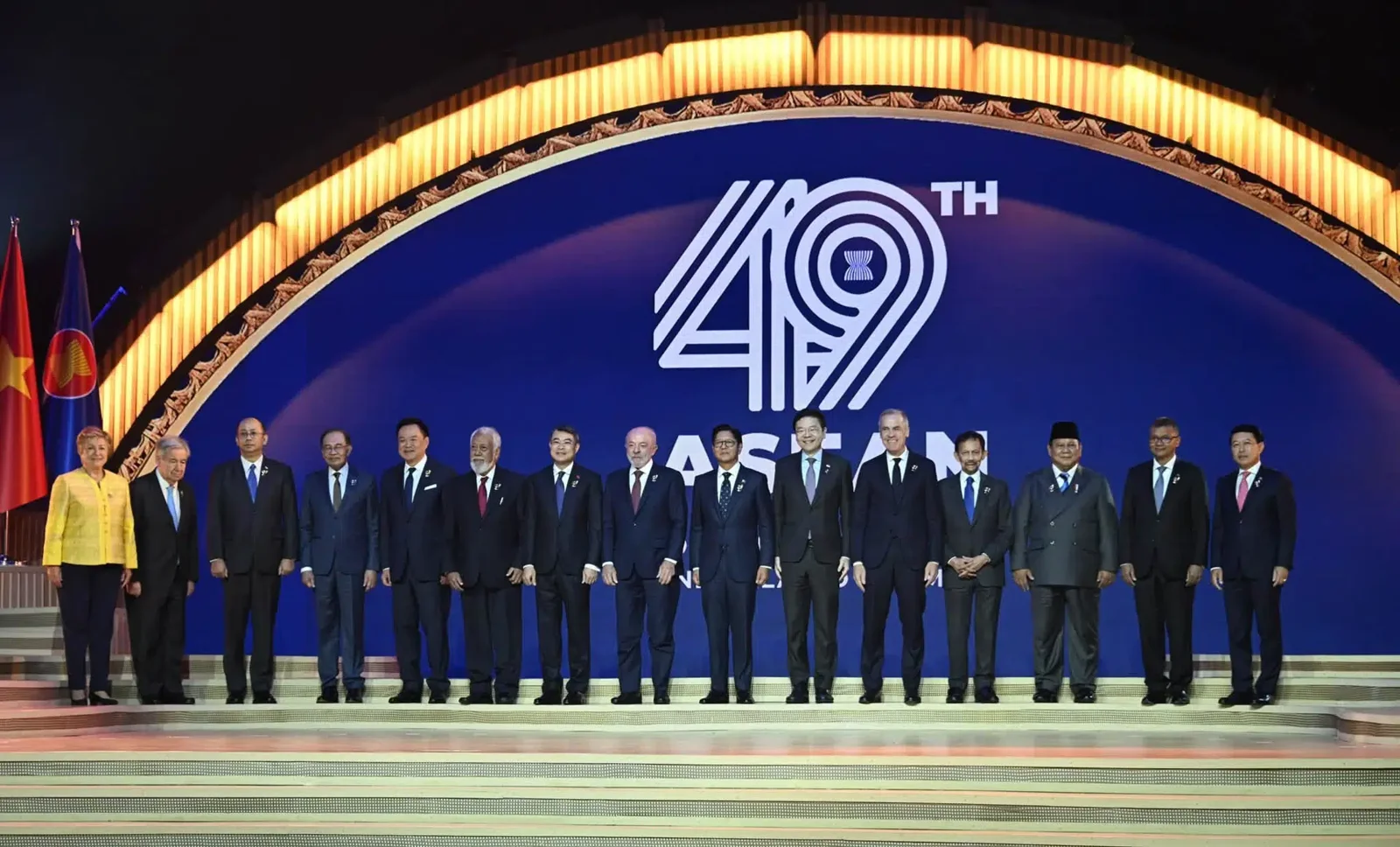
Kuala Lumpur -- Leaders of the Association of Southeast Asian Nations (ASEAN) expressed deep concern on Sunday over the conflicts and humanitarian situation in Myanmar, emphasizing the need for further progress in implementing the Five-Point Consensus to address the crisis. In a joint statement on the sidelines of their 49th summit and related meetings in Manila, the capital of the Philippines, the leaders said that progress in implementing the consensus on Myanmar remained insufficient and that delivering humanitarian assistance through ASEAN’s Coordinating Centre for Humanitarian Assistance on disaster management (AHA Centre) had seen only limited progress.
The leaders affirmed that ASEAN would continue to restrict Myanmar’s representation at its summits and foreign ministers’ meetings to non-political representatives until tangible progress is made in implementing the consensus. They noted that ASEAN might consider gradually restoring Myanmar’s full political representation if the country makes tangible and sustained progress in implementation.
The leaders condemned violence against civilians and public facilities, urging all parties, especially the armed forces, security forces, and armed groups, to immediately cease random violence, end attacks targeting civilians and civilian infrastructure, and exercise maximum restraint. They reaffirmed that the Five-Point Consensus remains the primary reference for addressing the political crisis, noting that Myanmar is an integral part of ASEAN. The consensus calls for an immediate cessation of violence, a commitment by all parties to exercise maximum restraint, the initiation of constructive dialogue among the concerned parties, facilitation of mediation by the ASEAN Chair’s envoy with the assistance of the Secretary-General, delivery of assistance through the ASEAN Coordinating Centre for Humanitarian Assistance, and a visit by the envoy and his delegation to Myanmar to meet with all parties.
On the humanitarian front, the leaders called on regional and international partners to increase their financial support to enable the AHA Centre to continue delivering aid. They urged Myanmar to allow the Centre and humanitarian organizations access to underserved communities and to ensure that assistance reaches internally displaced persons directly, safely, transparently, and without discrimination, based on a joint needs assessment.
Myanmar was scheduled to hold the ASEAN chairmanship in 2026, before ASEAN leaders at the Jakarta summit in September 2023 decided to assign it to the Philippines, which follows Myanmar alphabetically among member states. Following the military’s seizure of power in 2021, ASEAN restricted Myanmar’s participation in its summits and foreign ministers’ meetings to non-political representatives. At the Manila summit, Myanmar was represented by Ohn Win Aung, Director-General of the ASEAN Affairs Department at Myanmar’s Ministry of Foreign Affairs.
The Philippines, which holds the ASEAN chairmanship this year, is hosting the 49th ASEAN Summit and related meetings, attended by at least 19 leaders representing countries and international institutions from Southeast Asia and ASEAN’s dialogue and development partners.
ASEAN was established on August 8, 1967, by five countries: Indonesia, Malaysia, the Philippines, Singapore, and Thailand. Its membership later expanded to include Brunei, Vietnam, Laos, Myanmar, and Cambodia, and Timor-Leste, which officially joined in October 2025, bringing the total number of member states to 11. ASEAN maintains formal dialogue relations with 12 partners, including the United States, China, Japan, South Korea, India, Australia, New Zealand, Russia, Canada, the United Kingdom, Turkey, and the European Union. These partnerships aim to enhance political, security, economic, and technological cooperation and to coordinate positions on regional and international issues.
The Association also maintains sectoral dialogue partnerships with ten countries: the United Arab Emirates, Qatar, Brazil, Morocco, Denmark, Germany, Norway, Pakistan, South Africa, and Switzerland, covering cooperation in trade, investment, energy, technology, and development. In addition, five other countries hold the status of development partners: France, Italy, the Netherlands, Chile, and Peru, with the aim of supporting development projects and capacity building. (End) AAB / MK
