Qatar Emir reaffirms his country's firm stance supporting Syria's sovereignty
صورة: وكالة الأنباء الكويتية (كونا)
Qatar's Emir meets the Syrian President and the Ethiopian President in Antalya.
Translated by Alqyas from KUNA — Original source
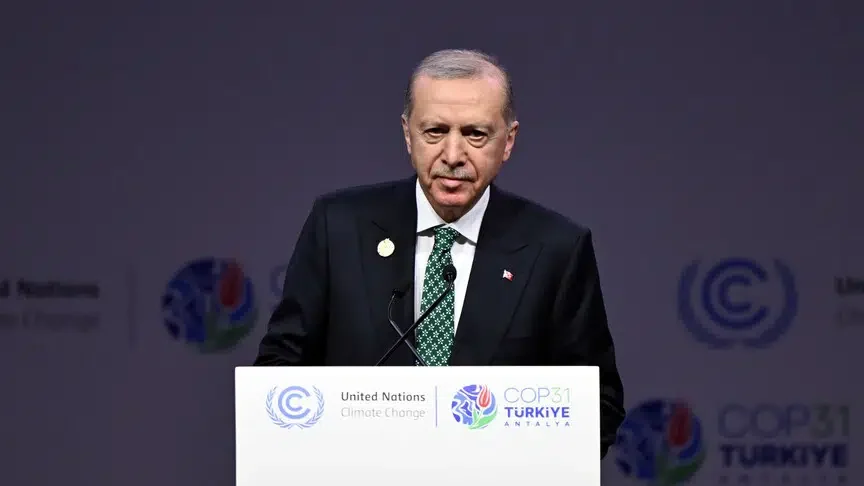
Istanbul, November 11 (KUNA) -- Turkish President Recep Tayyip Erdogan called on developed countries today, Wednesday, to assume greater responsibility for reducing carbon emissions and providing climate finance. This came during a speech delivered by President Erdogan at the official opening ceremony of the Conference of the Parties (COP31) to the United Nations Framework Convention on Climate Change (UNFCCC). The conference, which will run in the Turkish city of Antalya until November 20, is attended by leaders from 95 countries and officials from seven international organizations.
President Erdogan stressed the need to facilitate access for least developed countries and small island developing states to finance, technology, and capacity-building opportunities, noting that developed nations, which have consumed the largest share of the global carbon budget, must bear greater responsibility for emission reductions and financing.
He added that “the world faces serious challenges such as global warming, biodiversity loss, depletion of natural resources, and threats to food security,” affirming that “the essence of our civilization is rooted in respect for nature; the Earth is a sacred trust that we must protect and nurture.”
He pointed out that the conference has made highlighting and drawing attention to the needs of Pacific Island nations a priority and a core responsibility.
Regarding Turkey’s efforts to combat climate change, President Erdogan affirmed that his country is steadfastly pursuing its green development path, in line with its goal of achieving net-zero emissions by 2053. He explained that Turkey is restructuring all sectors—from energy and industry to transport and agriculture—along a pathway to reduce carbon emissions. He noted that the national recycling rate has risen from approximately 13 percent in 2017, when the “Zero Waste” initiative was launched, to nearly 40 percent by the end of 2025.
President Erdogan outlined his country’s objectives for the next decade, which include increasing electricity use by 50 percent, halving the waste growth rate, and expanding the use of recycled materials in industry. (End) T.A. / F.L.A.
