Kuwait Presents Its Final Report on Developing the Governance System of ASCO During Meetings in Muscat
صورة: وكالة الأنباء الكويتية (كونا)
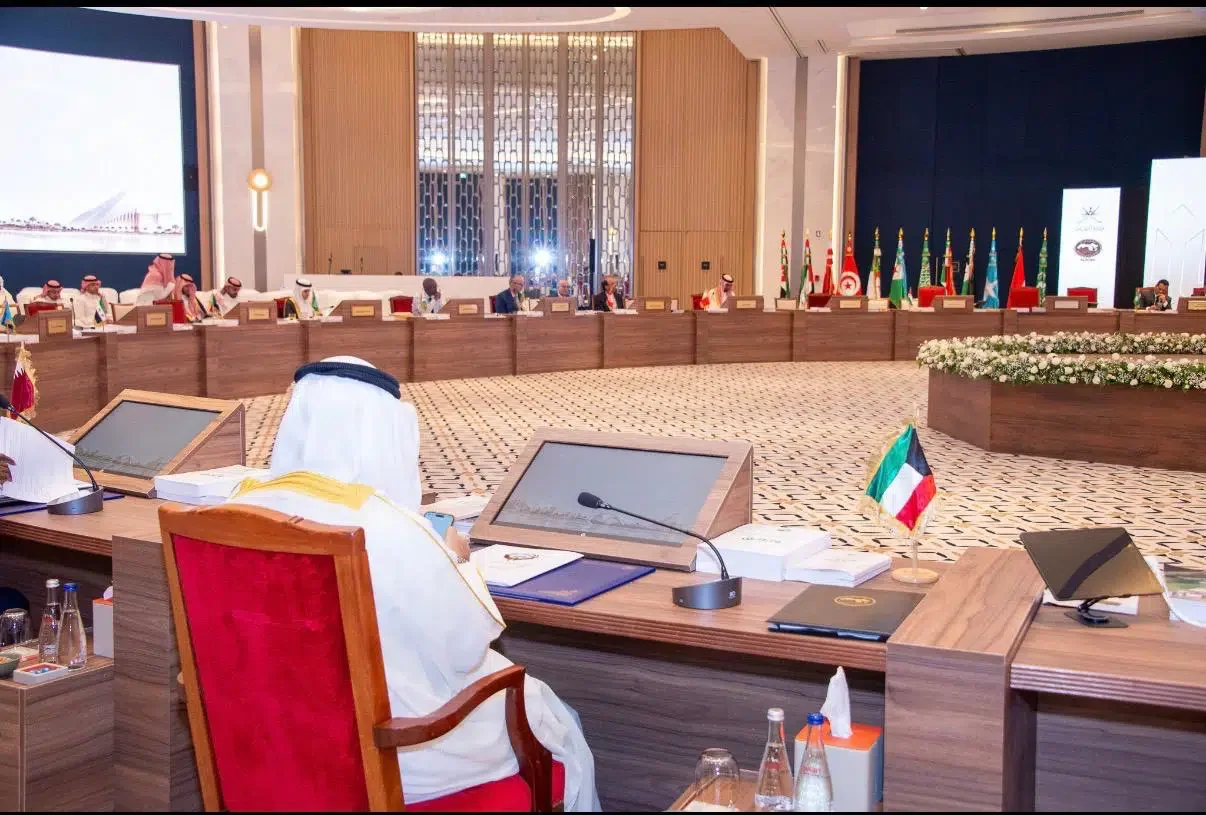
A Kuwaiti delegation led by Al-Khalidi presents the report on developing ASCO's performance governance at meetings in Muscat
Translated by Alqyas from KUNA — Original source
Muscat -- Kuwait presented the final report of the Committee for Developing the Performance Governance System of the Arab League Educational, Cultural and Scientific Organization (ALECSO) today, Tuesday, as part of the agenda for the 28th session of the Organization’s General Conference, scheduled to be held on Thursday. This came during the participation of a Kuwaiti delegation, led by Mohammed Al-Khalidi, Assistant Undersecretary for Administrative and Financial Affairs at the Ministry of Education, in the 125th ordinary session of ALECSO’s Executive Board, held in the Sultanate of Oman with the participation of representatives of Arab member states and representatives of the General Secretariat of the Arab League.
Kuwait chaired the committee’s work from January to May 2026, with active participation from 16 Arab countries. This period witnessed intensive weekly meetings that yielded significant outputs, including the preparation of the first comprehensive reference framework for the Organization’s performance governance, the issuance of a guideline for institutional performance governance, and the adoption of an implementation plan for the years 2026–2028.
Kuwait’s Minister of Education, Sayed Jalal Al-Tabatabaei, had introduced an initiative titled “The Governance Committee Initiative,” aiming to establish a new phase of institutional work based on transparency, accountability, and performance measurement, in addition to enhancing resource management efficiency and ensuring the effective follow-up of decision implementation. The initiative reflects Kuwait’s pioneering role in supporting and developing institutions of joint Arab action, thereby strengthening its status and active presence at the Arab level through launching sustainable institutional initiatives that contribute to achieving the Organization’s objectives and lofty goals.
During a virtual presentation delivered by the Kuwaiti delegation, led by Assistant Undersecretary Al-Khalidi, the challenges that necessitated the formation of the committee were reviewed. These included the absence of an integrated framework for the Organization’s performance governance, discrepancies between textual provisions and actual implementation, limited follow-up and evaluation mechanisms, and the need for standardized templates for files and reports. These factors underscored the importance of activating the Organization’s performance governance by institutionalizing governance principles, ensuring the practical application of policies and regulations, and enhancing oversight and accountability.
According to the presentation, the committee held 14 meetings after its formation, with its work period spanning from January to May of last year. For the first time in ALECSO, a comprehensive reference framework for the Organization’s performance governance and a roadmap for implementation up to 2028 were prepared. The committee also issued a set of publications, including the general framework for the Organization’s governance, the Organization’s governance manual, a proposal for developing the organizational structure, and the implementation plan up to 2028.
The presentation covered the committee’s key outputs, including the submission of a current situation study, the adoption of the general framework for the Organization’s performance governance, the adoption of the Organization’s performance governance manual, and a document on the governance framework for committees emanating from the Council. It also highlighted agreement on the continuity of the committee and the follow-up of governance implementation, as well as a recommendation to submit the governance model to the Economic and Social Council of the Arab League as a guiding model.
The presentation pointed to the main expected transformations in the Organization’s work following the committee’s outputs, including clarity of authorities, report quality, follow-up on decision implementation, digital transformation, financial discipline, accountability, and risk management.
Yesterday, Monday, the Executive Board of the Arab League Educational, Cultural and Scientific Organization (ALECSO) began the work of its 125th ordinary session, hosted in Muscat for two days, as part of preparations for the 28th session of the Organization’s General Conference, scheduled for next Thursday. The Executive Board discussed a number of topics and agenda items, most notably the Director General’s report on the implementation of the Organization’s programs and activities for 2025, and the strategic plans for international cooperation and partnerships.
They also discussed enhancing the role of media and marketing, and the comprehensive strategy for building the capacities of the organization’s staff and its external centers, alongside educational, cultural, and scientific conditions in Palestine and countries affected by crises, disasters, and emergencies, as well as several administrative and financial topics. It is worth noting that the Arab Organization for Education, Culture and Science (ALECSO) was established in 1970 and is one of the specialized agencies affiliated with the League of Arab States, comprising 22 Arab member states. Headquartered in Tunis, ALECSO aims to advance the sectors of education, culture, and science and to strengthen coordination and cooperation among member states in these fields. (End) M.J.B. / N.S.A.
