Kuwait: Government Partnership Framework to Drive Development and Strengthen Institutional Integration
صورة: وكالة الأنباء الكويتية (كونا)
Kuwait has launched a strategic government partnership framework covering digital transformation, energy security, and education to enhance development and institutional integration.
Translated by Alqyas from KUNA — Original source
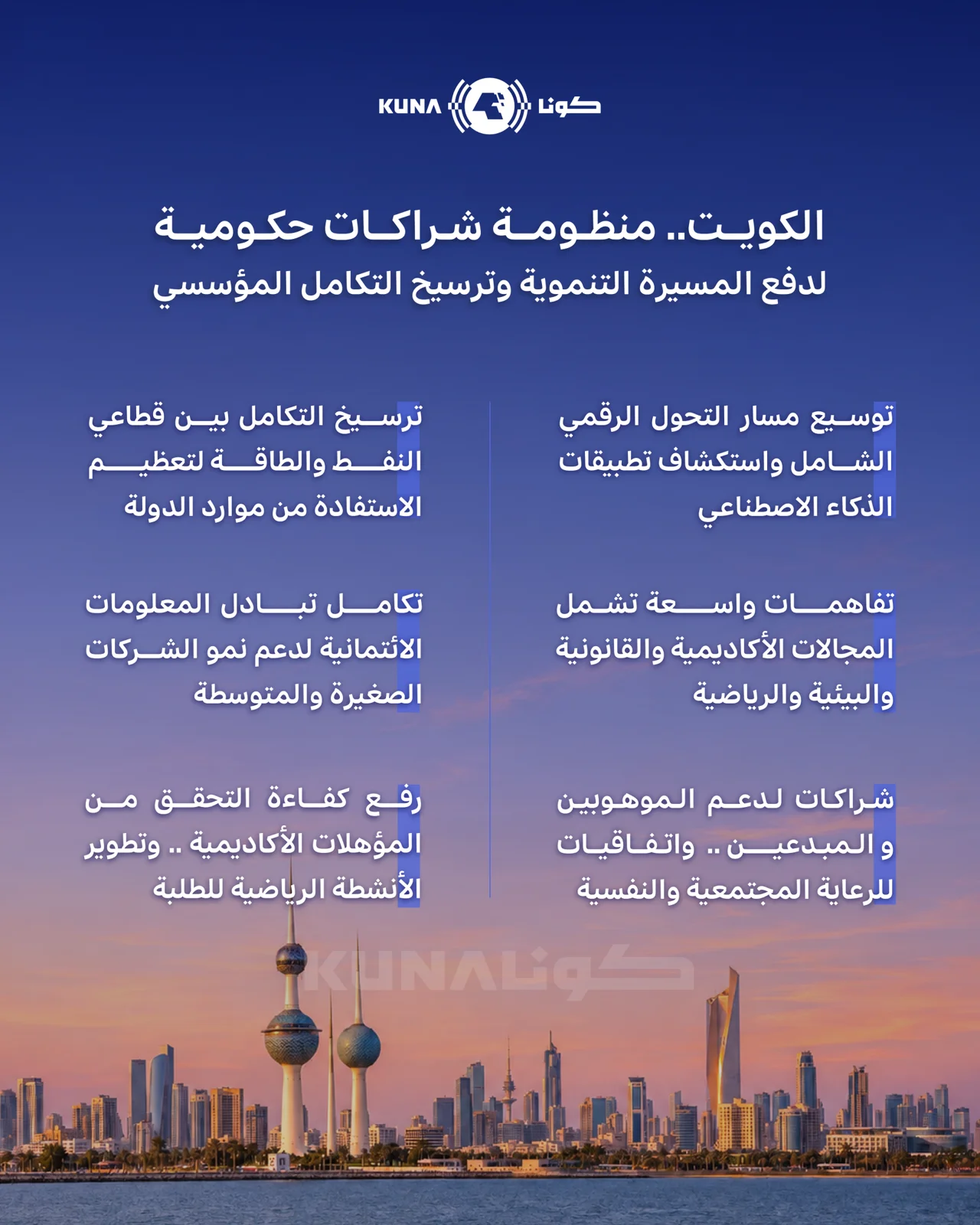
By Ahmed Abdulstatar (Report) Kuwait - Since the beginning of 2026, Kuwaiti government ministries and entities have launched a strategic public-private partnership framework consisting of a series of agreements and memoranda of understanding (MoUs). This initiative aims to strengthen coordination ties, consolidate institutional integration, and enhance role synergy with the private sector and development institutions. The signed agreements target accelerating the development trajectory, improving government performance efficiency, and boosting the country’s competitiveness in international indicators. The package covers strategic pillars including digital transformation, energy security, environmental sustainability, human development, and social care.
In the realm of comprehensive digital transformation, the Ministry of State for Communications and Information Technology Affairs signed an MoU with E-Portal Holding Company, a subsidiary of Kuwait Telecommunications Company (STC), to support the development and launch of additional digital government services via the unified government application for electronic services, "Sahl." Furthermore, the MoU signed between the Public Authority for Communications and Information Technology and Huawei Kuwait establishes a cooperation framework in several priority areas, including the exchange of expertise and knowledge, exploration of artificial intelligence applications, cloud computing, and advanced fifth-generation (5G) technologies, alongside supporting innovation, building national capacities, and developing specialized competencies.
Concurrently, the Ministry of Defense signed a protocol with the Central Agency for Information Technology (CAIT) to enhance cooperation in digital transformation and develop a data and information exchange system among government entities. This aims to strengthen integration among them, aligning with the Ministry of Defense’s strategic objectives and improving government services. Additionally, CAIT and the General Secretariat of the Council of Private Universities signed a cooperation agreement aimed at expanding joint work areas and leveraging technical solutions to support digital transformation and service development. The agreement includes enhancing cooperation in technical fields, exchanging expertise, and utilizing available resources to simplify procedures, develop services, and improve institutional efficiency.
In parallel with these efforts, proactive steps were taken to support the investment climate and business sector. The National Fund for the Care and Development of Small and Medium Enterprises (SMEs) signed a strategic MoU with Kuwait Credit Information Network Company (CINET) to enhance credit transparency and support the growth of SMEs through integrated credit information exchange. Meanwhile, the Ministry of Finance signed a cooperation protocol with regulatory bodies, represented by the Ministry of Commerce and Industry, the Central Bank of Kuwait, the Capital Markets Authority, and the Insurance Regulatory Unit, to strengthen institutional coordination regarding information exchange for tax purposes.
Integration efforts also extended to energy security and environmental sustainability. Kuwait Petroleum Corporation (KPC), the Ministry of Electricity, Water and Renewable Energy, and Kuwait Oil Company (KOC) signed an MoU to establish a combined heat and power (CHP) plant in the Arqa area. This strategic project enhances integration between Kuwait’s oil and energy sectors, ensuring optimal resource utilization. The new plant is expected to provide the steam required for heavy oil production operations in the South Rataqa field, supporting the plan to gradually increase production to approximately 120,000 barrels per day.
This was accompanied by the signing of an agreement by the Public Authority for Public-Private Partnership Projects for the Al-Zour North Power Plant and Desalination Project (Phases II and III), reflecting the government’s direction to deepen partnerships with the private sector. The project represents one of the key initiatives within the state’s strategy to meet the growing demand for electricity and water and to enhance readiness to keep pace with the requirements of sustainable development and future projects.
The Public Authority for Environment signed a memorandum of cooperation with the Public Authority for Youth and Sports to launch the first national system for measuring and improving environmental performance in clubs, centers, and youth and sports facilities. Additionally, the Environment Authority signed memoranda of understanding with the Arab Open University and the Scientific Center to enhance cooperation in areas of environmental protection, sustainable development, and the preservation of biodiversity and its natural habitats in the State of Kuwait.
The agreements, which focused on education, sports, and the nurturing of talent, reflected the government’s expansion of investment in human capital and support for innovation. A joint cooperation protocol between the Ministry of Education and the Ministry of State for Youth and Sports Affairs strengthened their partnership in school sports and the development of sports programs and activities targeted at students.
The agreement signed by the Ministry of Higher Education and Scientific Research with the DataFlow Group supported the direction to enhance the efficiency of procedures for verifying academic qualifications and expedite their completion. For its part, the Ministry of Education signed a cooperation protocol with the Ministry of Justice to strengthen educational and legal aspects, thereby contributing to improving institutional efficiency.
Kuwait Airways signed a memorandum of understanding with the American University in Kuwait (AUK) to enhance joint cooperation in academic, training, and professional fields, as well as in program development. In the same context, the Sabah Al-Ahmad Center for Talent and Creativity, one of the centers under the Kuwait Foundation for the Advancement of Sciences, signed a memorandum of understanding with the American International University (AIU) to support talented and creative individuals and to foster a culture of innovation in the State of Kuwait.
The modern partnerships network did not overlook service and social aspects. Kuwait Airways signed two strategic partnership agreements with Talaa and Dima, deferred payment companies, to provide travelers with the option to split the cost of air tickets into four equal installments without additional profits or fees, facilitating travel for passengers.
In the realm of community and psychological care, the Supreme Council for Family and Childhood Affairs signed a memorandum of understanding with Dawaei, a platform specializing in online psychological counseling, to provide psychological support sessions for those facing pressures due to the exceptional circumstances affecting Kuwait and the region.
In the path of enhancing the protection and preventive security system, the Kuwait Institute for Scientific Research signed a memorandum of understanding with the Ministry of Defense, represented by the National Committee for the Prohibition of Chemical Weapons. The agreement aims to enhance scientific and technical cooperation in the field of chemical security.
In a step aimed at strengthening cooperation and coordination in combating money laundering, related crimes, and terrorist financing, the Financial Investigations Unit signed memoranda of understanding with both the Public Authority for Industry and the Ministry of Finance to exchange information in this field.
The Kuwait Institute for Judicial and Legal Studies signed a memorandum of understanding with the Ministry of Interior to enhance cooperation, and the exchange of experiences, expertise, and information in the field of training, and to utilize the means and capabilities available to each party, with the goal of developing highly competent national cadres.
These diverse partnerships reflect the government’s orientation toward consolidating a more integrated model of public service, based on unifying efforts, exchanging expertise, and leveraging national capacities. They also underscore the importance of partnering with the private sector and academic and research institutions to accelerate the implementation of development priorities and keep pace with technological, economic, and environmental transformations. The effective activation of these understandings and their translation into practical initiatives and programs remain the cornerstone for achieving tangible results that contribute to enhancing public services, improving the efficiency of government institutions, and strengthening Kuwait’s standing and competitiveness at both regional and international levels. During the meeting held on October 20, the Cabinet stressed the importance of continuing coordination among government entities and integrating efforts to implement national priorities and support state initiatives, thereby enhancing the efficiency of government procedures and strengthening the country’s competitiveness in international indices and reports. (End) S.A.R
