Qatar: Prosperous Nations Equipped to Play a Pivotal Role in Achieving International Peace
صورة: وكالة الأنباء الكويتية (كونا)
Sheikh Mohammed bin Abdulrahman affirmed that prosperous nations are well-positioned to play a pivotal role in achieving international peace through a collective approach.
Translated by Qiyas from كونا — Original source
Doha, Nov 7 (KUNA) -- Qatar’s Prime Minister and Minister of Foreign Affairs, Sheikh Mohammed bin Abdulrahman Al Thani, said on Saturday that prosperous countries, which have made fundamental contributions to global prosperity, now enjoy a unique status that qualifies them to play a similar role in achieving international peace.
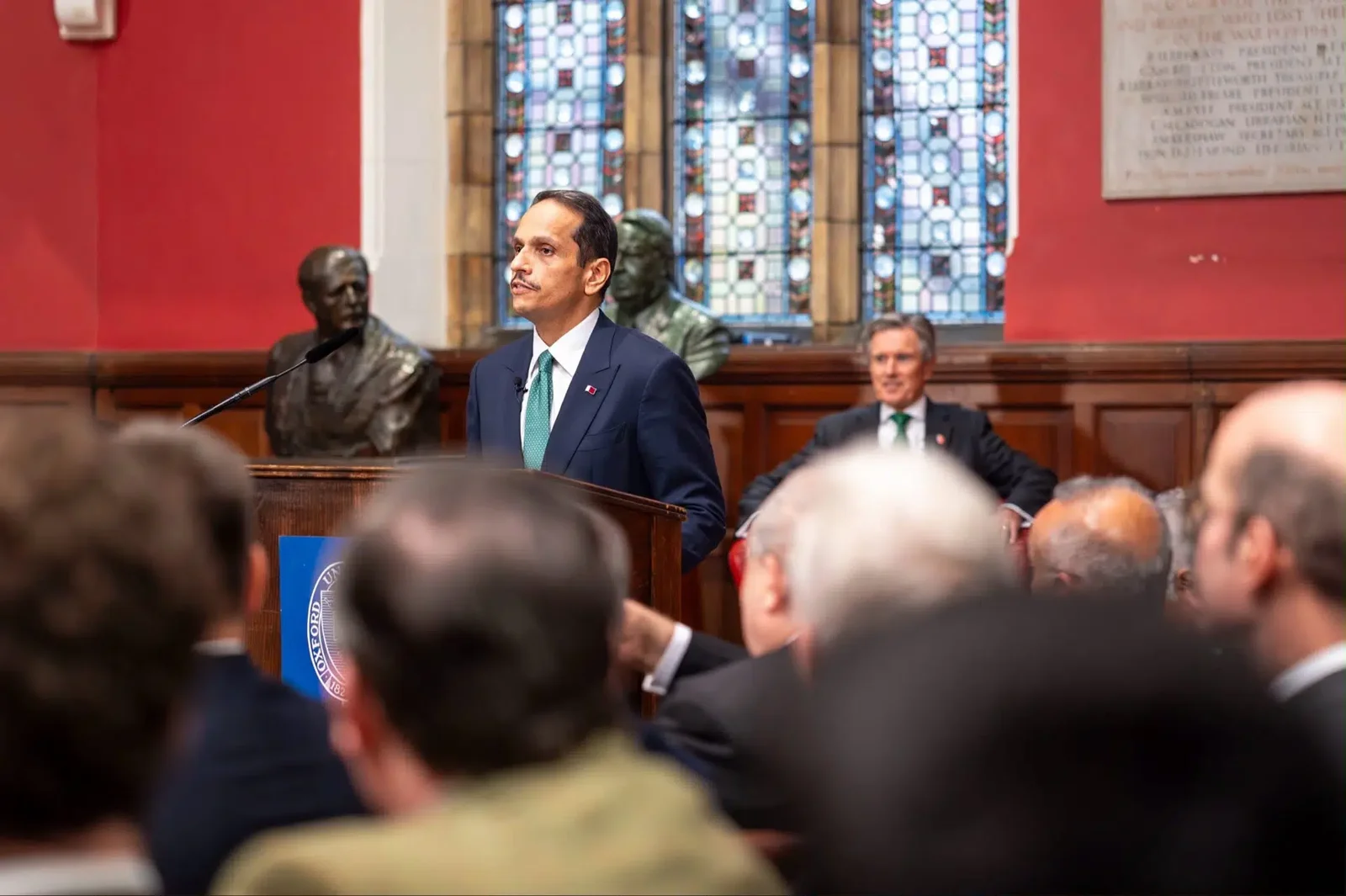
The Qatari Ministry of Foreign Affairs said in a statement that this remark was made by Sheikh Mohammed during a speech he delivered at the Oxford Union, titled “Prosperity in a Divided World: Small States and Redrawing the Map of Global Influence,” in the city of Oxford.
Sheikh Mohammed added that prosperous countries are qualified to play a similar role in achieving international peace not through individual initiatives, but through a collective, organized, and cumulative approach. He explained that the international system established after World War II was based on the concept that peace cannot be maintained by force alone, and it laid the foundation for a system of international rules, institutions, and open markets.
He noted that more than 120 countries have joined the international community since 1945, giving previously voiceless peoples their own voice on the global stage and opening the door for smaller states, such as Qatar, to achieve prosperity by providing them with protection from annexation, regional hegemony, and great-power competition.
He pointed out that many of these countries are neither regional powers nor global superpowers, yet they have achieved prosperity by investing in their populations, infrastructure, and economic models, gaining international significance and becoming an integral part of the global economy.
“According to traditional classifications, countries are categorized as developed or developing,” he said, proposing an alternative name for a specific group of countries: “resilient, stable, prosperous, and reliable states” that have turned their size into an advantage and become prominent contributors to global peace and prosperity. He referred to them as “prosperous states.”
He emphasized that the international system that emerged after World War II was not always just, nor were its rules consistently and uniformly applied. “We should not idealize an international system in which power has long played an influential role,” he said.
He clarified that the UN Charter enshrined the principle of sovereign equality among states and the peaceful settlement of disputes, noting that international institutions and rules have enabled small states to voice their opinions, protect their rights, and make international relations more predictable.
He added that while these institutions have not eliminated power imbalances, they have expanded the space for small states to make independent decisions, moving away from the logic of “might makes right” that dominated in past centuries.
He continued, “However, while economic opportunities have become increasingly global, decisions regarding international peace and security have remained concentrated in the hands of a few, largely excluding countries that are indispensable to global prosperity from decisions that determine international peace and stability.”
He explained that the ongoing war in the region has revealed the severity of this imbalance, as decades of military adventures, unresolved conflicts, violations of international law, and ambitions for regional hegemony have disrupted energy supplies, threatened vital maritime navigation routes, and exposed international markets to uncertainty. He noted that even countries not involved in these conflicts bear economic and security repercussions.
He pointed out that Qatar recognized that its future depends not only on the resources it possesses, but also on the capabilities it can build and the relationships it can establish. It has chosen to invest in its people, develop its economy, and be a reliable and trustworthy partner in the international community.
He added that the geographic realities of the State of Qatar and the nature of the international economy have led it to recognize that its prosperity cannot be isolated from regional and international conflicts, prompting it to invest in facilitating peace, mediation, and maintaining communication channels with parties that others have not always been able to reach. He clarified that prosperous countries cannot overcome these challenges alone, nor can they replace major powers; however, by pooling their expertise, economic capabilities, and diplomatic networks, they can contribute to establishing a comprehensive system of foundations for peace and stability worldwide and ensuring its continuity. (End) S S S / T M A
