Kuwaiti academic: Kuwait University is at the forefront in implementing artificial intelligence
صورة: وكالة الأنباء الكويتية (كونا)
Deputy Rector of Kuwait University confirms the university's lead in implementing AI during a UNESCO conference in Doha.
Translated by Qiyas from كونا — Original source
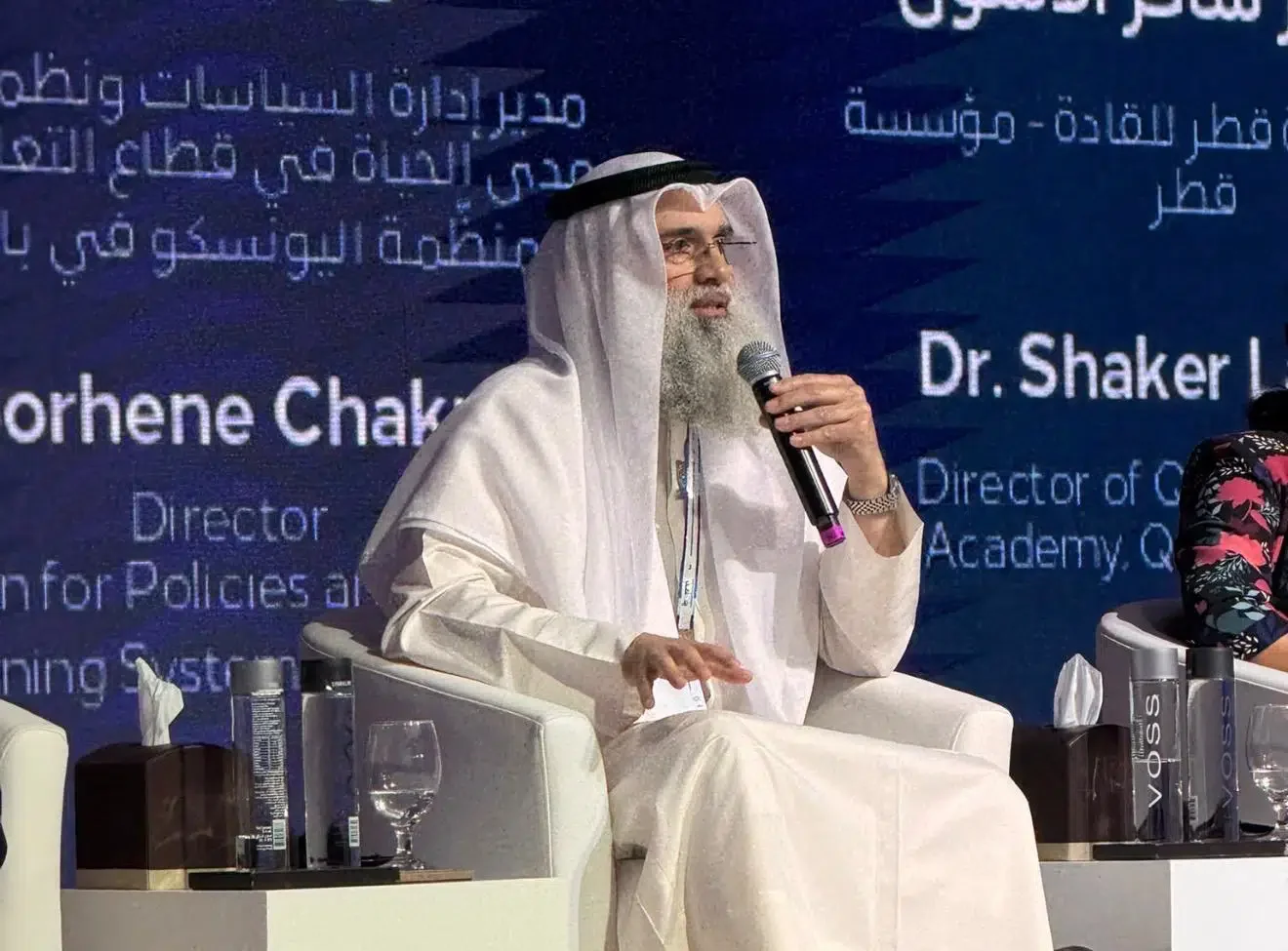
Doha -- The Deputy Director of Academic Support Services at Kuwait University, Professor Dr. Abdullah Al-Mutawa, said on Tuesday that “Kuwait University is among the pioneering universities in applying artificial intelligence in higher education.” This statement came during Dr. Al-Mutawa’s participation in a dialogue seminar titled “Digital Transformation and Artificial Intelligence in Higher Education,” held as part of the fifth UNESCO Conference on Higher Education in Arab Countries, which kicked off in Doha on Monday.
Al-Mutawa emphasized that “the real transformation lies not in the tool itself, but in the governance of learning.” He noted that Kuwait University is a pioneer in this field, having adopted a university-wide generative artificial intelligence regulation in November 2024. He clarified that the regulation does not ban such tools but establishes guidelines for their use in courses, requiring students to disclose the tools and prompts they used, ensuring that AI remains a disclosed and reviewed auxiliary tool in scientific research.
He explained that the university began by establishing governance frameworks and training faculty members before adopting these tools, and subsequently provided 4,500 generative AI (Gemini) licenses and AI agents to students and faculty. He stressed that “universities foster innovation through regulation, not prohibition, as disclosure reinforces academic integrity.”
Al-Mutawa further noted that Kuwait University chairs a committee, mandated by the General Secretariat of the Gulf Cooperation Council (GCC), along with four other Gulf universities, to draft a unified GCC policy on the use of AI in higher education and scientific research.
Addressing the gap between AI tools and education in the region, Al-Mutawa attributed it to outdated curricula and assessment methods, noting that most models used are foreign and closed. This necessitates developing a local language model in the region that understands the local language and educational context, while ensuring that student and researcher data remain under the control of local institutions. He called for redesigning assessment models that focus on process and critical thinking, and for preparing faculty before expanding the use of tools, as well as sharing guidelines and models at the regional level.
The fifth UNESCO Conference on Higher Education in Arab Countries began on Monday in Doha under the theme “The New Landscape of Learning in Higher Education in Arab Countries.” The two-day event is organized by the Qatar Ministry of Education and Higher Education in collaboration with UNESCO and the Qatar National Commission for Education, Culture and Science.
The conference brings together a distinguished group of academics, experts, policymakers, university representatives, and officials from regional and international organizations to discuss the key transformations and challenges facing higher education and to envision its future beyond 2030, thereby enhancing the quality of education, scientific research, and innovation, and supporting the development of academic policies and practices. (End) S S S / A M S
