Fintech Summit Discusses Market Challenges, Investment Opportunities, and the Role of AI
صورة: وكالة الأنباء الكويتية (كونا)
The Fintech Summit discussed economic challenges, investment opportunities, and the role of artificial intelligence in Kuwait's financial sector.
Translated by Qiyas from كونا — Original source
Kuwait City, Nov 1 (KUNA) – The fifth edition of the “FinTech Summit,” organized by Al-Jarida newspaper today, Sunday, brought together wealth managers, investors, technology sector leaders, venture capital funds, and entrepreneurs to discuss current market challenges, investment opportunities, and the role of artificial intelligence.
In his opening address at the one-day summit, Al-Jarida Editor-in-Chief Nasser Al-Otaibi stated that the summit is taking place amid rapid geopolitical developments and regional events that are reshaping the global economy and international trade. He pointed out that Gulf countries have faced Iranian attacks over the past months targeting economic sectors, oil and industrial facilities, and civilian infrastructure, as well as the continued targeting of Saudi airports and cities by Houthi militias.
Al-Otaibi added that these disruptions have affected the finance and business sectors, as well as small and medium-sized enterprises (SMEs). However, Gulf countries managed to overcome the repercussions of the closure of the Strait of Hormuz, disruptions in air cargo, and rising transport costs, while maintaining business continuity, growth, and profitability.
He clarified that crises affect companies unevenly; while some decline, others manage to turn challenges into opportunities. This depends on management readiness, clear vision, and the ability to make decisions under difficult circumstances. He emphasized that technology is no longer a luxury or a supporting tool, but has become the first line of defense for business continuity. Digital infrastructure has enabled continued communication with customers and sustained economic activity despite disruptions in supply chains and transport. He noted that uncertainty is no longer a temporary condition but a reality that companies must adapt to, reassess risks, and seize opportunities.
Al-Otaibi announced the launch of the “FinTech Community,” a service that combines technology and media, allowing members to follow key events, economic news, summit activities, and related events, while also connecting private sector companies and enhancing the exchange of news, services, and products.
For his part, Abdulaziz Al-Babtain, CEO of Ooredoo Kuwait, said in a similar address that the company’s results were not a matter of chance, but the outcome of a clear strategy implemented over the past years. This strategy included diversifying customer segments and products, and leveraging lessons learned from the COVID-19 pandemic, which strengthened the company’s ability to handle the recent crisis.
Al-Babtain added that strengthening international connectivity routes and backup alternatives is a fundamental element for communication continuity. He noted the existence of approximately nine cables distributed across maritime and land routes, and efforts to diversify their distribution and paths to enhance readiness and mitigate the impact of outages.
He said the government supported this direction after raising the risk assessment related to cable routes last June, explaining that the government, led by Prime Minister Sheikh Ahmed Abdullah Al-Ahmad Al-Sabah, recognized that the issue concerns providing alternative routes and enhancing communication reliability, rather than merely addressing fees and costs.
He pointed out that cables may be severed due to ships dropping anchors, particularly in congested areas off the coast of the United Arab Emirates. He explained that repairing a cable can take anywhere from two weeks to three months, and the absence of alternative routes could lead to slow internet speeds even if the service remains operational.
Al-Babtain emphasized that artificial intelligence has become a necessity across various sectors, particularly cybersecurity, amid the growing number of cyberattacks and threats, noting that traditional monitoring methods are no longer sufficient. He added that protecting customer data and ensuring service continuity require the deployment of modern technologies, praising the efficiency and capabilities of Kuwaiti youth and the cooperation with relevant government authorities that contributed to overcoming the crisis.
In a similar address, Hitham Al-Turki, Deputy Chief Executive Officer for Technology and Operations at Kuwait Finance House, underscored the importance of building a diversified economy and resilient financial institutions capable of attracting capital and turning challenges into growth opportunities. He stated that investing during times of uncertainty, attracting regional wealth and investments, and directing them toward productive projects are key pillars for enhancing Kuwait’s financial standing and achieving the objectives of Kuwait Vision 2035. Al-Turki noted that the responsibility of financial institutions extends beyond providing financing to supporting productive enterprises, empowering companies, and connecting investors with economic opportunities.
He clarified that Kuwait Finance House is keen to leverage its financial, operational, and technological expertise to support individuals and businesses, finance the real economy, and develop innovative solutions. He pointed out that the bank’s clients had executed over 700 million electronic banking transactions by the third quarter of 2026, reflecting the growing reliance on digital services and their role in facilitating transactions and enhancing service delivery efficiency. He affirmed that artificial intelligence represents a new stage in the evolution of the financial sector, given its potential in data analysis, improving customer experience, automating processes, risk management, and early fraud detection. He stressed the importance of responsible use of these technologies, adherence to data governance and transparency, and strengthening cybersecurity and operational resilience to protect funds and data.
For his part, Mohammed Al-Othman, Chief Executive Officer of Personal and Digital Banking at National Bank of Kuwait, said in a speech that customer experience has changed noticeably since the coronavirus pandemic, with individuals spending approximately 15 to 20 percent more time in front of screens, prompting banks to expand their investments in digital services. Al-Othman added that the banking sector has undergone significant transformations, as bank clients can now conduct almost all their banking transactions online or via mobile banking apps, leading to a decline in branch visits while enabling access to services anytime and anywhere.
The summit program included nine sessions, comprising keynote addresses, panel discussions, and interactive dialogues, featuring 17 speakers from Kuwait, Saudi Arabia, and the United Arab Emirates, along with representatives from global firms BlackRock and Carlyle.
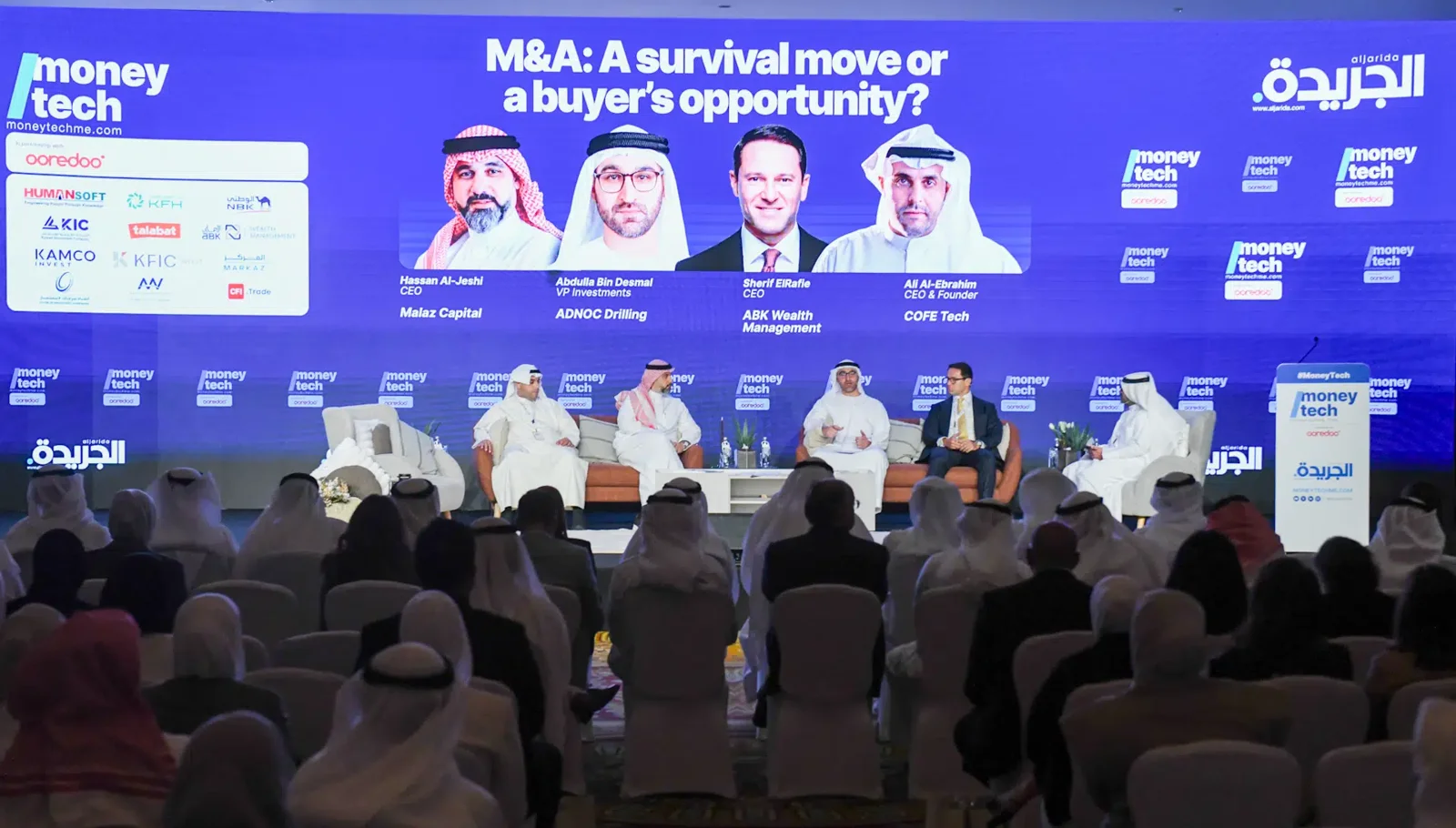
The first panel discussion, titled “Mergers and Acquisitions: A Survival Step or an Opportunity for Buyers?”, featured Hassan Al-Jishi, CEO of Al-Muzna Financial Services; Abdullah bin Dasmal, Vice President of Investments at ADNOC Drilling; Sherif Al-Rafaei, CEO of ABK Wealth Management; and Ali Al-Ibrahim, Founder and CEO of Kovee Technology. Participants reviewed mechanisms for valuing companies amid market volatility, the differences between forced sales and strategic acquisitions, and sectors likely to see upcoming merger and acquisition deals.
The second panel discussion, titled “Investment Amid Uncertainty: Resilience, Risks, and Opportunities,” was moderated by Noura Al-Abdulkarim, Head of Markets at the Kuwait Stock Exchange. It featured Ali Al-Qadi, Head of the BlackRock Kuwait Office, and Ahmed Al-Bushra, Chief Executive Officer of the Carlyle Group. The session explored whether the current climate of uncertainty is a transient phase or a new reality likely to persist, and how investors can strengthen the resilience of their portfolios in both listed and unlisted markets, manage risks not yet reflected in prices, and seize opportunities during periods of stress. The session concluded with a discussion on the factors that position Kuwait as a natural destination for long-term investments, featuring insights and experience from Nour Al-Bahr, Managing Director of Talabat Kuwait, followed by a dialogue session with Badr Al-Attar, Executive Director of Planning and Finance at the Kuwait Petroleum Corporation.
The third and final panel discussion, titled “Has the Time Come for the Return of Wealth?”, included Abdullah Abulqasim, Vice President – Wealth Management at the Kuwait Investment Company; Raha Al-Rashid, Vice President – Wealth Management and Business Development at the Kuwait Financial Centre (Markaz); Ziyad Al-Farhan, Portfolio Manager – Asset Management at KFH Capital; and Fawaz Al-Mutawa, Assistant Vice President – Private Investments at KAMCO Invest. Participants discussed the feasibility of redirecting a larger share of Gulf investments from abroad back to regional markets, the opportunities these markets currently offer, and the requirements needed to sustain these investments within Kuwait and other Gulf states.
The FinTech Summit, launched in 2022, is an annual gathering that brings together investment, business, and technology sectors. It attracts wealth managers, investors, technology sector leaders, venture capital funds, and entrepreneurs from across the Gulf region. The fifth edition was held in partnership with Ooredoo. (End) A.A.B./F.N.K./H.A.
