Guterres: Permanent peace in the region cannot be achieved without resolving the Palestinian issue
صورة: وكالة الأنباء الكويتية (كونا)
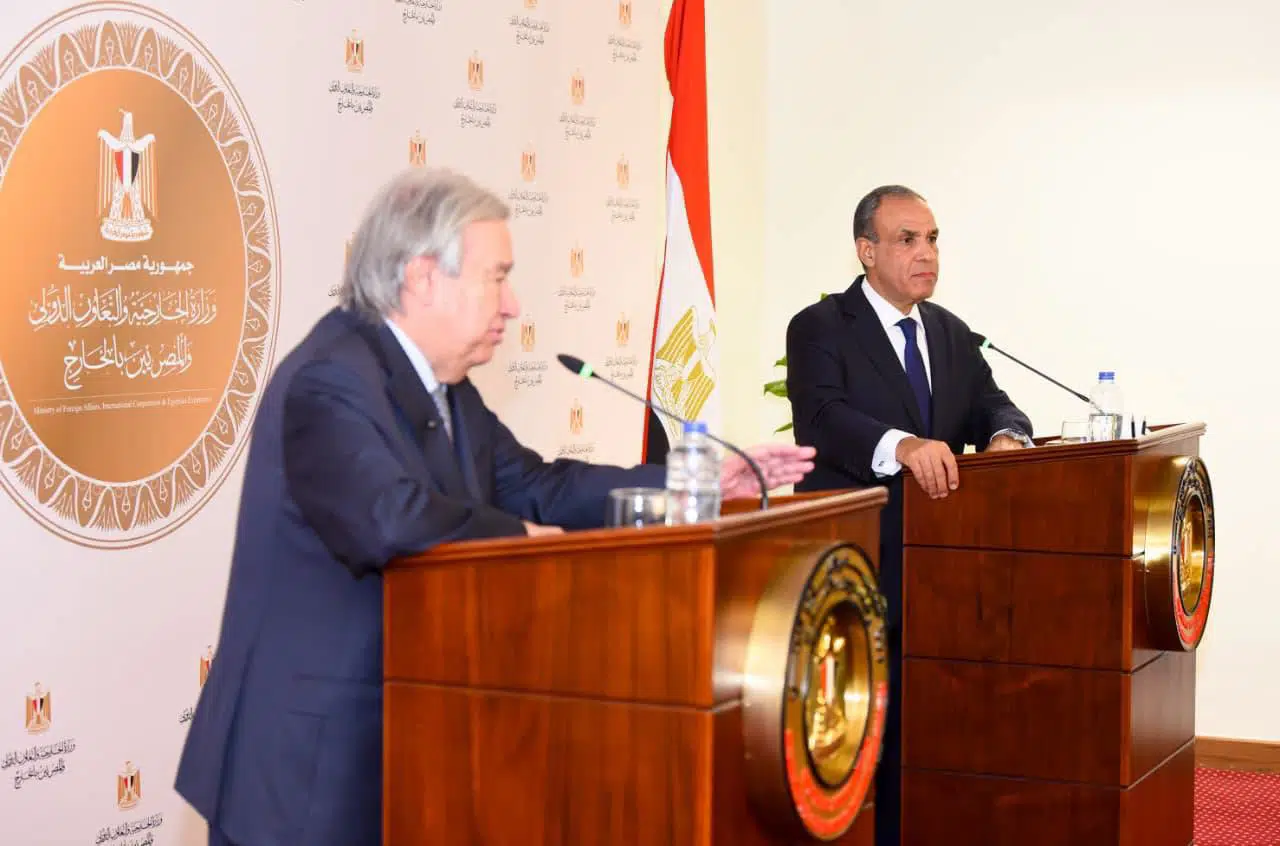
Guterres emphasized during his meeting with Badr Abdelatty in Cairo that permanent peace in the Middle East requires a just resolution to the Palestinian issue and respect for international law.
Translated by Alqyas from KUNA — Original source
Cairo -- UN Secretary-General Antonio Guterres affirmed on Monday that a permanent and sustainable peace in the Middle East cannot be achieved without a just resolution to the Palestinian issue and recognition of the Palestinian people’s right to self-determination. This statement came during a joint press conference held by Guterres with Egyptian Minister of Foreign Affairs and International Cooperation Dr. Badr Abdelatty following their talks in Cairo, which addressed ways to enhance bilateral cooperation, developments in regional and international affairs, and joint efforts aimed at de-escalation and conflict resolution.
Guterres expressed deep concern over Israeli occupation movements in the occupied West Bank, including the expansion of settlements, the increase in the number of settlements, the displacement of Palestinians from their homes, and attacks on civilians, including journalists. He stated, “We have seen coercion aimed at ethnic cleansing, and this must end.” He emphasized that “the two-state solution is the only path for Israel and Palestine, and they must live side by side in security and safety in accordance with international law and resolutions of the international community.”
He expressed his profound appreciation for the Egyptian people and government and their efforts to halt the war, noting that during his talks in Cairo he had commended Egypt’s “indispensable role,” pointing out that since the beginning of the crisis in Gaza, Egypt has been a key player in mediation and humanitarian efforts. He stressed that Palestinians continue to suffer greatly, and that all restrictions on the entry of humanitarian aid into Gaza must be lifted, while civilians must be protected and international law respected.
In a separate context, the UN Secretary-General warned against the risk of the current situation in the region escalating into a major crisis that could spiral out of control. He affirmed that the war in Gaza and the disturbances in the Red Sea continue to harm global trade and the world economy. He clarified that the talks also addressed the situation in Sudan, emphasizing the need to halt fighting and that the fate of Sudan must be determined by its own people through a political process that preserves its unity, territorial integrity, and sovereignty.
He added that the discussions also covered the situation in Libya, stressing the necessity of unifying Libyan institutions to pave the way for a political process that ends the conflict.
For his part, Minister Abdelatty affirmed that Guterres has played a highly significant role in addressing crises not only in the Middle East but globally, amid rising tensions and polarization in the international system. He noted that Guterres’s positions have been characterized by great wisdom and a consistent commitment to the principles of international law.
He pointed out that the discussions addressed ways to reform international institutions to make them more suitable and democratic, thereby serving the interests of developing countries. He noted that these institutions were established after World War II and primarily served the interests of certain countries rather than developing nations.
Abdelatty explained that in-depth discussions took place on regional issues, foremost among them the Palestinian issue. He emphasized that the Secretary-General affirmed it lies at the heart of the conflict in the region, and stressed that even if other conflicts are resolved without addressing the Palestinian issue, sustainable development and lasting stability will not be achieved in the region.
He added that the talks also covered the Iranian file and the current military escalation, which poses risks to countries in the region, including Gulf Cooperation Council states and Egypt, as well as to the global economy as a whole.
He noted that the Egyptian President and the UN Secretary-General agreed, in this regard, to intensify efforts aimed at de-escalation and avoiding the outbreak of a comprehensive military confrontation, as such a scenario would have highly negative repercussions for the entire region and the world as a whole. The two sides also exchanged views on future steps and necessary initiatives to contain the escalation. Abdel-Ati said that the talks also addressed the situations in Libya and Sudan, ways to achieve stability in the Horn of Africa region, and freedom of navigation in the Strait of Hormuz, the Bab el-Mandeb Strait, and the Black Sea, as well as an extensive dialogue on the issue of water security, emphasizing that it is “an existential matter of paramount importance to Egypt and one that cannot be taken lightly.” (End) A.S.M./N.S.A.
