Al-Zaidi insists on taking over Kurdistan's crossings and fields
Iraqi Prime Minister Ali Al-Zaidi defended his decisions to place Kurdistan's crossings and fields under the control of the federal government, while border forces command announced closure of unofficial crossings amid protests in Erbil and agreements on national dialogue.
Translated by Alqyas from Al-Jarida — Original source
Iraqi Prime Minister Ali al-Allawi defended his recent decisions to place the border crossings of the Kurdistan Region of Iraq and oil fields located in Kurdish areas under the control of the federal government, decisions that were rejected by the regional government, as Iraqi border guards announced the start of closing unofficial crossings.
During a meeting with European ambassadors in Baghdad, al-Allawi stated that the Federal Court had confirmed the federal government’s responsibility for securing Iraq’s international borders through federal security forces and the Iraqi Army, as well as the management of oil resources by federal authorities, in accordance with the Constitution.
He added that Kurds are an integral part of the Iraqi people, and that the federal government is keen to ensure their rights and secure their livelihood needs, to the same extent that it is committed to the rights of all citizens in Iraqi governorates.
Al-Allawi emphasized that there would be no retreat from the path of combating corruption, that no weapons would exist outside the framework of the Constitution and the law, and that strict measures would be taken to prevent oil smuggling across Iraq and to protect the constitutional rights of all Iraqis.
In subsequent remarks, al-Allawi escalated his rhetoric, asserting that “imports into the Kurdistan Region go to certain groups and are not distributed to the Iraqi people,” and he suggested that “there are those who want to drag our Kurdish people into an oil smuggling crisis to protect their influence and wealth.”
Al-Allawi said that “there are those who want the country’s borders to remain full of loopholes,” noting that “our army, which comprises all components, will be stationed at the borders, not inside cities.”
This came as political communications took place in Iraq in recent hours to de-escalate tensions following his recent decisions.
The four Iraqi presidencies agreed in a meeting held yesterday evening to hold a national dialogue, sponsored by the head of the Supreme Judicial Council, Faiz al-Zidan, in early December, with the participation of relevant parties, to find constitutional solutions to the crisis between the federal government and the Kurdistan Region government.
The Presidency of the Republic stated in a bulletin that the meeting, hosted by President Nizar al-Amidi and attended by the heads of the executive, legislative, and judicial branches, welcomed al-Zidan’s initiative to hold the dialogue on December 1, with the participation of the four presidencies and the hosting of relevant parties or any assisting party, with the aim of addressing the crisis in accordance with the Constitution.
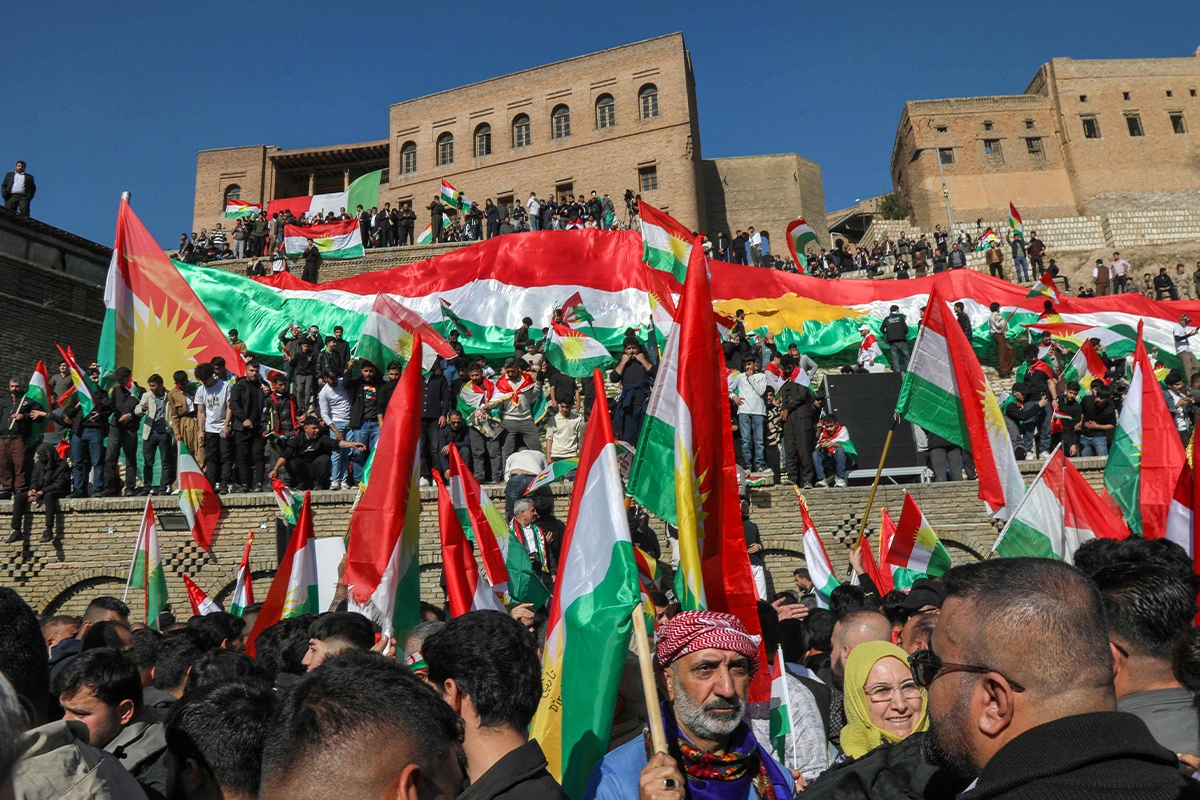
Large-scale popular demonstrations took place today in the city of Erbil near the historic Erbil Citadel to express anger and rejection of the recent decisions issued by the federal government in Baghdad regarding the Kurdistan Region. Protesters carried slogans and banners condemning Baghdad’s policies toward the region’s rights and its financial and administrative entitlements.
Earlier, Iraqi government spokesperson Haider al-Abudi denied yesterday’s reports circulating about the movement of Iraqi Army units toward the Kurdistan Region, stating that the government is working to protect the people of Kurdistan, not to threaten them.
He clarified that al-Allawi “has taken upon himself the defense of the rights of Iraqis from Zakho to Basra,” and is “keen on protecting the entitlements and constitutional rights of the Kurdish people.”
Meanwhile, the Iraqi judiciary issued 15-year prison sentences to individuals accused of involvement in smuggling oil from Basra to “neighboring countries.” According to a judicial statement, the convicted individuals belong to an armed group led by the fugitive Ahmad Shaie.
Meanwhile, the Iraqi Border Forces command announced today the immediate implementation of the Commander-in-Chief of the Armed Forces’ directive to close all unofficial border crossings. It clarified that “the Border Forces are responsible for the border strip, not the crossings, as units handling the border strip and crossings fall under the jurisdiction of the Border Crossings Authority,” adding that “there is an effort and directive to centralize the management of crossings in the Kurdistan Region alongside other crossings.”
Earlier, the Iraqi Ministry of Defense announced yesterday evening that its forces had begun cutting off oil smuggling routes in areas extending between Iraqi governorates and the Kurdistan Region, known in security terms as Joint Interest Areas.
Spokesman for the ministry, Major General Yahya Rasoul, told the Iraqi official news agency that Commander-in-Chief Ali al-Zaidi had ordered the Joint Interest Areas brigades to block informal roads marked along oil smuggling operational routes. These are “informal secondary and territorial passages, as well as those identified through intelligence and used for smuggling.”
The Border Forces commander noted that the use of modern technologies and smart surveillance has contributed to curbing infiltration and smuggling operations, affirming “advanced levels of border control with Syria, Jordan, Saudi Arabia, Kuwait, and Iran.”
