Bashar Khalifa Reveals the Beauty of the Grand Sea Palace and Its Architectural Evolution
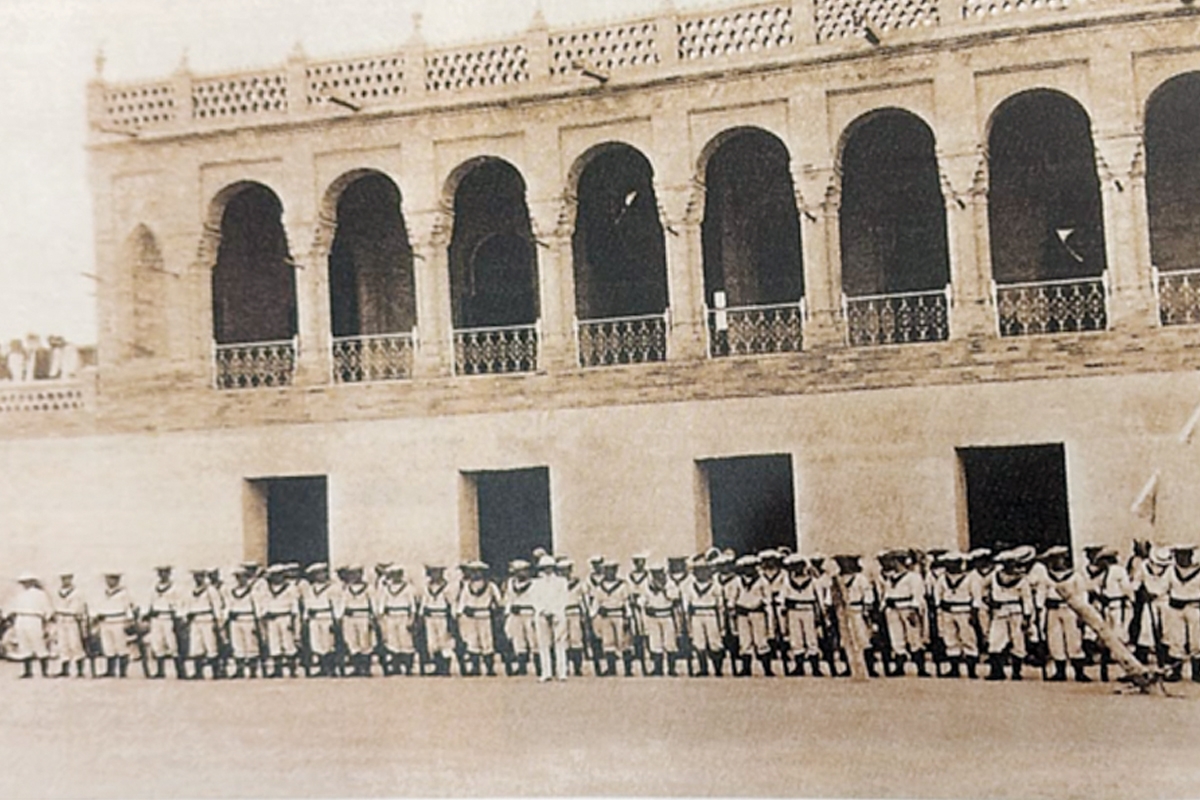
Bashar Khalifa's book documents the history and architectural beauty of the Sea Palace since 1906.
Translated by Alqyas from Al-Jarida — Original source
In his book “Qasr Al-Sayf: A History of Beauty and Architecture,” architectural researcher Bashar Khalifa explores the aesthetic qualities of the palace and the evolution of its architecture from its establishment in 1906 to the present day. This publication adds to his research portfolio, following two previous books published by the Kuwait Center for Research and Studies: “The Third Wall of Kuwait” and “Decoration in Ancient Kuwaiti Architecture.”
The book, which relies on field studies supported by a team of specialists from the Diwan Amiri and the author’s artist friends, serves as a documentation of the symbolic identity represented by Qasr Al-Sayf in Kuwaiti history. As the official seat of government since its construction by Sheikh Mubarak Al-Sabah in 1906, it has hosted successive Kuwaiti rulers.
The researcher emphasizes in the book that Kuwait possesses a distinctive architectural style that falls within the prevailing architectural pattern of the Gulf and Arabian Peninsula. He notes that the palace is a masterpiece in its own right, despite relying in its foundational stages and earlier periods on physical strength and ancient artistic and engineering methods that preceded the development of modern construction techniques.
The book’s content is divided into three main chapters and two appendices. The first chapter, titled “Site Strategy and the Urban and Social Policy of Qasr Al-Sayf,” highlights the geographical importance of its location, its openness to the city, the urban planning of the straight line, as well as the social system and events it hosted throughout its history. The second chapter, “Stages of the Palace’s Construction and Formation Through History,” branches into three sections. The book concludes with two appendices: the first is dedicated to a timeline of the palace’s urban development stages, while the second examines the architectural style of the studied palace.
Among the most famous names and phrases associated with the history of Qasr Al-Sayf are two that reflect the philosophy of the message the palace carries and the policy of governance.
The first is the name “Qasr Al-Sayf Al-Amir” (The Flourishing Palace of the Sword). This title has been circulated in both ancient and modern sources, on the lips of historians and the general public alike, signifying the constant generosity of Kuwaitis in hospitality toward their guests, and its status as a thriving home filled with blessings for all throughout its history.
The second is the phrase “If it were to endure, it would not reach you” (a proverb implying that what belongs to others will not last for you). This phrase was inscribed by Sheikh Salem Al-Mubarak Al-Sabah when constructing the new gates of the palace, and later transferred by Sheikh Abdullah Al-Salem Al-Sabah to the main external gate facing the public street toward the city of Kuwait. This wisdom embodies absolute faith in destiny and submission to God Almighty. It is worth noting that classical literature from the Abbasid era (the time of Harun al-Rashid) attributes its first speaker to Ahmad, son of Caliph Harun al-Rashid, making it one of the most famous proverbs in Islamic history since then.
Qasr Al-Sayf was known for hosting the Council of the Amir, Sheikh Ahmad Al-Jaber Al-Sabah, which convened every morning in the central hall. This hall subsequently served as a general council for the rulers of Kuwait.
The palace witnessed several prominent social events, some of which the author listed, including: the wedding of Sheikh Hamad Al-Mubarak in 1908, the wedding of Sheikh Abdullah Al-Salem in 1908, and the wedding of Sheikh Saud bin Muhammad Al-Sabah to the daughter of Sheikh Mubarak Al-Sabah.
• The reception of American physician Arthur Bennett and American Reverend Van Ess in 1911, to negotiate the purchase of land for establishing a hospital for the American Mission.
• The visit of the Danish traveler Ronkaer in February 1912, during which he spoke about Kuwait’s location and its importance in the region. He also took many photographs and described the buildings belonging to the palace.
• Visit of Sheikh Muhammad Rashid Rida, owner of the magazine “Al-Manar,” which took place in May 1912.
• Presentation of a portrait of British King George V to Sheikh Mubarak Al-Sabah, which took place on July 9, 1913.
• Reception of Lord Hardinge, Viceroy of British India, which took place in February 1915.
• Conferment of the Order of the Star of India upon Sheikh Salem Al-Mubarak Al-Sabah by the British Indian government, which took place on March 26, 1919.
• Conferment of another order upon Sheikh Ahmad Al-Jaber Al-Sabah by the Indian government, which took place on May 16, 1942.
• Reception of Sheikh Ahmad Al-Jaber Al-Sabah’s arrival from India, which took place on October 14, 1947, with celebrations and performances held in Al-Safah Square.
• Artistic military parade presented by the Diwan Guard in front of the Palace Square.
• On Saturday, November 5, 1949, the Mission magazine reported the visit of Sheikh Salman bin Isa Al Khalifa (ruler of Bahrain), who was received at the port and proceeded to the Diwan Palace.
• Celebration of the anniversary of Sheikh Abdullah Al-Salem Al-Sabah’s accession, which took place in February 1953.
