"Nizah": Project to mechanize financial status declarations
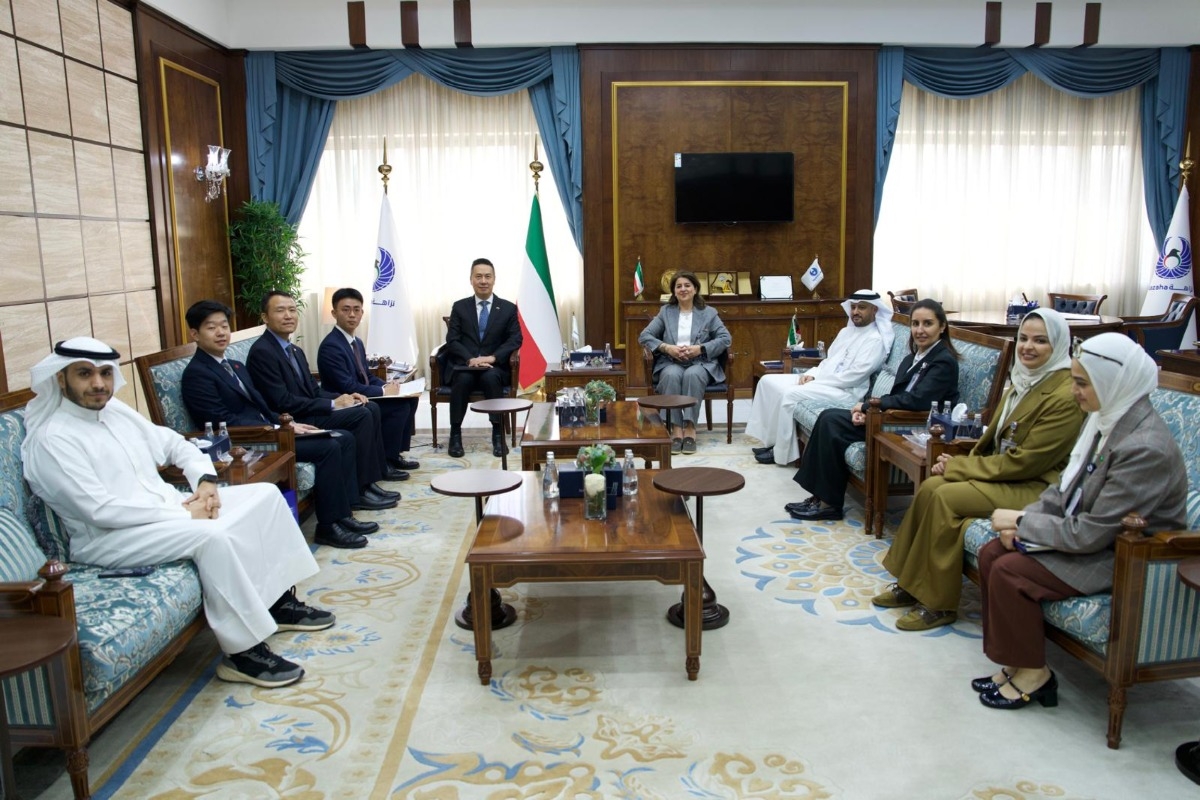
The Public Authority for Combating Corruption received the Chinese Ambassador to discuss enhancing cooperation and exchanging expertise in combating corruption
Translated by Alqyas from Al-Jarida — Original source
Dr. Rana Al-Faris, President of the Public Authority for Combating Corruption (Nazaha), received Mr. Yang Xin, Ambassador of the People’s Republic of China to Kuwait, in the presence of Dr. Majed Al-Daihani, Vice President of the Authority, members of the Authority’s Board of Directors, and the Acting Director of the International Cooperation Department. Representatives from the Chinese side included the Deputy Head of the Mission and several embassy staff members.
The meeting discussed ways to enhance cooperation and exchange views on issues of mutual interest, as well as perspectives on information sharing in the fight against corruption, including transnational crimes, in accordance with relevant international conventions and while respecting the national legislation of both countries.
Al-Faris welcomed the Ambassador and emphasized the strong strategic partnership between the two countries, particularly in the construction sector. She outlined the Authority’s mandate and sectors, highlighting key areas such as corruption detection, asset declaration, and prevention. She also reviewed the channels for receiving reports and the preventive programs implemented by the Authority in partnership with the public and private sectors and civil society.
She addressed the issuance of Decree No. (69) of 2025 amending Law No. (2) of 2016, and the legislative amendments currently being pursued by the Authority. She affirmed that the Authority exercises its functions with full independence and that the current Board of Directors aims to make Nazaha stronger and more effective. She expressed her interest in learning about Chinese practices, experiences, policies, and legislation related to anti-corruption, and in benefiting from the expertise of Chinese specialists.
For his part, the Chinese Ambassador expressed his high appreciation for the political leadership in Kuwait, affirming that the leaderships of both countries remain committed to fighting corruption despite the challenges facing the region.
He stated that anti-corruption is a fundamental pillar of economic and social development, noting that China was among the first countries to sign the United Nations Convention against Corruption (UNCAC). He invited the Authority to visit Chinese supervisory bodies to observe their experiences, welcoming intensified mutual cooperation.
In response, Al-Daihani thanked the Ambassador for his praise of Kuwait’s efforts and emphasized the importance of leveraging China’s advanced applications in artificial intelligence to enhance digital oversight and corruption risk analysis.
He revealed an ongoing project to computerize asset declarations and transition them to electronic submission upon the enactment of the necessary legislative amendments. He also highlighted Kuwait’s and Nazaha’s aspiration for a leading role in international organizations, citing the adoption of two pioneering resolutions on the transparency of beneficial ownership and beneficial interest—one Arab resolution within the framework of the Arab League, and one Islamic resolution within the framework of the Organization of Islamic Cooperation.
Anwar Al-Qadiri, Acting Director of the International Cooperation Department at the Authority, reviewed existing communication channels with Chinese counterpart bodies. She praised China’s role in international forums and congratulated China on securing a seat on the Steering Committee of the GlobE Network, an operational network of anti-corruption law enforcement authorities, whose secretariat is hosted by the United Nations Office on Drugs and Crime (UNODC). She affirmed the Authority’s aspiration to join the network, particularly given that the Authority currently chairs two of the three thematic working groups within the network.
At the conclusion of the meeting, both sides emphasized the importance of enhancing cooperation and information exchange in the fight against corruption, including transnational crimes, in accordance with relevant international conventions and while respecting the national legislation of both countries.
