NATO: Our regional centre in Kuwait a platform to translate Gulf partnerships into tangible results
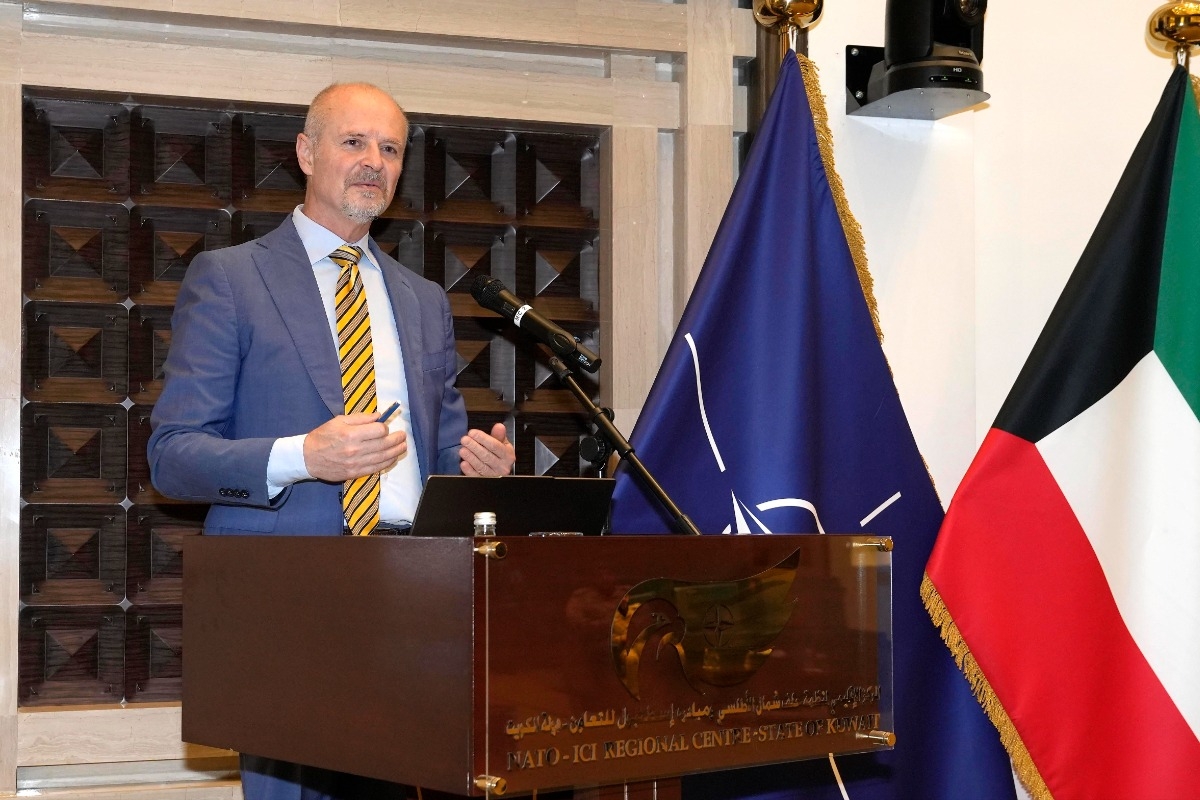
Giovanni Romani stressed the importance of the Alliance's regional centre in Kuwait in enhancing cooperation with Gulf states and confronting shared security threats.
Translated by Alqyas from Al-Jarida — Original source
Giovanni Romani, Director of the NATO Southern Neighbourhood Team, affirmed on Tuesday the pivotal role played by the NATO Regional Centre and the Istanbul Cooperation Initiative (ICI) in Kuwait in strengthening cooperation between the Alliance and the Gulf Cooperation Council (GCC) states, and in translating existing partnerships into practical and tangible results.
Romani made these remarks in an interview with KUNA on the sidelines of the launch of a two-day simulation exercise on “Forensic Evidence in the Battlefield – Countering Terrorist Threats and Threats Related to the Use of Unmanned Aerial Systems (UAS),” attended by member states of the ICI, as well as Saudi Arabia, Oman, and Jordan.
Romani stated that the Alliance is preparing next year to celebrate the tenth anniversary of the Centre’s opening in Kuwait in 2017, expressing NATO’s pride in its cooperation with Kuwait, which has provided opportunities to engage with the six Gulf states and the GCC as a regional organization, both within and outside the framework of the ICI.
He added that the Centre serves as an open platform for all NATO member states and GCC countries, and its role extends beyond delivering education and training programs to include exchanging perspectives and expertise, and enhancing mutual understanding of security challenges and ways to address them.
He noted that these areas were identified as shared challenges during discussions held at the Centre in Kuwait in December 2025, bringing together the Alliance and its partners. He pointed out that recent regional developments have further underscored the importance of cooperation in these fields for both Gulf states and the Alliance.
Romani emphasized the Alliance’s commitment to leveraging the experiences and expertise of Gulf states in confronting security threats, stressing that cooperation and the exchange of expertise represent a mutually beneficial path for all parties.
Regarding the Centre’s future, he expressed his hope that it would play an increasingly prominent role in enhancing practical cooperation between the Alliance and Gulf states, commending the participation of Saudi Arabia and Oman in its activities despite their not being formal members of the ICI.
He highlighted ongoing consultations with the Kuwaiti Ministry of Foreign Affairs to explore opportunities to expand participation in the Centre’s activities to include countries outside the Gulf region, citing Jordan’s participation in the current exercise and anticipating similar future participation.
For his part, Emad Al-Kandari, Director of the NATO Regional Centre and the Istanbul Cooperation Initiative, told KUNA that the simulation exercise on forensic evidence in the battlefield and countering terrorist and UAS-related threats is the first of the flagship projects of the Alliance and the ICI.
Al-Kandari added that these projects resulted from recommendations of the seventh meeting of the ICI Policy Advisory Group, hosted by Kuwait in December 2025, and were endorsed by the Alliance during its summit held in Ankara last July.
He noted that the exercise, conducted in cooperation with the NATO Counter-Terrorism Division and involving trainees from Gulf states and the Hashemite Kingdom of Jordan, brings together a group of experts to discuss threats arising from the use of UAS by terrorist groups and non-state militias.
He pointed out that the exercise aims to enhance participants’ capabilities in countering terrorist threats, and to exchange expertise and lessons learned in areas of cooperation among relevant stakeholders, technical analysis, information sharing and analysis, thereby contributing to preventing such incidents and ensuring optimal responses to them.
The Center reaffirmed its continued commitment to supporting and developing regional capacities and enhancing cooperation with partner countries across various fields, particularly those aligned with security developments and current and future needs.
For her part, Charlotte Hallgren, Director of Operations in the Operations Department of NATO’s International Staff, emphasized in a recorded statement presented to participants the importance of strengthening international cooperation to counter growing terrorist threats linked to the use of unmanned aerial systems (UAS). She noted that the rapid advancement and widespread dissemination of this technology have brought about a fundamental shift in the security environment.
Hallgren stated that drones are no longer an exclusive military technology but have become commercially available, more advanced, less costly, and customizable, thereby increasing the complexity of security challenges associated with their use by terrorist groups and non-state actors.
She highlighted the strategic importance of the Gulf region due to its location at the crossroads of international trade routes and its hosting of vital energy facilities and infrastructure, adding that threats originating at the local level can quickly escalate to regional and international levels, affecting maritime navigation and energy supplies.
She stressed the importance of addressing these threats from both strategic and operational perspectives, enhancing coordination among security, military, and civilian institutions, and developing mechanisms for information and expertise exchange to ensure swift and effective responses.
She pointed out the necessity of analyzing forensic evidence related to drones, as they serve as a valuable source of information that contributes to supporting investigations, uncovering supply networks, improving preventive measures, and anticipating future threats.
Regarding the Alliance’s flagship projects, Hallgren explained that they represent a practical platform for enhancing multilateral cooperation with regional partners, based on shared priorities and leveraging regional capacities, expertise, and knowledge to translate them into tangible results.
She expressed her satisfaction with the momentum achieved by these projects since their launch last July, commending the NATO Regional Center and the Istanbul Cooperation Initiative in Kuwait for hosting this exercise, which exemplifies the Center’s important role in fostering dialogue, practical cooperation, and capacity-building to address common security challenges.
She affirmed that the continuous evolution of terrorist threats linked to drones requires a rapid, flexible, and cooperation-based response, calling on participants to use the exercise to identify gaps, exchange expertise, and develop practical recommendations that enhance collective readiness to confront these threats.
