Lana Nuseibeh... A Gulf figure towards leading global diplomacy to contain crises before they widen
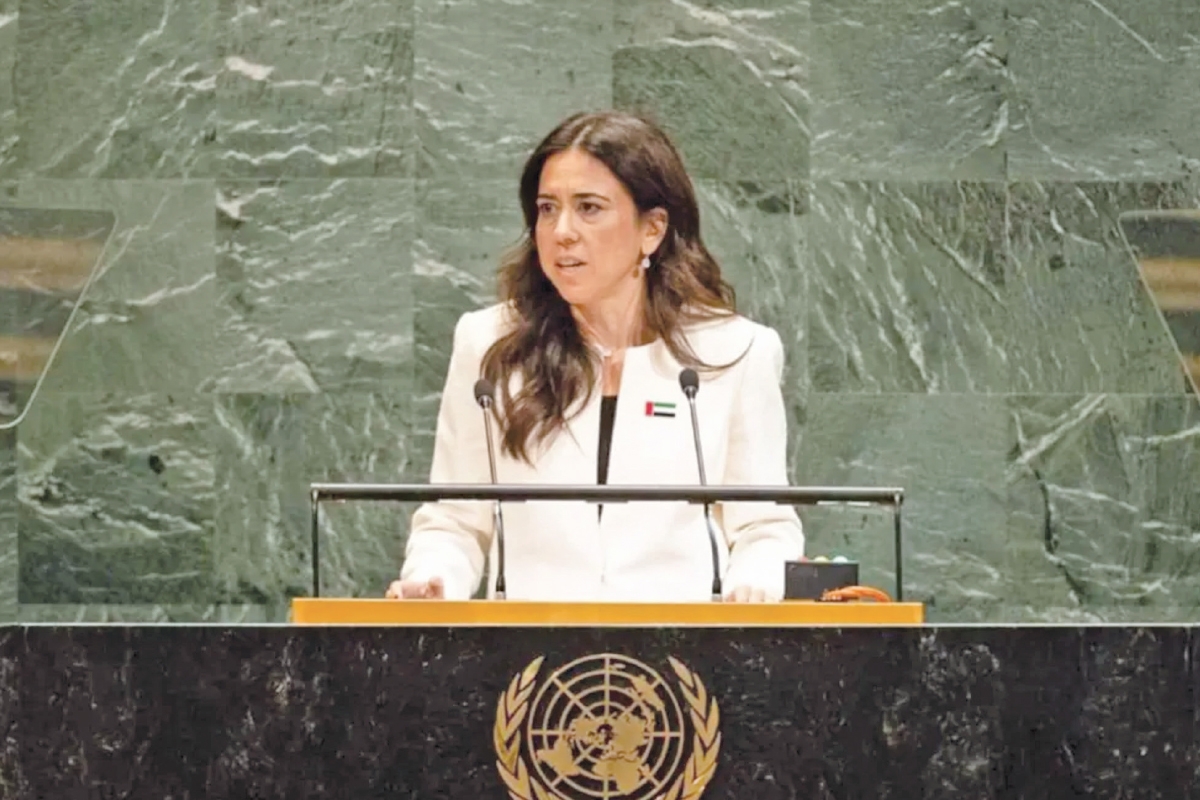
Kuwait and the UAE support the nomination of Lana Nuseibeh to enhance Gulf UN cooperation.
Translated by Alqyas from Al-Jarida — Original source
In November of this year, Kuwait, before the United Nations General Assembly, called for strengthening institutional cooperation with the Gulf Cooperation Council (GCC) and expanding consultations in mediation and preventive diplomacy.
In this context, the consensus announced by GCC Secretary-General Jassem Al-Bedawi on October 22 last year has gained support for the nomination of UAE’s Lana Zaki Nuseibeh to the UN Secretariat, a development with significance that transcends the race for the position.
The question that matters to Kuwait is not only who will lead the organization, but how the United Nations can work with Gulf states before a crisis escalates, rather than merely consulting them after it occurs.
Kuwaiti-UAE relations play a role in this assessment, as they are fraternal ties translated into institutional work, from the Supreme Joint Committee to consular and economic coordination. In January 2026, Kuwait hosted the sixth session of the Supreme Joint Committee, with cooperation covering areas ranging from consumer protection to tourism and standards. While these files may seem distant from New York, they demonstrate that the rapprochement between the two countries is not limited to political stances. Naturally, the nomination of an experienced UAE figure with UN expertise resonates in Kuwait, although the bilateral relationship alone should not be the sole basis for judging her suitability for the post.
Regional developments this year have highlighted the cost of delayed action. When tensions escalate around the Strait of Hormuz, the impact is not confined to oil tanker movements; it extends to crew safety, shipping schedules, and the cost of goods delivery.
The UN is not expected to become a party to every regional dispute, but it can help keep communication channels open and contain incidents, without allowing de-escalation to become an excuse for tolerating violations of state sovereignty or the safety of navigation.
Kuwait contributed to laying the foundation for this cooperation by presenting, on behalf of the GCC member states, a draft resolution on cooperation between the Council and the United Nations, which was adopted by the General Assembly by consensus in June 2025. In April 2026, the Security Council, under the presidency of Bahrain, held the first high-level meeting on this partnership, encouraging cooperation in maritime, food, and water security. The next step is to pre-agree on how to exchange information and consult when incidents occur, and to leverage mediators capable of communicating with all parties. Channels built during calm times are those that can be relied upon when the scope for understanding narrows.
This approach opens space for Kuwait to continue its role in bridging differences from a clear position: respecting state sovereignty does not conflict with keeping the door to dialogue open. This can be translated into partnership with the UN through regular consultations, not tied to the timing of summits or changes in the GCC’s rotating presidency. If it is known in advance who will handle communication, and how facts are conveyed and reviewed, faster action can be taken when narratives diverge and pressures mount. This is an aspect of prevention that may not appear in statements, but makes a difference when tested.
Here, the connection between Nisba’s program and Kuwaiti interests becomes evident. She does not believe that the United Nations must lead every mediation effort, but rather that it should support those who can reach the parties involved and assist in monitoring implementation. The UAE served as a representative at the United Nations from 2013 to 2024 and presided over the Security Council twice. In December 2023, her country introduced draft resolution 2720 concerning aid to Gaza, following consultations with Egypt and Palestine. The resolution enabled the creation of a UN mechanism to accelerate the delivery of relief, but it did not halt the war, and Nisba did not present it as a substitute for a ceasefire. What is credited to her is pushing for urgent action without conflating it with a political solution.
This distinction is crucial in the Kuwaiti reading of the Gaza file. Facilitating the delivery of aid does not absolve the international community of its responsibility to protect civilians, nor does it replace the need to work toward a settlement that guarantees the Palestinian people their right to establish an independent state. What is required of the Secretary-General is not to use the same language in every crisis, but to adhere to the same standard: respecting international law and working to protect civilians, even when the Security Council is divided. A mediator’s limited success in reaching an agreement does not exempt them from monitoring its implementation or from continuing efforts on issues remaining outside the agreement.
The standard of implementation also applies to Nisba’s proposals for reforming the organization. She calls for reducing duplication of efforts, bringing decision-making and resources closer to field teams, and demonstrating what programs have achieved relative to their costs.
In the Gulf, this can be tested on issues such as water security and the continuity of essential services during disturbances. If information is delayed or the responsibility of each party in responding is unclear, having a plan that is complete on paper will be of little benefit. UN cooperation here does not require new mechanisms every time; first, it needs to define what the organization adds to the work of existing Gulf entities and how the impact of that addition can be measured.
The informal Security Council poll on November 20 did not yield consensus on the choice of the next Secretary-General, but the significance of Gulf support does not depend solely on the outcome of the race. Nisba’s candidacy holds merits worthy of support: experience in negotiation, an understanding of the role of regional partners, and a focus on monitoring implementation.
The standard that should remain after the appointment, regardless of who takes the post, is that the United Nations should work with the Gulf Cooperation Council before a crisis escalates, and that it should uphold the principles of sovereignty and freedom of navigation when defending them becomes more costly. The security that concerns Kuwait does not begin with the issuance of a statement; it begins when it is possible to prevent an incident from becoming a crisis.
