Alfajr Al-Sabah: The Word as a Bridge of Culture in Confronting Global Challenges
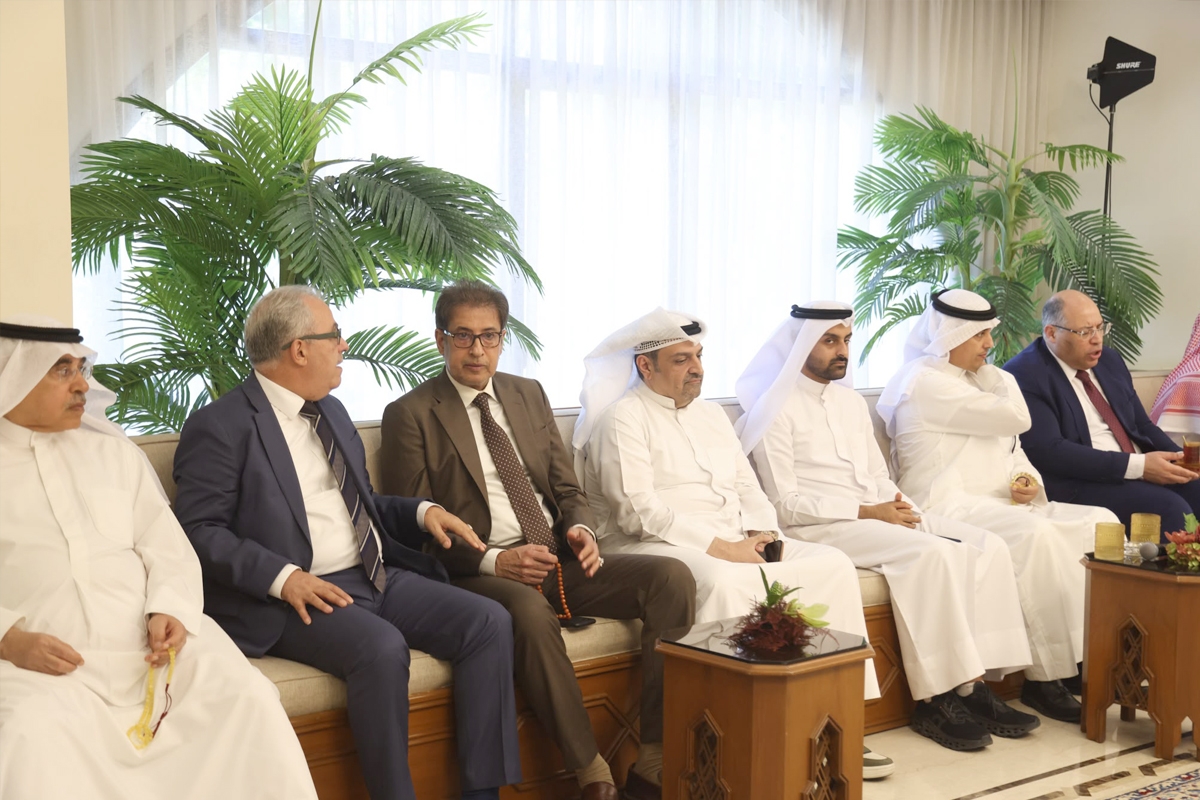
Sheikha Afrah Al-Mubarak Al-Sabah Salon Discussed the Impact of Artificial Intelligence on Literature and Publishing in Kuwait
Translated by Alqyas from Al-Jarida — Original source
In an evening adorned with a diversity of names and experiences, the Sheikha Afrah Al-Mubarak Al-Sabah Salon hosted a distinguished gathering of ambassadors, writers, poets, authors, journalists, publishing house representatives, and cultural enthusiasts from Kuwait and several Arab countries, alongside officials from the National Council for Culture, Arts and Letters, in an event that celebrated intellect and affirmed that culture remains the broadest space for dialogue and the bridge through which souls connect with one another.
In her welcome address, Sheikha Afrah expressed her delight at this literary gathering, which draws inspiration from the spirit of the late Sheikh Abdullah Al-Jaber Al-Sabah and evokes his legacy in supporting education and culture in Kuwait. She highlighted his role in backing education and founding a literary club, planting the seeds of knowledge and enlightenment whose roots have extended through generations, bearing fruit in a cultural awareness that illuminates the present and connects the past with the future.
She emphasized that words are not merely letters arranged on paper, but rather presence, influence, and responsibility; a weapon and a cultural bridge in the face of the challenges the world is witnessing, and a human refuge when life becomes turbulent and distances widen. In an era where the causes of division multiply, words remain a window through which humans look at one another, discovering through them what unites them, transcending differences in perspectives and interests.
Sheikha Afrah added that cultural and literary meetings and dialogues enrich society, contributing to the re-humanization of its details by reviving the value of the word and opening spaces for communication among various spectrums and orientations.
The cultural meeting featured a discussion sparked by writer Hamza Aliyan, who posed a question about the impact of artificial intelligence on the publishing industry and literary creativity, and the standards that publishing houses should adopt when dealing with works whose authors utilize these technologies. This comes amid diverging publisher stances, ranging from allowing its use within specific limits to rejecting works that rely on it entirely.
In his intervention, writer Dr. Mohammed Al-Bagili expressed his hope that this cultural gathering would be repeated at the Sheikha Afrah Al-Sabah Salon, which provided him and the attendees with the opportunity to meet, communicate, and exchange views in an atmosphere brimming with literature, culture, and intellect.
Commenting on the use of artificial intelligence in the publishing industry, Al-Bagili stated, “We need technology that acts as a double-edged sword,” citing the development of communication tools, computers, and cybersecurity. He affirmed that “societies need to keep pace with technological development while simultaneously building a new intellectual current and supporting innovative publishing houses and authors capable of changing the map of ideas and orientations. We hope that in the future, we will have minds capable of creativity that keeps pace with challenges, harnessing them to serve the creative process.”
Publisher Dr. Fatima Al-Boudi remarked, “Technological development is not necessarily harmful, and dealing with it should be based on benefiting from what suits the needs of the publishing industry, without compromising the human spirit, creativity, and innovation that distinguish literary work. Reading committees in publishing houses may be disturbed when they notice authors relying clearly on artificial intelligence, as it offers greater opportunities for human creativity and the human spirit, which is capable of crafting the literary state.”
Al-Boudi emphasized that publishing houses that merely accept ready-made texts do not fulfill their true required role in book production. She noted that they always prefer relying on human elements, even in cover design, because it carries a human imprint that technology cannot provide.
In her intervention, Dr. Laila Mansour stated that she supports the use of artificial intelligence in various fields of life, but emphasized that this intervention in the creative process should not exceed its use as a supportive tool, as it cannot replace the unique human style, especially in poetry, whose value lies in the manner of expression and the ability to convey feelings and emotions.
Dr. Mansour added that what distinguishes a poet is their personal style and creative fingerprint, whereas AI outputs tend to offer similar templates. She noted that while she encourages the use of these technologies, it is essential to preserve the human role in innovation and expressing emotions.
Dr. Suha Al-Faraj expressed her happiness at the atmosphere of the cultural salon, which allowed her to meet her students, colleagues, and a group of cultural enthusiasts. She commented that “modern technologies bring much good and much harm to humanity, but they have become a necessity in our lives that cannot be dispensed with, provided they are handled with awareness that preserves the value of words, the Arabic language, and reading.”
Dr. Al-Faraj stressed the importance of maintaining the presence of printed books in the cultural landscape and paying attention to the Arabic language, as an integral part of cultural identity. She called for not being dazzled by everything produced by modern technologies or dealing with them without awareness, noting that the value of knowledge is not measured solely by degrees and experience, but by a person’s ability to utilize it to serve others.
During the session, writer Saleh Al-Ghazi stated that Arab culture has not achieved a digital presence commensurate with its value and output. He pointed out that Arab success in spreading online has been more closely linked to music and songs, thanks to production companies that worked on building international partnerships and agreements in marketing and intellectual property rights.
Al-Ghazi emphasized the importance of providing a system that supports the presence of Arab authors, writers, and artists on global digital platforms, protects their intellectual property rights, and facilitates the promotion of their work to reach a wider audience. He noted that Arab books do not receive adequate visibility and promotion on global platforms, despite the existence of important literary figures at present.
For her part, Dr. Suad Al-Tararwa stressed the importance and role of writing in local dialects in promoting and facilitating communication among Arab peoples. She affirmed that different dialects are capable of reaching the audience’s emotions, citing the poetry of Birta Al-Tunisi and other poetic experiences that remain present in Arab memory.
Dr. Al-Tararwa added that the Egyptian dialect has managed to reach various Arab societies through literature, cinema, and arts. She recounted an incident involving a Libyan official in 2006, when she discovered that he spoke the Kuwaiti dialect, which he had learned by following the works of the late artist Abdulhussain Abdulredha. She considered that what comes from the heart can reach the hearts of others, and that local dialects can serve as a bridge for communication and promoting cultural identity.
Writer Jazi Al-Snafi highlighted the role of institutions in the creative process, protecting intellectual property rights, and utilizing technology to serve cultural production under clear laws that support literary movements and enhance their steps toward the future.
For his part, Dr. Abdulhussein Shaaban emphasized the importance of the spoken and written word and knowledge, and their role in the lives of societies, citing the philosopher Francis Bacon’s famous dictum, “Knowledge is power.” He clarified that knowledge also represents authority and the capacity to influence and bring about change. He noted that the gathering brings together feelings of joy and sorrow; the cultural event, with its humanistic atmosphere, inspires optimism, even as people in Gaza, southern Lebanon, and other parts of the Arab world endure daily tragedies.
Dr. Shaaban considered what the philosopher Antonio Gramsci described as “optimism of the will” to be a crucial value in confronting a reality that tends toward pessimism. He expressed his appreciation for the intimate atmosphere that brings together intellectuals and creative minds, affirming that the word, with its meaning, significance, and enduring reach, remains a source of hope and vitality. He praised cultural initiatives that strengthen human and spiritual bonds and facilitate the exchange of ideas and experiences among attendees.
