Eisenkot: No Imminent Iranian Threat Requiring Military Intervention
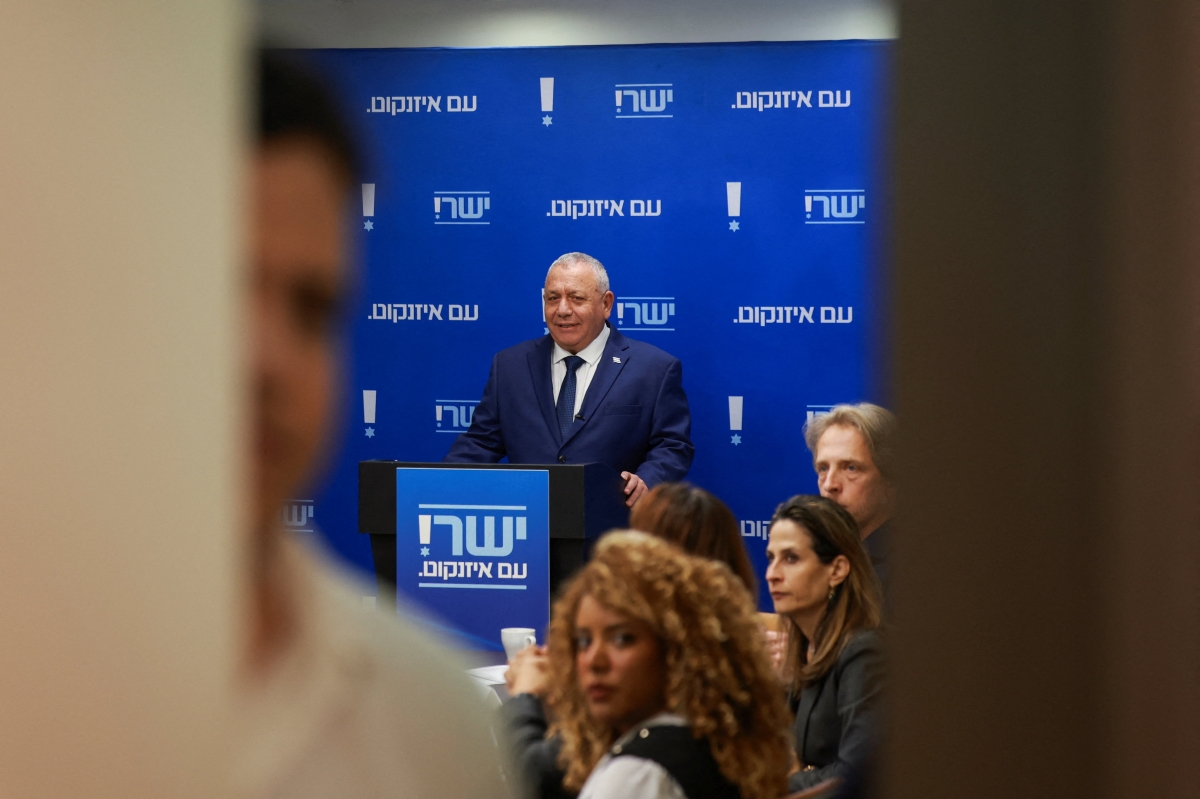
Eisenkot sees no imminent Iranian threat requiring military action, contradicting Netanyahu's warnings, amid negotiations to form a national unity government.
Translated by Alqyas from Al-Jarida — Original source
Gadi Eisenkot, tasked with forming Israel’s new government on Monday, said he saw no need to carry out a rapid military operation against Iran, a stance that contradicted remarks by outgoing Prime Minister Benjamin Netanyahu, who had warned against downplaying “serious threats.”
The politicians’ comments came hours before the third meeting of their party delegations to discuss the possibility of forming a governing coalition, following a round of talks that yielded no breakthrough.
Former Israeli Chief of Staff Eisenkot has until December 6, with a possible 14-day extension, to form a government to replace Netanyahu’s, as neither side secured the 61-seat majority required in the 120-seat Knesset in the October elections.
The third round of talks takes place amid divisions within the broad coalition led by Eisenkot over whether to ally with Haredi (ultra-Orthodox Jewish) parties, Arab lists, or form a national unity government with Netanyahu’s Likud party.
During a briefing in the parliament (Knesset) on Monday, Eisenkot said, “The Iranian threat is the most dangerous for the State of Israel.”
He added, “But at this moment, I do not see a direct and imminent threat to the State of Israel that would require action before the government is formed.”
In contrast, Netanyahu stressed the necessity of unity “in the face of the major threats surrounding us.”
He said in remarks delivered in the Knesset, “Anyone who belittles or downplays these direct, serious, and grave threats surrounding us is doing so for political reasons.”
The delegations of Eisenkot’s centrist Yesh Atid party and the right-wing Likud party are scheduled to meet on Monday evening for a third round of negotiations, according to a Likud spokesperson speaking to Agence France-Presse.
Representatives of the two parties held a meeting on Sunday that lasted nearly four hours, during which they presented their positions on “a number of fundamental issues,” without indications of a breakthrough in the talks.
On Saturday, Yesh Atid described these negotiations as a “genuine commitment to forming the broadest possible government,” noting that Eisenkot had instructed his representatives to explore all available options and scenarios.
However, Likud quickly set several conditions for its participation in a national unity government, the format Netanyahu is pushing for as he fights to secure his political future.
Likud is demanding, among other things, the cessation of “all personal attacks and incitement to hatred” targeting the outgoing prime minister and his government, as well as a commitment to form a governing coalition that includes “all parties that support the existence of Israel as the nation-state of the Jewish people,” while excluding Arab parties.
If it proves impossible to secure a majority of 61 MKs, Eisenkot may be able to form a minority government.
Netanyahu is seeking to form a national unity government that could include a rotation of the prime ministership between himself and Eisenkot, an arrangement Israel has previously experienced.
Such an agreement would provide Netanyahu with political immunity granted by holding government office, particularly as he faces corruption charges and opposes the establishment of an independent commission of inquiry into security failures during Hamas’s attack on southern Israel on October 7, 2023.
Eisenkot had focused his election campaign on rejecting Netanyahu’s continued hold on power and had ruled out joining a government led by him.
Last week, Eisenkot announced his willingness to propose the formation of a national emergency government without a parliamentary majority for a vote in the Knesset, should efforts to form an expanded government including multiple political factions fail.
