Trump warns Iran against challenging blockade, threatens strike after New Year
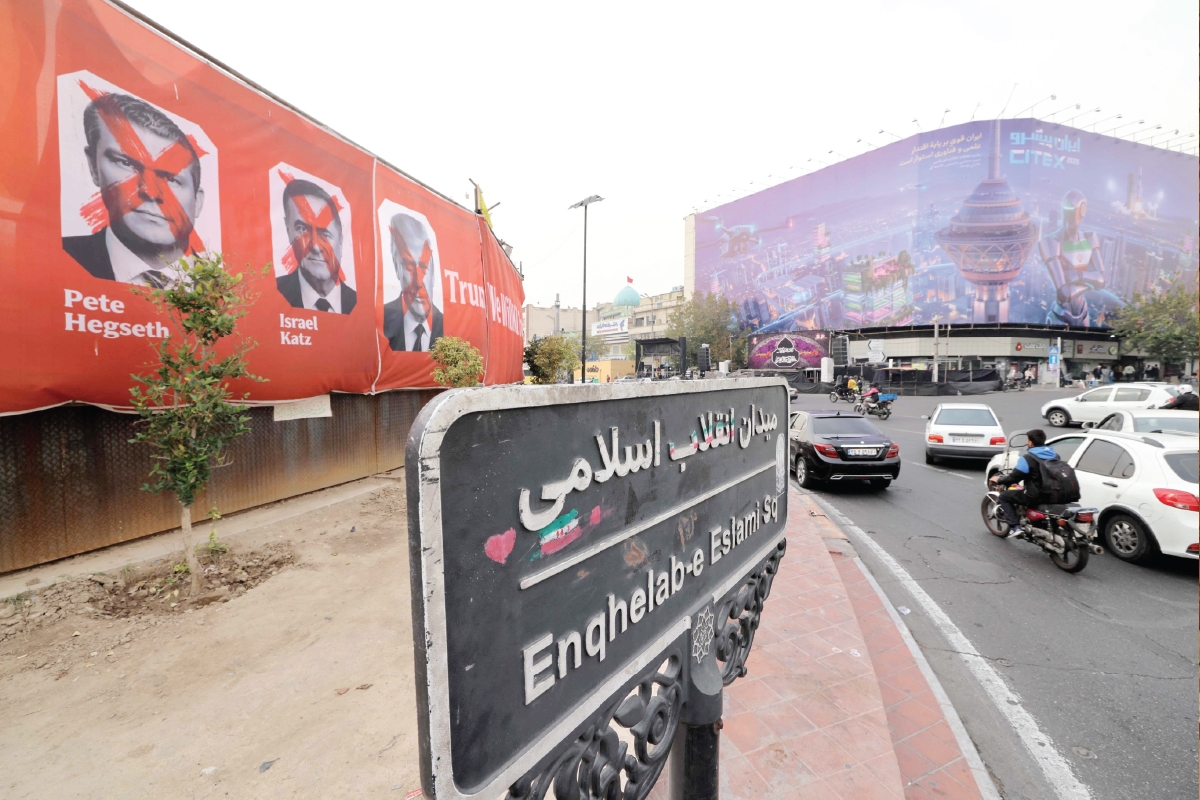
US President Donald Trump warned Iran against challenging the naval blockade and promised a military strike after the New Year, while Iranian President Masoud Pezeshkian stressed using all means to break the blockade, amid escalating tensions in the Gulf.
Translated by Alqyas from Al-Jarida — Original source
Amid heightened regional alert over the possibility of a new escalation, fueled by growing signs that diplomatic efforts to contain the crisis are failing, US President Donald Trump warned Iran against attempting to break the US naval blockade. In an interview with Fox News, he asserted that any vessel attempting to violate the restrictions imposed by US Central Command (CENTCOM) on access to or departure from Iranian ports would be shot at and end up at the bottom of the sea.
In a statement indicating a leaning toward resuming military strikes, despite leaks suggesting divisions within his administration over the move, Trump said, “We will restart the war on Iran after the New Year if no agreement is reached.”
The Republican president accused Iranian negotiators of stalling, evading, and shirking in talks, arguing that their stance had become more hostile compared to the period preceding the US midterm elections, which resulted in his party losing control of Congress to the Democrats.
On his Truth Social platform, Trump stated that Iran launched more drones and missiles last week than at any time in over a year, adding that US forces had shot them all down without causing any damage.
Coinciding with these threats, which did not include a deadline for reaching an agreement until early next year, the Israeli newspaper Yedioth Ahronoth reported that Israel continues to pressure the US administration to launch an attack against Iran, proposing an intensive military operation lasting several days aimed at weakening the regime’s capabilities and bringing it close to collapse, even if its fall is not guaranteed.
The Hebrew newspaper quoted Israeli officials as saying that Tel Aviv does not rule out the possibility of a unilateral attack on Iran, but that the preferred option for outgoing Prime Minister Benjamin Netanyahu and Chief of Staff Eyal Zamir is to carry out an attack in coordination with Washington. In contrast, Gadi Eisenkot, tasked with forming a new government, affirmed that there is no immediate and direct Iranian threat warranting a military operation during the current political transition period and before the formation of the new government.
This came as political sources noted that additional cargo planes, bearing no identifying marks, had arrived in Israel as part of a US military bridgehead aimed at bolstering regional defenses in anticipation of potential escalation.
On the other side, Iranian Foreign Ministry spokesperson Esmaeil Baqaei said yesterday that his country would use “all available means” to break the US blockade. With the Iranian regime implementing several austerity measures, including rationing bread and electricity to address supply shortages, Baqaei stated, “We will not endure the continuation of the naval blockade and economic pressures, and we will use all available means to counter US aggression.”
He added, “We have the right to utilize all available tools to defend ourselves.” He continued, “A set of political, diplomatic, and defensive measures has been put in place to overcome sanctions and the blockade.”
He pointed out that necessary executive actions would be taken according to circumstances and at the time determined by the relevant authorities.
He also noted that Tehran would not accept the presence of any foreign military or security forces near its borders with neighboring countries, claiming that Armenia had provided guarantees regarding this matter following the announcement of the start of work on the “Trump Strategic Road.”
The Iranian official blamed what he described as “the behavior of the US side” for weakening the role of mediation, emphasizing that Tehran would not forget its past experiences and knows that Washington does not honor its commitments and constantly changes its positions.
In a move contrary to calls launched by hardline factions within the Iranian regime demanding a challenge to the US Navy by sending a convoy of oil tankers to break the blockade and threatening to destroy oil facilities in the Gulf if intercepted by CENTCOM, Iranian President Masoud Pezeshkian warned that the United States and his country’s enemies are seeking to subjugate it through the imposition of restrictions and sanctions. He called for cooperation with neighboring countries to make land routes an alternative to others, aiming to reduce the restrictions and problems facing his country.
Meanwhile, maritime data revealed that reported attacks against ships in the Strait of Hormuz and surrounding areas have reached their highest levels since the outbreak of the US-Iranian conflict on February 28.
According to the data, the number of reported attacks exceeded 30 in October, marking the first time since the conflict began.
As of last Sunday, at least 22 attacks were recorded in November, the second-highest monthly total since the start of the war, according to an analysis by CNN.
Prior to October, the average number of reported attacks in the region was around 10 per month.
Experts believe that the Iranian regime has escalated its attacks on ships in the strait amid a sharp decline in its ability to sell oil and collect revenues, as well as fears of a social crisis due to shortages of essential supplies for agricultural and economic sectors.
In a related development, South Korean Defense Minister Kang Shin-chul stated that a proposal to extend the deployment of the Cheonghae Unit for anti-piracy operations in the Gulf of Aden does not mean engaging in the US-Israeli war against Iran in the Strait of Hormuz, emphasizing that the purpose of the mission is to protect ships and citizens of Seoul.
