Wall Street Journal: Why Kim escapes punishment despite nuclear development and ignoring Trump?
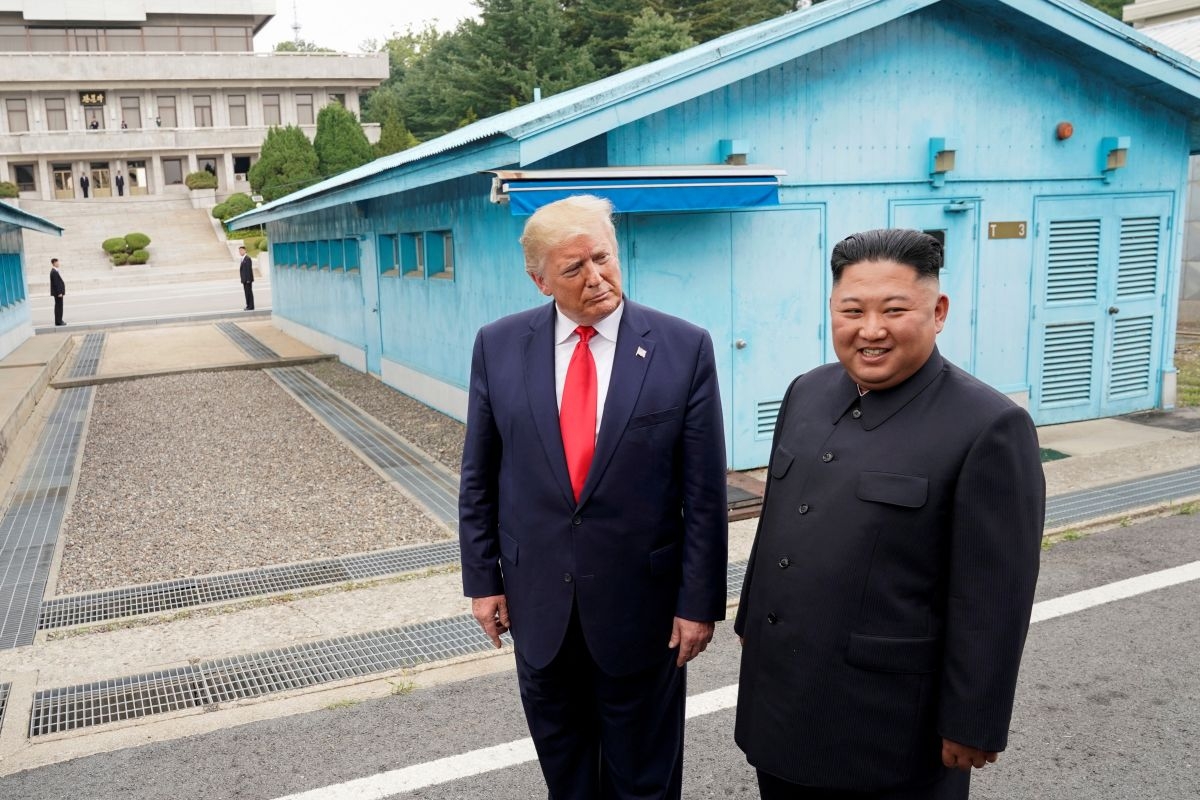
Wall Street Journal report reveals Trump's failure to persuade Kim Jong Un to abandon his nuclear program despite intensive diplomatic efforts
Translated by Alqyas from Al-Jarida — Original source
The Wall Street Journal reported that U.S. President Donald Trump attempted to contact North Korean leader Kim Jong Un last year via telephone lines and approved communication channels, but received no response.
Citing informed sources, the newspaper reported that Trump resorted to writing a letter, but the challenge lay in delivering it to Kim. White House officials devised a plan to wait for a group of people outside the office of North Korea’s Permanent Mission to the United Nations in Manhattan. When a North Korean diplomat passed by, the group approached him and placed the letter in his hand, but sources said the diplomat dropped the letter—still sealed—in front of a U.S. representative.
During Trump’s first term, the two leaders met three times, with nuclear disarmament serving as the focal point of their talks. It now appears that the North Korean leader has no interest in relinquishing his nuclear arsenal or forging a friendship with the leader of what is supposed to be the “free world,” according to the Wall Street Journal.
The newspaper quoted sources stating that the Trump administration lacks a detailed political strategy regarding North Korea during his current term, unlike during his first term.
The newspaper noted that Trump left the position of Special Envoy for North Korea policy vacant, and the National Security Strategy issued by the White House last year made no mention of North Korea, marking the first such omission since the end of the Cold War.
It pointed out that although the U.S. Department of Defense’s National Defense Strategy, issued in January, stated that North Korea poses a “clear and present danger of a nuclear attack on U.S. territory,” it did not include any mention of North Korean denuclearization.
The Wall Street Journal said that during the U.S. president’s trip to Asia this week, Trump’s renewed efforts to arrange a meeting with Kim were thwarted by obstacles that prevented it.
It added that the Trump administration explored the possibility of direct talks at the last minute, but North Korean leader Kim Jong Un set conditions that the United States could not accept, according to people familiar with the talks.
In a speech last February, Kim said the United States could achieve peaceful coexistence if it accepted his country’s nuclear program.
Trump, now in a weaker position after the Republican Party’s defeat in the midterm elections, is looking to achieve an accomplishment that will cement his legacy on the international stage. Therefore, Trump urged his aides to arrange a meeting with Kim ahead of his Asian tour last week, according to the newspaper.
An informed source told the Wall Street Journal that U.S. officials discussed proposals to pave the way for a meeting between Trump and Kim, including formally ending the Korean War, which effectively ended with an armistice more than seven decades ago.
It revealed that officials discussed issuing a statement that would not officially recognize North Korea as a nuclear state, but would at the same time not demand the dismantling of its nuclear program. In return, the United States would seek to impose restrictions on nuclear and missile tests, and Washington might also seek to open liaison offices, as a preliminary step toward establishing more formal diplomatic relations.
The Wall Street Journal quoted experts as saying that recognizing North Korea as a nuclear-armed state would constitute a radical shift in U.S. policy, and that entering into talks with Kim Jong Un without pressing for denuclearization would represent a significant departure from Washington’s long-standing approach, potentially raising concerns among its allies in South Korea, Japan, and Europe.
The newspaper noted that Trump’s attempts to arrange a meeting with the North Korean leader, met with silence from Pyongyang, come against the backdrop of a long-standing U.S. failure to persuade North Korea to abandon its nuclear arsenal. Over decades, Washington has tried various approaches, including negotiations, offering incentives, imposing sanctions, and political isolation.
The Journal emphasized that the United States must now confront the possibility that North Korea’s nuclear status is irreversible, pointing out that last year’s annual U.S. intelligence threat assessment acknowledged that “Kim does not intend to negotiate away his strategic weapons programs.”
According to the newspaper, since the last meeting between Kim and Trump in 2019, North Korea’s nuclear arsenal has expanded, with the number of nuclear warheads now estimated at around 60. Solid-fueled intercontinental ballistic missiles have also become capable of reaching U.S. territory.
It added that Pyongyang has bolstered its defenses against U.S. pressure by strengthening its alliance with Moscow, noting that Kim found his lifeline in Russia’s war on Ukraine in 2022, announcing his support for Russian President Vladimir Putin and signing a mutual defense agreement that commits both sides to provide mutual assistance if either is attacked.
The report pointed out that Kim’s regime has also been reinforced by a clear shift in China’s policy, which had long opposed North Korea’s pursuit of nuclear weapons.
However, in recent times, Beijing has ceased issuing such calls, instead advocating what it describes as a “fair and neutral” approach to achieving peace on the Korean Peninsula, suggesting that it will not object to the de facto nuclear status quo in North Korea.
