Kawar and Wafiq present a contemporary reading of Suad Al-Sabah's poetic worlds
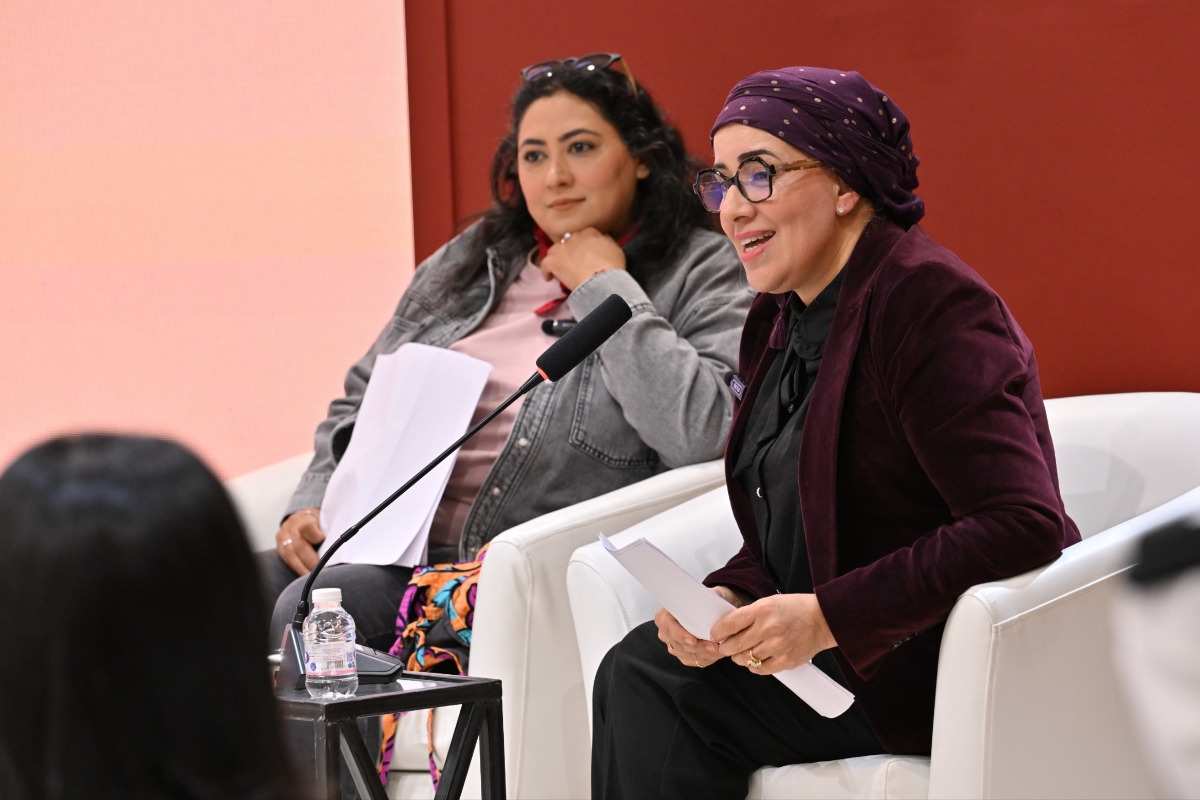
A dialogue seminar was held at the Kuwait Book Fair in collaboration with the French Institute, presented by Kawar and Wafiq, attended by cultural and political figures.
Translated by Alqyas from Al-Jarida — Original source
As part of the cultural events accompanying the 49th edition of the Kuwait International Book Fair, and in collaboration with the French Institute, a dialogue seminar titled “Exploring Dr. Suad Al-Sabah’s Works: A Contemporary Reading” was held at the VIP Lounge (Hall 6) in the Mishref area. The session was presented by Dr. Asma Kwar and poet Mouna Wafiq.
The seminar was attended by Aisha Al-Mahmoud, Assistant Secretary-General for Cultural Affairs at the National Council for Culture, Arts and Letters; Soraya Sa’i, Cultural Cooperation and Action Advisor and Director of the French Institute in Kuwait; and Sheikha Shaima Abdullah Al-Mubarak Al-Sabah, representing her mother, Dr. Sheikha Suad Al-Sabah. Also present were several members of the ruling family, including Sheikha Al-Anoud Ibrahim Al-Duwaikh Al-Sabah, Sheikhas Suad and Nour Mohammed Abdullah Al-Mubarak, Sheikha Suad Ahmed Al-Duwaikh, Sheikh Ahmed Mubarak Abdullah Al-Mubarak, and Sheikh Hamoud Mohammed Abdullah Al-Mubarak.
Opening the event, Soraya Sa’i expressed the French Institute’s pride in hosting this event, which celebrates Sheikha Dr. Suad Al-Sabah, her literary career, and her poetic contributions. She noted that the dialogue seminar offers an occasion to honor one of Kuwait’s prominent literary figures and a poet who has left a significant mark on the cultural landscape.
Sa’i emphasized that the event provides an opportunity to rediscover Dr. Suad Al-Sabah’s works through a contemporary lens, affirming that her poetry remains relevant and continues to inspire poets worldwide. She described her as an inspiring figure on both human and creative levels.
Dr. Kwar presented a research paper titled “The Multiple Identities in Suad Al-Sabah’s Texts.” She began by expressing her pride in participating in the evening, stating, “It is an honor to be among you this evening to speak about a woman who gave much to Arabic culture and to humanity, whose contributions transcended the boundaries of the Arab world. She is an icon of Arab pride.”
In her paper, Dr. Kwar explored the multifaceted nature of Dr. Suad Al-Sabah’s persona, noting, “We cannot reduce Sheikha Suad Al-Sabah’s identity to a single definition; whenever we thought we had grasped her identity, a poem, a prose text, or a historical document revealed another facet of her, or a new relationship in which different analogies operate.”
She added, “We did not wish to present Suad Al-Sabah in a single, final image: not merely as a poetess, nor solely as a feminist, a nationalist, or a lover. We sought to read how she constructs herself through her texts, and how she moves from an inherited identity to a chosen one. If we were to condense this movement into a phrase, we might say that her creative identity is (sovereignty seized through the word). She is Kuwaiti without insularity, Arab without turning away from criticism, modern without severing ties with memory, and a lover without compromising her independence. Once again, she is a woman (without shores); not because she lacks land, but because she refuses to let land become walls.”
For her part, poet Mouna Wafiq presented a paper titled “Rediscovering Suad Al-Sabah,” stating, “Suad Al-Sabah is not a name foreign to my memory; she has resonated in my soul since my middle school years. Among the memories I retained from those years is the poem ‘Be My Friend,’ sung by Majida Al-Roumi. I encountered the poem at an early stage in my relationship with poetry, before my own questions about poetry and language had taken shape. I received it with the emotion and wonder that age allowed: her voice reached me before I began to think about the poem or the way it was crafted.”
On the sidelines of the seminar, Ali Al-Masoudi, Director of the Suad Al-Sabah House for Culture and Creativity, stated that the event highlighted the international presence of poetry, using Dr. Suad Al-Sabah as a model of an Arab poet who expanded the creative horizon across the Arab region and beyond, particularly through her translated poetry, which is studied at universities worldwide in the United States, Europe, and the Far East, including China, India, and other countries. He added that the event was attended by a select group of academics who examined various aspects of this unique poetic experience.
In conclusion, Al-Masoudi expressed his gratitude and appreciation to the National Council for Culture, Arts and Letters for its cooperation and support of creative and cultural initiatives and proposals, and for its openness to diverse ideas, whether through the Suad Al-Sabah House or in collaboration with other publishing houses. He praised the Council’s distinguished cultural activities within the framework of the Book Fair, as well as the high-quality programs and enriching seminars it offers, which contribute to enriching cultural discourse and strengthening communication among writers, intellectuals, and academics, reflecting the vital role the Council plays in supporting culture and creativity.
