Shenzhen meeting... an opportunity for the Eastern Bloc to contain the sick West
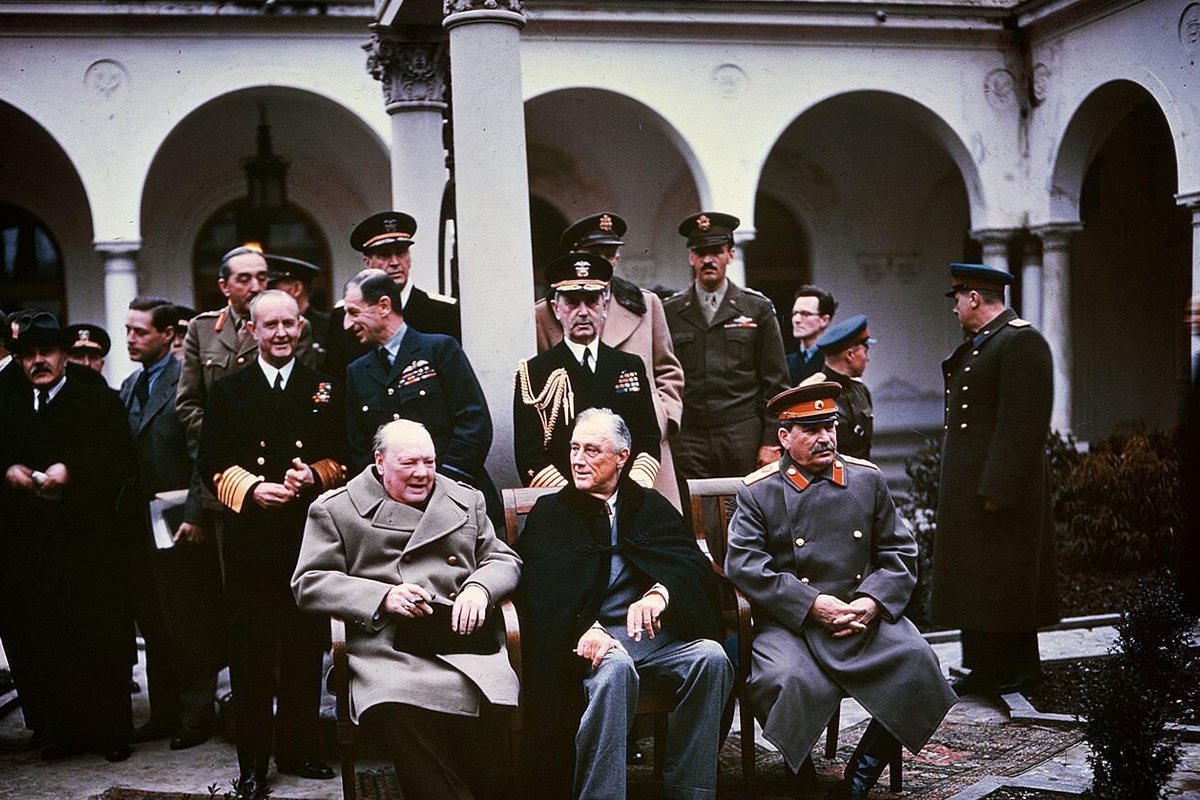
A comparison between the Shenzhen meeting and Yalta in reshaping the international system
Translated by Alqyas from Al-Jarida — Original source
The image capturing the leaders of China, Russia, and the United States in the Chinese city of Shenzhen last Thursday brought to mind one of the most controversial moments in modern history: the 1945 Yalta Conference.
At the sidelines of the Asia-Pacific Economic Cooperation (APEC) Economic Leaders’ Meeting in Shenzhen, Xi Jinping, Vladimir Putin, and Donald Trump discussed nuclear arms reduction and the wars in Ukraine and Iran, resulting in understandings that went beyond the historical image uniting them under the banner of a “peace declaration.”
The historical image evoked from 1945, just months before the end of World War II, was taken in Yalta, Crimea. It featured U.S. President Franklin D. Roosevelt, British Prime Minister Winston Churchill, and Soviet leader Joseph Stalin, who met to discuss post-war arrangements, the future of Germany, occupation zones, the establishment of the United Nations, and the Soviet role in the war against Japan.
Since history repeats itself, and because the Yalta meeting was not merely a diplomatic encounter among three “poles” but a pivotal moment that shaped the international order following the war, it was natural to view the Shenzhen gathering not just as a “peace declaration” signed by three “poles,” but as a historical juncture that will be closely watched. Perhaps what follows will not mirror what preceded it, just as was the case at Yalta.
During the war against Japan, Stalin pledged to enter the conflict against Japan following Germany’s defeat, in exchange for territorial gains in Asia.
However, what actually occurred was the emergence of the Cold War’s contours through the Marshall Plan, which aimed to contain Soviet influence in Europe. This eventually paved the way for the Soviet Union’s dissolution amid escalating ideological and political rifts between Beijing and Moscow, culminating in what was termed “Perestroika”—Mikhail Gorbachev’s reforms that led to the breakup of the Soviet Union into 15 independent states and a reshaping of global power balances.
Today, 35 years after the collapse of the Eastern Bloc and in a period hotter than the Cold War era, the Eastern Bloc—represented by China and Russia—has the opportunity to reshape global power balances once again.
At Yalta, Western powers, represented by the United States and Britain, stood alone against the Soviet Union. In contrast, at Shenzhen, the Eastern Bloc, represented by China and Russia, met with the United States apart from its European allies, amid widespread fractures in transatlantic relations.
As former U.S. Secretary of State and National Security Advisor Henry Kissinger said, “There is nothing new in international politics, only new analyses.” Each of the assembled powers still pursues its own agenda centered on interests and influence. However, today’s battle differs from yesterday’s, and the agendas of Yalta differ from those of Shenzhen. Global power balances are no longer measured solely by a country’s political or military influence; rather, economics, energy, technology, and trade have become key tools in shaping the new international order.
In this scene, leaders representing 23% of the world’s total population gathered, their combined economic power amounting to $57 trillion, while controlling 25% of global trade flows. This highlights the shifting dynamics of decision-making centers, with China emerging as an indispensable player in international economic and political affairs. Beijing can, or should, leverage this position as a central pillar of the Eastern bloc to isolate Trump and contain the influence of his state. This is not an endorsement of that bloc, but rather an opportunity for the world to end the absolute hegemony of a single power over global affairs and to fragment its influence between two roughly equal powers, especially at a time when the US administration appears as a sick man in his weakest phase, lacking reliable allies.
On the first pages of the agendas of the three leaders, Trump sought a new nuclear arms control agreement, containment of threats related to Iran, protection of US supremacy in artificial intelligence and semiconductors, and extraction of trade concessions from China.
Putin, meanwhile, sought understandings regarding the war with Ukraine, easing of US economic sanctions, and preservation of Russia’s influence in energy markets.
Xi Jinping, on the other hand, aimed to maintain the trade truce, ease restrictions on technology and chips, reach understandings regarding Taiwan, and ensure that the scale of nuclear arsenals is accounted for in any agreement.
Regarding Trump’s agenda, the man captured by cameras with his eyes closed, appearing to be dozing off, seemed still asleep from his dream of supremacy across many files, particularly technology. This comes after a series of technical failures recently disrupted US aviation, banking, and national security systems in recent days. When Trump heard about these incidents in Manila, he remarked: “It’s like when you’re great and powerful, and you have all the money. Things like this happen. Everything is fine.”
Conversely, the Eastern bloc appears more likely to impose its agendas than the Western leader, who appeared asleep, detached from reality and from his allies. For Beijing’s agenda, it suffices to read within its margins the reference to the “Nvidia” scandal. For Moscow, the complex equation that forced Washington to reach an agreement with it to supply additional diesel to global markets before the midterm congressional elections, which Trump’s camp lost, appeared in the margins of its agenda.
Two sectors, economically the most critical, have clearly seen the Eastern bloc’s superiority. These developments coincided with the fastest decline in foreign holdings of US Treasury bonds since March last year, dropping to $9.241 trillion by the end of September from $9.317 trillion in August, a decrease of $75.5 billion. This signals a loss of global confidence in US debt at a time when financial security is no longer considered separate from political influence.
Thus, this scene does not raise the questions that circulated after the publication of the Shenzhen photo: Has the world faced a genuine redistribution of power centers, as occurred after the Yalta Conference? Or is what we are witnessing a new phase of competition among major powers to control the tools of the global economy? This aligns with the interests of the three parties, placing them before their destinies and providing the Eastern bloc with an opportunity to exploit its economic superiority in these areas to rewrite history... but this time, based on what was outlined in the agendas placed on the Shenzhen table.
