China and Arabs: Expanding Partnership and Divergent Arab Priorities
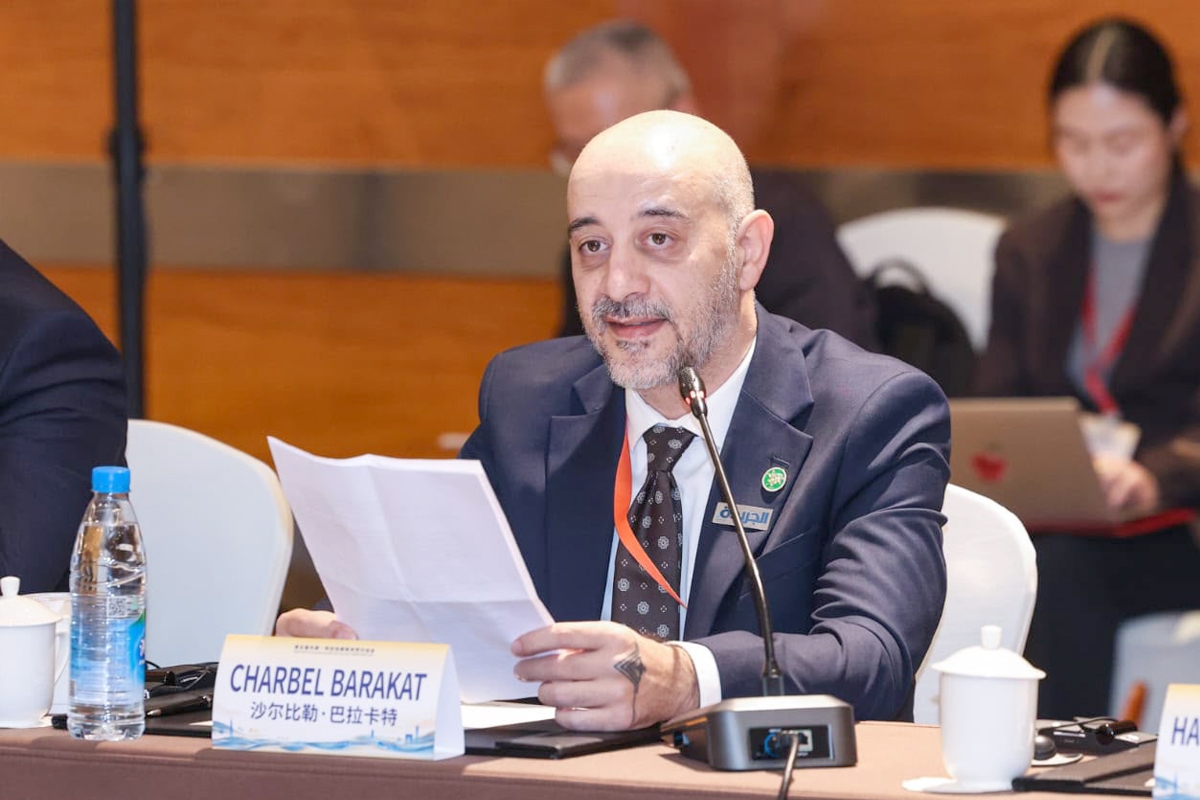
Suzhou hosted the fifth edition of the dialogue conference between the Chinese Communist Party and Arab parties with broad participation, focusing on economic and political cooperation and Arab divergences.
Translated by Alqyas from Al-Jarida — Original source
As part of Beijing’s efforts to strengthen its political and economic ties with the Arab world, the city of Suzhou, located in Jiangsu Province in eastern China, hosted the fifth edition of the Conference on Dialogue between the Communist Party of China and Arab Parties during the second week of November. For the first time, the conference saw the participation of representatives from all 22 Arab states.
The event was organized by the International Department of the CPC Central Committee and the Jiangsu Provincial Party Committee, with around 400 attendees, including officials, representatives from legislative and government bodies, party leaders, businessmen, think tank experts, and media representatives.
Also for the first time, a China-Arab Business Forum on the Belt and Road was held on the sidelines of the conference, with more than 200 Chinese and Arab companies participating.
Abdulrazzaq Al-Buainain, head of the Kuwait Investment Office in Shanghai under the Public Authority for Investment, was among the participants, while Al-Jarida was one of the few Arab media outlets invited to the conference.
The organizers selected Suzhou, situated in eastern China at the Yangtze River Delta, to host the fifth edition of the conference due to its deep symbolic significance in the historical trajectory of Arab-Chinese relations.
For centuries, Suzhou has been associated with the production of fine silk, and historians point to an active exchange of culture and expertise between Arab and Chinese artisans, clearly reflected in the arts of embroidery of letters and patterns on textiles.
The region also shares a maritime and commercial heritage. From a location near Suzhou, the Chinese Muslim admiral Zheng He set sail on his famous historic voyages that reached ports in the Arabian Gulf and the Red Sea. Meanwhile, the Arab traveler Sulayman al-Tajir, who visited China in the 9th century, documented his great admiration for the abundance and exceptional softness of silk in Chinese cities south of the river.
Today, through the gateway of “silk diplomacy” that united the two peoples centuries ago, Suzhou looks forward to reviving those historical ties and building a new bridge of cooperation and partnership with the Arab world.
The choice of Suzhou was not only due to its historical significance, but also its pivotal economic status today; it is a leading industrial and technological hub in China, home to major heavy industry and advanced technology companies, and enjoys a strategic location in Jiangsu Province near China’s most important export gateways.
The opening session of the conference featured Chinese participants including Liu Haisheng, Minister of the International Department of the CPC Central Committee, his deputy Jin Shen, and Xin Changcheng, Secretary of the CPC Jiangsu Provincial Committee and Secretary of the CPC Suzhou Municipal Committee, Fan Bu.
In his opening address, Liu Haisheng stated that international and regional transformations necessitate strengthening strategic communication between the Communist Party of China and Arab parties, emphasizing Beijing’s readiness to continue mutual support on issues related to the core interests of both sides.
He called for expanding the exchange of expertise in governance and state administration, activating party-to-party cooperation mechanisms, and leveraging the potential of local governments, think tanks, media, and youth to enhance China-Arab relations.
Remarks by other Chinese officials underscored the importance of expanding cooperation with Arab countries, describing the relations between the two sides as entering a golden age.
Kuwaiti officials also highlighted investment opportunities and economic cooperation in Suzhou, one of China’s largest economic hubs, which ranks highly among Chinese cities in terms of GDP, with an economy roughly comparable to that of Denmark and more than double that of Kuwait.
In response, speeches by Arab delegations called for expanding partnerships with China and leveraging its experience in economics, development, governance, and administration, while urging a greater Chinese role in the region.
The speeches also praised Beijing’s stance on Arab issues, particularly the Palestinian cause, and its calls to halt aggression against Gulf states and avoid imposing restrictions on international shipping lanes.
However, this consensus on the importance of strengthening ties with China did not obscure the significant political divergences and complexities within the Arab world. In Yemen, where the war continues and the internationally recognized government remains unable to exert authority over the entire country, there were calls for a more effective Chinese role in ending the conflict and curbing external interventions, particularly Iranian ones.
Palestinian interventions featured criticisms of certain political forces and their policies, which, according to those holding these views, have contributed to weakening the Palestinian position in the face of Israel. Meanwhile, remarks by representatives of the Iraqi delegation praised Iran, contrasting with criticisms directed at it, while other interventions included critiques of the policies and stances of various Arab states.
These interventions revealed the difficulty of formulating a cohesive, unified Arab position on regional issues, even within the context of dialogue with China. This may well be one of the most prominent weaknesses of Arab participation, especially when compared to the greater opportunities for understanding and enhanced cooperation that bilateral relations between Beijing and each Arab state can offer, tailored to more specific priorities and interests.
The conference proceedings revolved around the theme “Building a Chinese-Arab Community with a Shared Future Amid Unprecedented Changes in a Century: The Responsibility and Mission of Political Parties,” and were divided into four main axes covering the exchange of expertise in governance, party building, and state administration; leveraging party-to-party relations to enhance economic cooperation under the Belt and Road Initiative; activating the Global Civilization Initiative and people-to-people exchanges; and strategic coordination on regional and international issues and geopolitical shifts.
Al-Jarida delivered a speech at the sub-session dedicated to the Global Civilization Initiative and people-to-people exchanges, emphasizing the importance of strengthening scientific, academic, and cultural cooperation as a cornerstone for fostering closeness among peoples.
It noted that a significant number of Chinese diplomats who speak Arabic received part of their education or training in Kuwait through scientific and academic exchange programs. It also highlighted the development of cultural relations between Kuwait and China, particularly since the opening of the Chinese Cultural Center in Kuwait in 2025.
Prominent Chinese researchers and specialists on Arab affairs participated in the sub-sessions, including Wang Lizong, vice president of the Institute of West Asian and African Studies at the Chinese Academy of Social Sciences; Sun Degang, professor of political science and director of the Middle East Studies Center at Fudan University; and Ma Xiaolin, one of China’s leading commentators and lecturers on Middle Eastern affairs, who has accumulated journalistic experience in several Arab countries, including Kuwait.
On the sidelines of the conference, the China-Arab Business Forum on the “Belt and Road” was held, aiming to connect business representatives and investors from both sides and to showcase joint investment opportunities between Jiangsu Province and Arab countries.
According to 2025 data, trade volume between China and Arab countries reached approximately $422 billion. Arab countries have signed agreements and memoranda of understanding for cooperation with China under the “Belt and Road” initiative, while the number of projects implemented under joint cooperation has exceeded 200, benefiting around two billion people on both sides.
According to the Foreign Affairs Office of the Jiangsu Provincial Government, green energy and digital technologies stand out as new drivers of cooperation with Arab countries.
In this context, autonomous driving technologies developed by companies in the province are beginning to reach some Gulf and Arab markets, which are looking to develop intelligent transport systems and enhance logistics efficiency, particularly in airports and ports.
Saudi participation in the forum reflected the interest of Gulf companies in expanding their presence in the Chinese market, especially in sectors related to energy and infrastructure.
In this regard, Saleh Al-Khateeb, Executive Vice President of ACWA Power and Chairman of ACWA Power China, praised the launch of a direct shipping route between Taicang Port in Suzhou and the city of Jeddah, revealing his company’s strategy to invest around $30 billion in China by 2030.
During the forum, the “China-Arab Industrial and Commercial Dialogue Partners Program” was launched, aiming to enhance direct communication and develop partnerships in trade, investment, green technology, and digital technology.
As the delegation moved to the capital Beijing, Al-Jarida participated in a meeting between the heads of Arab delegations and Li Hongzhong, Vice Chairman of the Standing Committee of the National People’s Congress, at the Great Hall of the People, the Congress’s headquarters.
Li noted that China-Arab relations have entered their best historical phase since President Xi Jinping took power in 2012, emphasizing Beijing’s readiness to enhance party-to-party and legislative exchanges with Arab countries and to advance the building of a China-Arab community with a shared future.
Li recalled the historical depth of civilizational ties between China and Arabs, citing Chinese familiarity with the book “One Thousand and One Nights” and the well-known saying “Seek knowledge even if it is in China.” He stated that the success of civilizations in communicating in the past despite vast distances necessitates elevating communication and cooperation in our era, with distances shrinking due to technological development.
Alongside the meeting with Mr. Li, delegation members in Beijing attended lectures, one of which covered the Chinese model of modernization by Hu Guanchi, a Chinese academic and assistant researcher at the Industrial Economics Center of the Chinese Academy of Macroeconomic Research.
The delegation also reviewed political situations with Wang Tixiuan, Director of West Asia at the Foreign Affairs Department of the Central Committee of the Communist Party of China.
In conclusion, the conference reflected a clear Chinese desire to expand partnership with the Arab world politically, economically, and culturally, and to present Beijing’s experience in development and modernization as a field for cooperation and knowledge exchange.
However, capitalizing on these opportunities faces the reality of an Arab region burdened by crises, including the repercussions of the war with Iran, the stalemate of the Palestinian issue, conflicts in Sudan and Yemen, and fragile situations in Syria, Iraq, and Lebanon.
As China advances in the region with a clear vision and specific objectives, Arabs still lack a collective framework to define their priorities in engaging with China’s rise and how to leverage it to serve their interests.
The Chinese city of Suzhou is known as the “Venice of the East” due to its ancient waterways, which historically predate those of the European city of Venice, prompting observers to wonder: Shouldn’t Venice rather be called the “Suzhou of the West”?
Alongside its historical authenticity, Suzhou has emerged today as a global technological powerhouse. The Suzhou Industrial Park hosts thousands of companies in fields such as semiconductors and nanotechnology, while the city plays a leading role in the artificial intelligence and robotics revolutions through numerous specialized firms.
Its infrastructure is managed using the latest “digital twin” and cloud computing systems, making it a primary destination for some of the world’s largest research and development centers, particularly in autonomous driving. Thus, it embodies a unique model that blends the charm of the past with leadership in the future.
The conference included a field tour of several of Suzhou’s most prominent factories and investment companies, which later extended to Beijing. This allowed Arab delegations to closely observe various aspects of China’s industrial and technological development, ranging from heavy industries and automation to telecommunications and artificial intelligence.
The tour included a visit to “Zhonghe,” a company specializing in automated forklifts and handling and storage equipment, whose products are used in major ports, airports, and warehouses.
The delegation also visited “Daming,” a metal processing and manufacturing company that produces heavy components for ship hulls, port equipment, and liquefied natural gas carriers, as well as “Dejing,” a specialist in high-quality steel pipes that relies on smart production lines and advanced welding technologies.
In the maritime transport sector, the delegation observed the activities of “New Times Shipbuilding,” one of China’s largest shipbuilding companies, which manufactures tankers and cargo ships for global companies, including Maersk and MSC.
The tour also included the Higer bus factory, which produces various models powered by traditional fuels and electricity, equipped with driver assistance systems and digital technologies. Additionally, the delegation visited the Freelander car factory, a new brand being developed by Chinese automaker Chery in collaboration with Jaguar Land Rover, where they examined the Freelander 8, scheduled for launch soon in Gulf markets.
On the investment front, the delegation visited the Sandlic investment fund complex and observed the activities of Oryza Holding, the investment arm of the Suzhou government. Oryza manages investments in advanced technology, semiconductors, biomedicine, and emerging industries, operating through a wide network of investment funds to support promising companies and expand their operations.
In Beijing, a visit to ZTE, a telecommunications and information technology company, was among the most notable stops on the tour. The company is working on developing telecommunications network infrastructure and participating in research related to the transition from advanced fifth-generation (5G) to sixth-generation (6G) networks, alongside developing AI-based solutions to improve network efficiency and expand applications. It has previously collaborated with the UAE’s Etisalat (“du”) on advanced trials on frequency bands that pave the way for future telecommunications networks.
The delegation concluded its tour with a visit to LLVision, a company specializing in augmented reality glasses and AI applications, including real-time translation and text display glasses, as well as remote inspection and diagnostic solutions.
This tour reveals the diversity of the industrial and technological base that can create important opportunities for cooperation with Gulf countries, moving beyond merely importing finished products.
In the sectors of ports, maritime transport, and logistics, the expertise of Chinese companies can be leveraged to develop equipment and automation, thereby enhancing operational efficiency. Meanwhile, the shipbuilding, metals, and pipes industries offer opportunities for joint manufacturing and the localization of certain energy- and infrastructure-related industries.
As for Suzhou’s investment experience, it provides a model that can be utilized to build partnerships between Gulf sovereign wealth funds and their Chinese counterparts, to finance startups and advanced technologies, and to link Gulf capital with industrial and technological opportunities in China.
