Shenzhen Summit: Increased oil production and protecting its supplies is a global interest
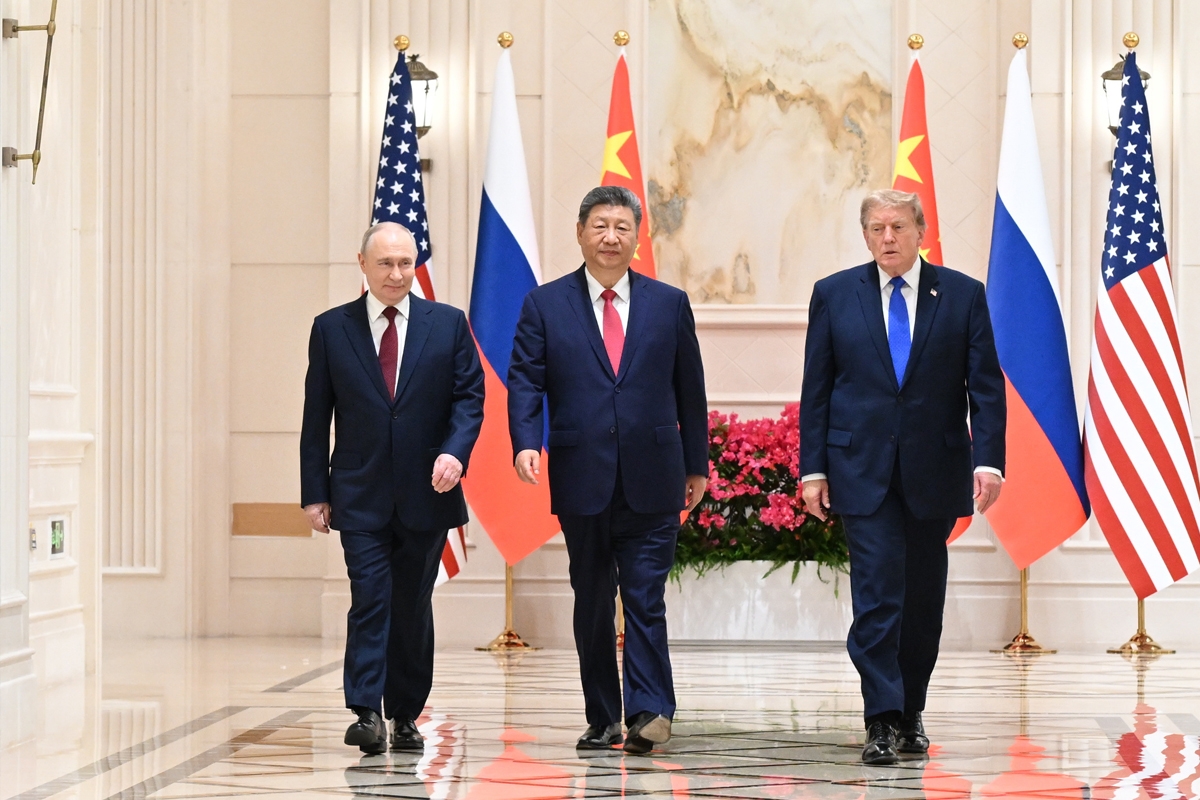
The presidents of China, the United States, and Russia launched a package of political and economic understandings under the name of the Peace Declaration, in which they pledged to increase oil production and protect supply chains and support United Nations reform.
Translated by Alqyas from Al-Jarida — Original source
In the first summit of its kind in decades, Chinese President Xi Jinping, U.S. President Donald Trump, and Russian President Vladimir Putin launched yesterday a package of political, security, and economic understandings under the name “Peace Declaration,” pledging to increase the production and supply of refined petroleum products, protect supply chains while maintaining strategic stability and international security, reduce the risk of nuclear war, support United Nations reform, and respect the sovereignty of states and the immunity of their officials from the International Criminal Court.
The three leaders issued their joint declaration following a meeting lasting about one hour and twenty minutes in the Chinese city of Shenzhen, on the sidelines of the Asia-Pacific Economic Cooperation (APEC) summit. They affirmed that they had held in-depth exchanges of views on the current international situation and renewed their commitment to maintaining strategic stability and international security.
Among the most prominent provisions of the Peace Declaration, the leaders of the three major powers agreed to increase the production and supply of refined petroleum products, benefiting countries worldwide, and emphasized the importance of maintaining stable energy flows.
The alignment of the three leaders on energy security and increased oil production comes at a highly sensitive time, amid disruptions in global markets and declining supplies due to the war in the Middle East and Iran’s illegal closure of the Strait of Hormuz to international navigation, which has had repercussions on oil supplies, prices, the global economy, and pressures on economies, markets, and refineries.
The trilateral declaration affirmed that a nuclear war cannot be won and must never be fought, and they pledged to enter into dialogue on reducing nuclear risks and preventing the proliferation of nuclear weapons. This step gains particular importance given that the three countries possess the world’s largest nuclear arsenals and growing concerns over the absence of strategic controls following the expiration of the U.S.-Russian New START treaty on nuclear arms reduction last February.
The three leaders also committed to advancing United Nations reform, enabling the organization to address global challenges more effectively and fulfill its core mission of maintaining international peace and security.
They acknowledged the paramount importance of the principle of state consent and respect for the immunity enjoyed by officials, and agreed that the International Criminal Court and similar institutions should not abuse their judicial jurisdictions.
They further stressed that the three countries must be partners, not adversaries, and bear responsibility for protecting the post-World War II international order and avoiding great-power confrontation.
For his part, Trump emphasized the importance of continuing oil flows through the Strait of Hormuz, noting that the Chinese and Russian presidents strongly feel the necessity of maintaining oil flows through the strait, whose navigation has been disrupted by the war with Iran. He also stressed the need to prevent Iran from acquiring nuclear weapons.
Trump described the meeting as historic, stating that the United States, Russia, and China, as the three largest nuclear powers by a wide margin compared to other countries, hold a unique position that allows them to explore ways to reduce nuclear weapons and minimize the risks of their use.
He acknowledged that abandoning such weapons is extremely difficult, pointing out that the United States possesses approximately 4,000 nuclear warheads, Russia around 3,800, and China between 400 and 500.
On the Taiwan issue, Trump informed that the United States does not support Taiwan’s independence, after the Chinese president urged Washington to take the correct stance to avoid causing significant disruptions in bilateral relations.
Putin considered that the three countries share responsibility for maintaining international peace and security, as they are victorious powers of World War II and founding members of the United Nations, noting the alignment of their interests in resolving regional conflicts, including the war in Ukraine, and combating international terrorism.
Regarding Ukraine, Putin said that Kyiv and European countries are not prepared to make concessions to end the conflict, affirming his readiness to discuss settlement terms with his partners within the framework of the ongoing process, and considering Russia’s demands for European security to be legitimate.
He expressed confidence that Trump is sincerely committed to resolving the Ukrainian conflict and improving relations, noting that reaching an agreement, even if not fully implemented, is better than failing to reach one.
