'Media': Government Press Office development project triples productivity by 300%
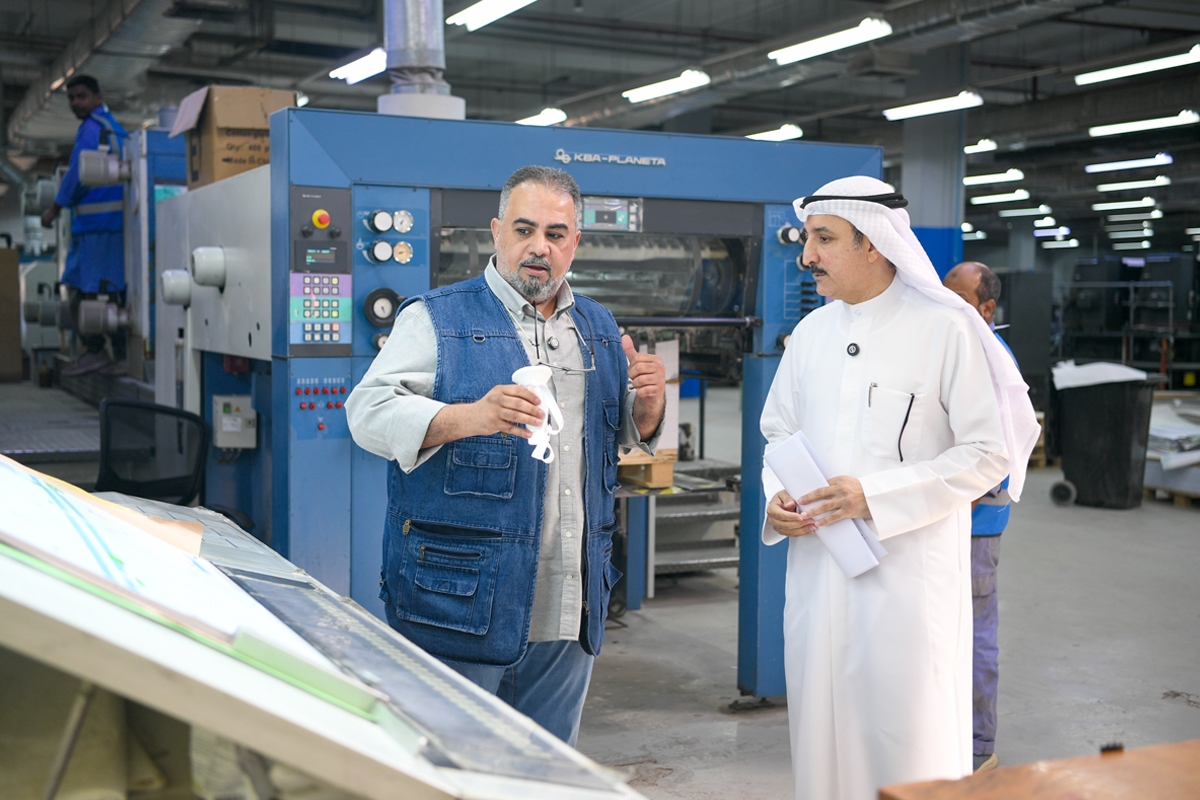
Ambitious project to develop the Government Press Office aims to triple production capacity and update equipment
Translated by Alqyas from Al-Jarida — Original source
As part of efforts to modernize infrastructure and enhance service efficiency, and in line with the state’s plans for digital transformation, increased productivity, and revenue maximization, the relevant authorities at the Ministry of Information are working on an ambitious project to upgrade the Government Printing Press. The project aims to triple (300 percent) its production capacity.
This qualitative leap comes to keep pace with the continuous expansion of the state’s official needs, and to enhance the speed and accuracy of producing government publications across all categories. It builds on a rich heritage and advanced facilities that form the backbone of administrative and documentary work in Kuwait. The Government Printing Press specializes in meeting the printing needs of all ministries, agencies, and government bodies, ranging from official publications and correspondence documents to school textbooks.
During a special tour by Al-Jarida inside the Government Printing Press to highlight the scale of operations, the General Technical Supervisor of the Press, Ali Al-Ali, confirmed that the range of publications exceeds hundreds of different types. He noted that school textbooks top the Press’s priorities, followed by official correspondence documents and various envelopes, including ready-made and custom-made ones. He also mentioned official correspondence papers used by government entities, as well as informational brochures for various bodies such as the Ministry of Health, the Public Authority for Agriculture, and other organizations that need to raise public awareness on certain issues. He emphasized that the Press can complete printing jobs for different government entities with speed, accuracy, and high quality.
Al-Ali explained that the Government Printing Press records substantial figures throughout the year, with an estimated annual production volume of approximately 100 million sheets. These are distributed among books, magazines, and the Official Gazette, as well as administrative publications, correspondence, and other tasks completed for various government entities.
He pointed out that the Press is solely responsible for printing “Kuwait Al-Yawm,” Kuwait’s official weekly newspaper. It also produces emergency supplements issued to publish decrees urgently. The weekly print run of the Official Gazette ranges between 1,100 and 1,300 copies, depending on the volume of official and public subscription orders.
He noted that the Press relies on a complete fleet of modern and traditional equipment and machines that operate in perfect harmony. Among the most prominent are printing presses, including five single-sided four-color presses with a speed of up to 7,000 sheets per hour, and an advanced eight-color press that prints both sides simultaneously. Additionally, there are two Heidelberg Speedmaster four-color presses, “Qaleb” (single-color/black-only) presses that print both sides simultaneously, and Computer-to-Plate (CTP) machines specialized in printing plates.
Regarding the “Media” project to develop the Press, Al-Ali confirmed that the Ministry has made significant progress in this area. Three tenders for the Press’s development have been completed. The first tender covers the supply, installation, and operation of a set of modern machines. Another tender is for supplying essential raw materials such as paper, inks, and printing supplies. A third tender covers operation, maintenance, and follow-up services.
He stated that “the new machines will be among the most advanced globally, as the printing press’s production capacity will increase by approximately 300 percent thanks to the speed and precision of these machines. Some of them can print around 21,000 sheets per hour, whereas the currently operating machines handle about 9,000 sheets. This gives us the ability to significantly boost production capacity to meet the needs of various government entities.”
Al-Ali noted that, alongside modern technology, the printing press maintains some of its historic machinery, which continues to operate with full efficiency. One such example is a heat press manufactured in West Germany, which was introduced to the press around 1956. This thermal machine is used to emboss the state emblem onto official correspondence sheets, with a production capacity of approximately 1,000 sheets per hour.
Al-Ali emphasized that the press’s outputs undergo extremely rigorous inspection processes. Technicians and supervisors use advanced digital devices resembling digital microscopes to verify that color shades and print accuracy meet 100 percent standards before moving on to folding, assembly, and delivery to requesting entities, thereby ensuring that official publications meet the highest professional quality standards.
Al-Ali said that the press’s product list includes awareness and guidance brochures for the Ministry of Health, the General Fireforce, and other entities, as well as invoices for official government bodies, large-sized registers measuring between 35 cm and 120 cm, and various types and sizes of paper publications. He stressed that the press specializes exclusively in paper publications, not plastic cards.
Al-Ali reported that the press houses a set of special printing machines manufactured in West Germany, which have been operating with high efficiency since the mid-1950s to the present day.
Al-Ali mentioned that the press completed a large number of school books this year, printing a total of 2.24 million textbooks for various educational stages. He noted that delivery of these books to the Ministry of Education has begun gradually, and that the press prioritizes the Ministry of Education’s book requirements.
