Sulaiman Al-Bassam's 'Master Class' on the 'Arab Revolt Trilogy'
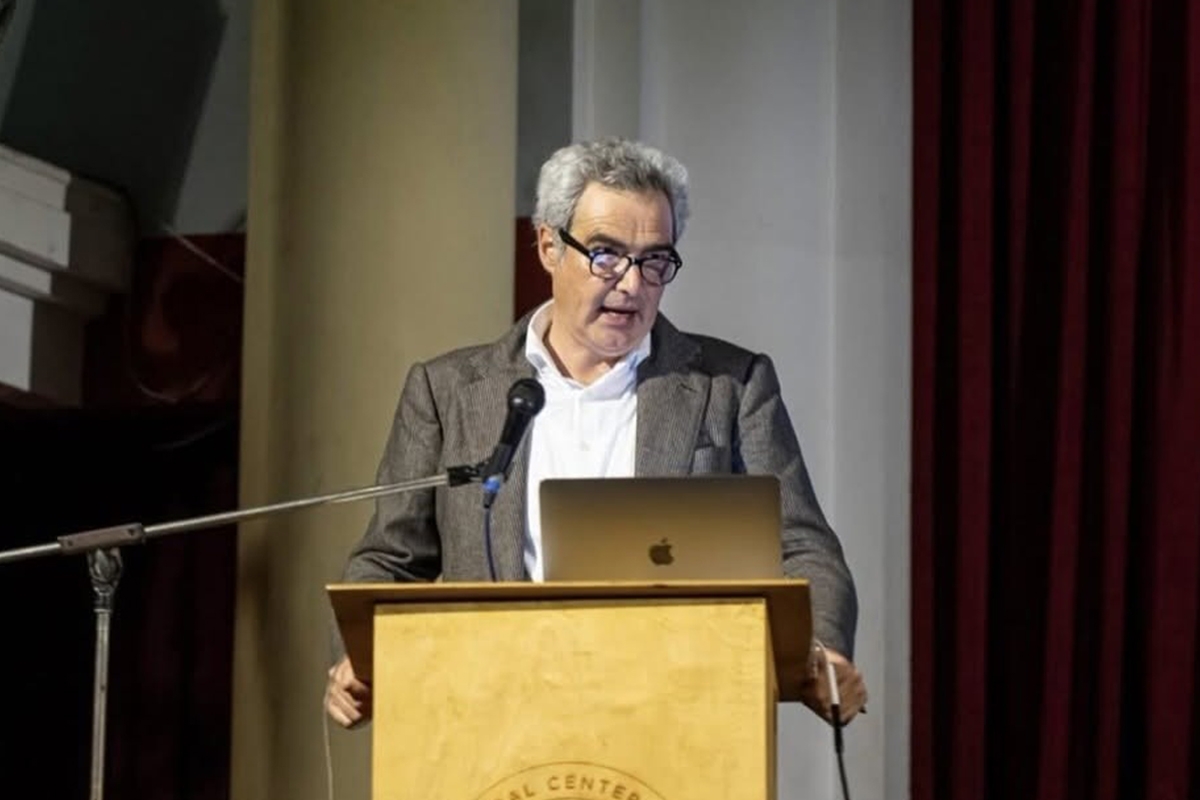
Sulaiman Al-Bassam presented a workshop on his three plays reflecting Arab unrest in Alexandria
Translated by Alqyas from Al-Jarida — Original source
Kuwaiti writer and theater director Sulaiman Al-Bassam presented a master class titled “The Arab Rebellion Trilogy: Theater in the Age of Uprising, War, and Exile” at the Italian Theater within the Jesuit Cultural Center in Alexandria, Egypt, as part of the tenth edition of Egypt’s “Lazem Masrah” festival, which this year adopted the theme “Return.”
Al-Bassam guided participants through a journey across his “Arab Rebellion Trilogy,” a series of three works written and directed by him, produced over approximately 12 years: “In the Eruptive Mode: Voices from a Stolen Spring,” “I M E D E A,” and “MUTE,” created between 2011 and 2024.
Participants explored the relationship between historical context and the artistic form of Al-Bassam’s theatrical works. He revealed that he has recently begun viewing these three pieces collectively as “The Arab Rebellion Trilogy,” noting that the title was partly inspired by his earlier work, “The Arab Shakespearean Trilogy.”
“In that trilogy, Shakespeare served as a textual and formal mask through which I addressed issues of dictatorship, war, political violence, and the relationship between the Arab world and the West,” Al-Bassam explained. “These three works operate differently; they stem more directly from the historical upheavals that began with what was called the Arab Spring and everything that followed.”
Al-Bassam outlined the conditions surrounding the production of the “Arab Rebellion Trilogy,” focusing on the changes that affected the textual and formal aspects of the works. He argued that these pieces were also shaped by the material conditions of theater production in the Arab world and beyond, including travel, censorship, small budgets, borders, visas, political restrictions, difficulties in transporting large troupes, and the challenge of maintaining stable theater institutions.
He emphasized that when economic and political constraints surrounding production became part of the dramaturgy, reductionism emerged as an adopted artistic form. This is significant because, in Al-Bassam’s view, theatrical innovation does not always arise from abundance; rather, it occurs when old conditions become impossible or unreliable, necessitating the invention of new forms. He linked this concept to the tenth edition’s theme, “Return,” which he believes manifests in both text and form.
“What preoccupied me during that period was the relationship between political upheaval and upheaval in theatrical form,” Al-Bassam said. “How the transformations experienced by the Arab world, roughly between 2012 and 2024, forced a change in the type of theater, both in writing and as an effect on stage. I became increasingly convinced that the tearing apart of the alphabet of political reality requires a new theatrical alphabet, and that a text cannot exist in isolation from its surrounding reality, continuing to simulate the world around it using the same foundations we have long been accustomed to.”
He noted that “historical reality imposes itself on dramatic construction choices, thereby generating new forms, as seen in the works of Samuel Beckett, Heiner Müller, Bernard-Marie Koltès, and Sarah Kane. It is this intricate relationship between history and dramatic structure that I sought to trace through the three works.”
Al-Bassam explains that he fell prey to the temptation of juxtaposing “revolution abroad and upheaval at home,” which led him to condense all these concepts into the single word “rebellion.” According to Al-Bassam, this binary approach permeates his three plays, which span years beginning with a massive popular demand for dignity, political agency, and transformation, then moving into an era of repression, counter-revolution, civil war, foreign intervention, sectarian violence, displacement, exile, and diaspora, alongside the rise of a surveillance crescent in dark skies, the militarization of violence with perpetrators rendered as passive constructions, and ultimately the abolition of bodily sanctity and the sacredness of life through genocide.
He argued that all of this influenced the artistic form and the choices of artistic vocabulary through deconstruction, collision, and omission, highlighting the structural artistic line in response to the rise of waves of repression, counter-revolutions, and displacement, culminating in the violation of the sanctity of life and the body. This trajectory began with the play “In the Mode of Boiling: Voices from a Stolen Spring,” which embodies multiple female voices across different geographies, finding themselves in states of intersection and transformation due to the external events surrounding them.
He continued: “Then came the play ‘I Media,’ when myth enters the present, autobiography infiltrates myth, and power and the concept of borders penetrate the boundaries of the family, leading to the play ‘Samt’ (Silence), where the character begins to disappear, the narrative is stripped of its elements, and eventually language itself becomes suspect. Al-Bassam describes this as a sequence of events and a realistic timeline, while simultaneously a formal and artistic progression that seeks, through its manifestations, to create permeable spaces that allow us to listen to what the Russian poet Osip Mandelstam called ‘the noise of time.’”
Forty writers, directors, actors, and theater enthusiasts from various parts of Egypt participated in the master class, following Al-Bassam’s artistic workshop held last month in the Egyptian capital, at the invitation of the Cairo Experimental Theater Festival.
