Iraqi State Launches Fateful Confrontation with Iran's Agents in Jarf Al-Sakhr
Iraq faces a security crisis in Jarf Al-Sakhr due to the refusal of Hezbollah militias to withdraw and the presence of illegal oil refineries, amid Iranian mediation.
Translated by Alqyas from Al-Jarida — Original source
Iraq has entered its most severe security and political test in years, as the confrontation between Prime Minister Ali al-Allawi and Iran-backed “Hezbollah” brigades shifts from issues of oil smuggling and the assertion of state authority to a critical phase that threatens to ignite armed clashes in the Jarf al-Sakhr area of Babil province. This escalation follows government investigations that uncovered two oil refineries operating within the zone, with a combined production capacity of approximately 9,500 barrels per day, amid accusations that the armed faction controls smuggling operations and refuses to withdraw despite the government’s decision to return the area to the jurisdiction of official state forces.
The crisis witnessed an unprecedented field development with the entry of a government committee and a judicial committee into Jarf al-Sakhr to conduct on-site inspections, marking the first such move in years. The mission included representatives from the ministries of Interior, Justice, and Agriculture, the Popular Mobilization Forces (PMF) Authority, intelligence and counter-terrorism agencies, and the Babil provincial government. Iraqi sources revealed that the area houses two refineries: the first has a daily production capacity of between 3,000 and 3,500 barrels, while the second’s capacity ranges between 5,000 and 6,000 barrels.
In a more dangerous development, a security source reported that “Hezbollah” elements in the area set fire to and blew up several sites after learning that the judicial committee was heading there, in an attempt to conceal evidence of oil pipeline theft. Meanwhile, their leadership rejected a directive issued by Falih al-Fayyadh, head of the PMF Authority, to replace the force controlling the area. This occurred simultaneously with government moves to reorganize security deployments and encircle the entrances and exits of Jarf al-Sakhr, paving the way for the restoration of security responsibility to official forces.
In the first open and direct challenge to the government, the “Hezbollah” brigades held a press conference near an oil warehouse within the area—a notable precedent—denying allegations of oil smuggling and describing the facilities as primitive plants that convert crude oil purchased by the faction into heavy fuel used to power generators and machinery during crises. Brigades leader Abu Talib al-Saadi stated that the plants had not been used for months and were located 5 kilometers away from oil pipelines, accusing the investigation committee of fabricating facts.
However, the most escalatory stance came from al-Saadi’s declaration that the brigades would not withdraw from Jarf al-Sakhr “even if it costs our bodies, our blood, our legacy, our wounded, and our martyrs,” a clear rejection of al-Allawi’s order. At the same time, he attempted to contain the possibility of confrontation, affirming that the faction did not intend to fight security agencies and that its leader, Abu al-Hussein al-Humaidawi, would handle the crisis with wisdom to prevent infighting.
In response, al-Allawi insisted on asserting full control over the area and refused to extend the deadline granted to the factions, set for Friday evening. He assured leaders of the Coordination Framework that the forces were prepared to carry out a military operation if the brigades did not comply with withdrawal demands.
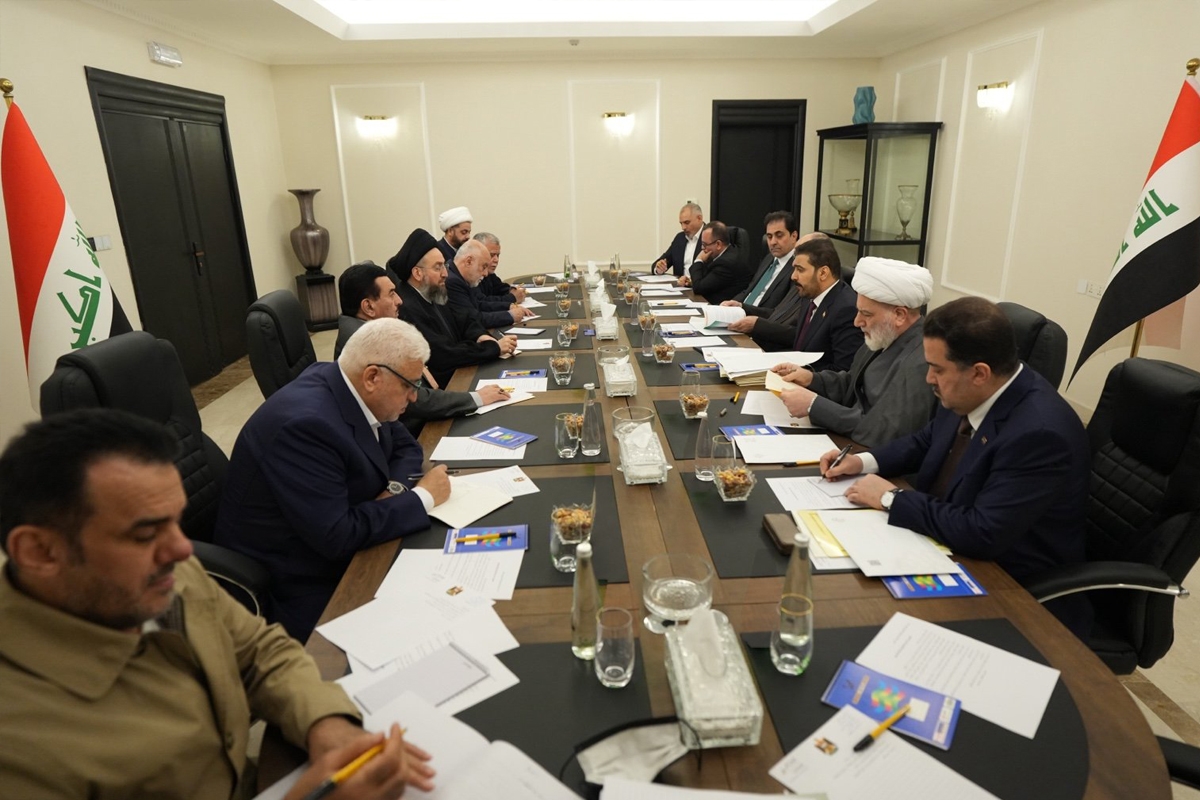
The division extended into the Coordination Framework itself, which witnessed a stormy meeting on the night of Monday-Tuesday, ending with al-Allawi’s departure after heated exchanges with prominent leaders, particularly Hadi al-Amiri, head of the Badr Organization. While al-Amiri and Abu Ala al-Walidi called for dialogue and avoiding military options, the Prime Minister insisted on implementing his decision without concessions or deadline extensions.
In an attempt to prevent the confrontation from escalating into an explosion, Iranian Quds Force commander Esmail Qaani arrived in Iraq as an envoy from Supreme Leader Mojtaba Khamenei, according to Iraqi sources, and held meetings with leaders of factions and figures within the Coordination Framework, seeking to contain the escalation and push for a political settlement. Qaani’s mediation has not yet achieved a breakthrough, given al-Zaidi’s steadfastness in his position. The proposed proposals include replacing Kataib forces with battalions from the Popular Mobilization Forces and the Federal Police, backed by the Counter-Terrorism Service, and continuing judicial investigations.
The confrontation gains its danger from the nature of Jarf al-Sakhr, which has remained since its recapture from the “Daesh” (ISIS) organization in 2014 under the influence of armed factions, far from government control, despite its strategic importance as a connecting point between Baghdad, Babylon, Karbala, and Anbar. Furthermore, the issue is linked to the return of thousands of displaced residents and security concerns related to war remnants, as well as allegations of the existence of military facilities and arms depots.
As Friday’s deadline approaches, al-Zaidi finds himself facing a test that goes beyond curbing oil smuggling to resolving the issue of the state’s monopoly on weapons and security decision-making, while the factions face an unprecedented test regarding the limits of their influence within state institutions. Amid the government’s determination, the Kataib’s refusal, and Iranian mediation pressures, Jarf al-Sakhr remains poised to become the most dangerous internal confrontation in Iraq if the settlement fails to prevent a clash.
During a visit to Najaf, where he chaired a government meeting and visited its religious museum, al-Zaidi addressed the “Dawn’s Valor” campaign to pursue corrupt individuals, affirming that it would continue without pause, and stressing that the state “will also pursue anyone bearing arms outside its framework, and will not allow any entity to tamper with the security of Iraqis or steal their assets and wealth.”
