Kuwait and China: Strengthening partnership in economy and artificial intelligence
Emphasis on deepening bilateral cooperation in technology, culture, and development
Translated by Alqyas from Al-Jarida — Original source
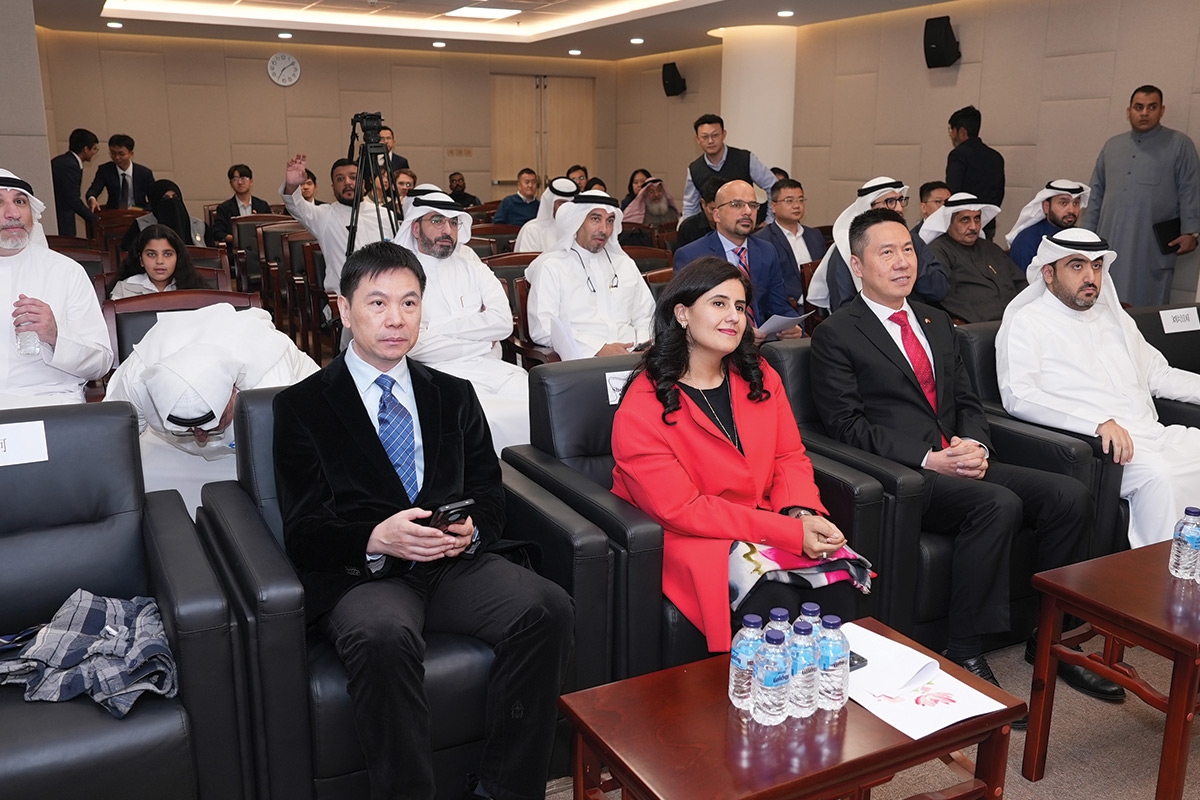
This came during a reading session on the first volume of Chinese President Xi Jinping’s book, “Governance of China under Xi Jinping,” held last Thursday evening, with participation from Chinese Ambassador to Kuwait Yang Xin, Sheikh Mohammed Al-Sabah, Chairman of the Board of Directors of the Kuwait Artificial Intelligence of Things Association, Sheikh Anoud Al-Duwaikh Al-Sabah, founder of the Kuwait-China Friendship Club, and a number of individuals interested in cultural, intellectual, and bilateral affairs.
During the session, Ambassador Yang Xin affirmed that Kuwait-China relations are witnessing growing cooperation across various fields. He noted that cultural exchange and people-to-people ties form a crucial foundation for enhancing mutual understanding and expanding economic and developmental cooperation, coinciding with both countries’ celebration of the 55th anniversary of the establishment of diplomatic relations this year.
He emphasized that China remains committed to an open-door policy toward the world and seeks to strengthen cooperation based on mutual benefit. He pointed out that Kuwait is an important partner for China in the Gulf region, and that the two countries are working to align China’s Belt and Road Initiative with Kuwait’s Vision 2035, yielding tangible results in several areas.
Yang Xin stressed his country’s readiness to work with Kuwait to implement the agreements reached by the leaders of both nations, deepen the exchange of expertise in state administration and governance, and expand cooperation across various fields to serve shared development.
For his part, Sheikh Mohammed Al-Sabah affirmed that China’s developmental experience offers important lessons in strategic planning and investment in human capital, as well as in transforming knowledge and innovation into key drivers of economic growth.
He stated that Kuwait-China relations have evolved from traditional trade exchanges to broader cooperation in energy, investment, infrastructure, and culture, emphasizing that the two countries have an opportunity to transition toward a deeper partnership in knowledge, technology, and innovation.
He clarified that artificial intelligence represents one of the most promising opportunities to enhance cooperation between the two countries. Chinese technological advancements, alongside Kuwait’s developmental aspirations under Vision 2035, create opportunities for partnerships in smart cities, energy, healthcare, education, and scientific research.
For her part, Sheikh Anoud Al-Duwaikh highlighted the role of technology and artificial intelligence in supporting culture and heritage, particularly through 3D scanning of archaeological sites, the use of modern technologies in restoring ancient texts, and the development of tools to protect heritage sites from risks and disasters.
She affirmed that cultural cooperation between Kuwait and China offers opportunities to enhance knowledge and civilizational exchange and to benefit from Chinese expertise in heritage protection and digitization, paving the way for joint projects that serve both countries.
