Al-Rajib: No Matter How Far His Imagination Wanders, a Writer Carries His Nation in His Stories
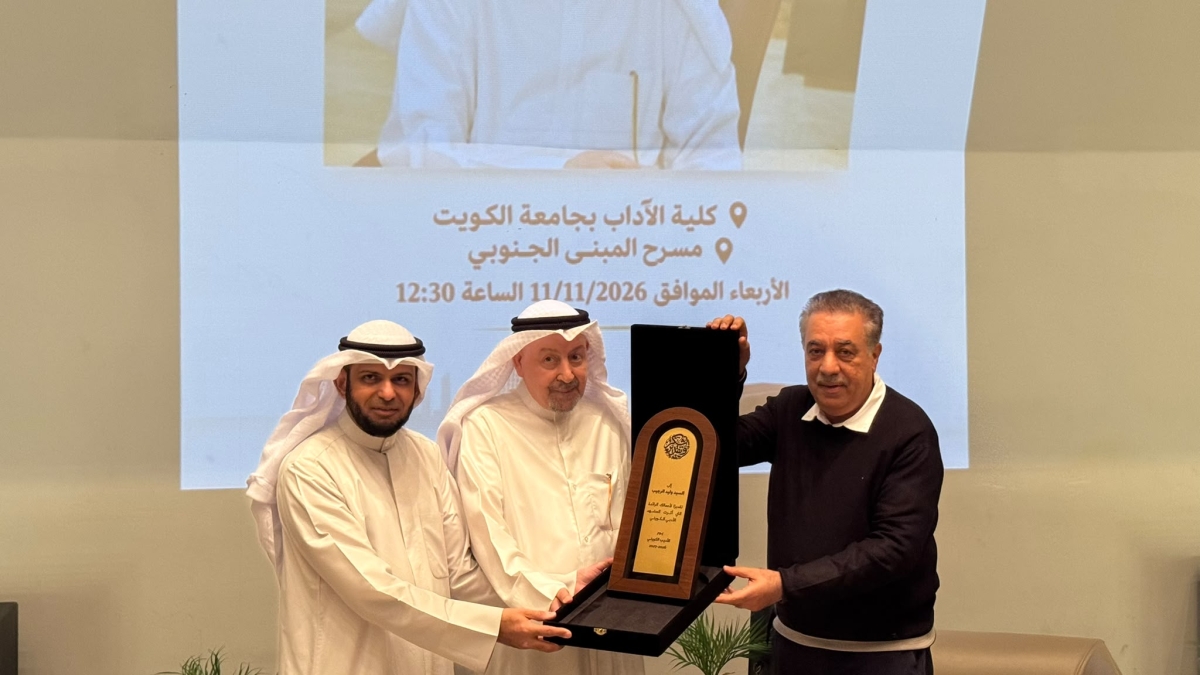
Kuwait University honors the writer Waleed Al-Rajib.
Translated by Qiyas from الجريدة — Original source
Within the precincts of Kuwait University, where knowledge meets creativity, the Department of Arabic Language and Literature at the College of Arts hosted its annual “Kuwaiti Writer’s Day” ceremony, honoring writer Waleed Al-Rajab in a gesture of gratitude and appreciation for Kuwaiti literary figures.
The event was presented by Dr. Omar Al-Adwani, a professor in the Department of Arabic Language and Literature, in the presence of Acting Dean of the College, Prof. Dr. Abdulmohsen Al-Tabtabaee, the honored guest Al-Rajab and his family, as well as a gathering of faculty members, students, and guests. It took place at the “Southern Arts” auditorium in the Sabah Al-Salem University City.
In his opening remarks, Dr. Al-Adwani said, “The writer holds a distinguished place in the life of nations, transcending mere eloquence; he is the memory of the people, the voice of their questions. We are delighted to gather with you on this Kuwaiti Writer’s Day to honor Writer Al-Rajab, in recognition of his literary career and cultural contributions, and out of pride for what he has added to the Kuwaiti literary landscape.”
For his part, Prof. Dr. Al-Tabtabaee stated, “Honoring the Kuwaiti writer is not merely an occasion to recognize an individual or showcase a creative experience; rather, it is a celebration of our national cultural memory. This underscores the importance of this initiative, which the Department of Arabic Language and Literature is keen to organize, based on the conviction that the university is not solely an institution for education and scientific research, but also a space for cultural dialogue, a platform for engaging with creative minds, and a place where academic expertise meets creative experience.”
He added, “Hosting writers and celebrating their experiences provides our students with the opportunity to approach the worlds of writing, explore creative pathways, and listen to the testimonies of those who have made literature an integral part of their lives.” He noted that Al-Rajab is among the literary names that have contributed to enriching Kuwait’s cultural movement, with a writing career spanning short stories, novels, and essays, alongside his intellectual and social interests.
On his part, the honored guest, Al-Rajab, said, “It is an honor for me to stand today within the precincts of Kuwait University, this venerable academic institution, expressing my deepest gratitude and appreciation to the Department of Arabic Language and Literature and the committee responsible for this honor. I cherish this noble initiative, which I view as a celebration of the word and an acknowledgment of literature’s role in shaping human consciousness and societal sentiment.”
He continued, “Perhaps the most beautiful aspect of this honor is that it comes from the homeland. When a writer is honored in his own country, it means his words return to the place of their origin, and his questions and dreams find resonance in the faces that share his memory and belonging. No matter how far a writer’s imagination may roam, he always carries his homeland within him—in his language, his characters, his stories, and even in his silence. A writer does not write about his homeland merely because he belongs to it; he also writes to understand the meaning of that belonging. And when his homeland honors him, it is as if the place says to him: ‘We have heard your voice, and your words have become part of our shared memory.’”
For her part, Dr. Hifaa Al-Sanousi, a member of the academic faculty at Kuwait University and professor of literature and psychoanalysis, who proposed honoring writer Waleed Al-Rajab, said, “Al-Rajab is a symbol and an imprint of Kuwaiti literary creativity over the years, with an experience spanning nearly 46 years.” She added, “I have known Waleed Al-Rajab for more than twenty years, through a story that initiated our connection—the first story I read of his. It was then that I became aware of Waleed Al-Rajab’s world and began to delve into his writings.”
Dr. Al-Sanousi explained that “it is a very beautiful story of communication, encompassing a humanistic concept and deep psychological dimensions that provide individuals with frameworks for cooperating with others on many levels. It is a story of communication between Waleed and Abdullah, and I used to read it to my students, particularly in the course on Literature and Psychoanalysis, because it dealt with the issue of communication between the self and the other at a very deep level. Here, I discovered that Al-Rajab’s worlds are captivating.”
Dr. Aisha Al-Shatti read a literary paper titled “A Tribute to Waleed Al-Rajab,” on behalf of her father, the writer Dr. Suleiman Al-Shatti. She stated: “Some initial encounters leave a renewed attraction in the soul. In the 1970s, at the Qadisiyah Library, in the care of its friendly custodian, Abdulaziz Al-Saree (may God have mercy on him), I was introduced to him: Waleed Al-Rajab, a writer who heralds goodness... He was a young man in his early twenties, appearing reserved and taciturn. Nevertheless, the impact of that first encounter remained engraved in my memory, not as a passing moment, but as a present force that motivated me to follow his work from afar. When I held his first collection, *A Point That Falls... Drops* (Ta’allaq Nuqtat Tasqut... Taq), the attraction of that first encounter revived, but this time in the face of texts that raise eyebrows with questions and expectations, starting with the strangeness of the title, which intrigues me but does not shock me. I view strangeness as a fundamental element of artistic experience; it is a state of astonishment that creates alertness in the reader, and alertness stimulates contemplation, resulting in joy and happiness when your reading anchors at the port of discovery, understanding meanings, ironies, and significant hints. At that moment, when I held his first work as a reader and then as a critic, I bet with myself that he would not disappoint those who trusted in Waleed Al-Rajab’s capabilities. His distinctive debut signaled an ascending experience that did not leave any corner in society or in the human soul unexamined and depicted, relying on a solid foundation in artistic treatment. I became a reader who gazes intently at the lines of his successive novels, which exceeded twenty, the latest of which, and not the last, is *East Around Me* (Sharq Hawli). Regarding this novel, I was not just a reader, but one of the first readers of some of his works, before the teeth of the printing press turned them into paper, thanks to the PDF.”
Dr. Latifa Al-Tamar, a member of the supporting academic faculty, presented a critical paper titled “The Semiotics of Spatiotemporality in the Novel *Badriya* and the Novel *East Around Me*.” Excerpts from her reading included: “The writer Al-Rajab’s name emerged in literary and novelistic works in Kuwait and the Arab Gulf through a number of novels and short story collections, which have become a landmark in Gulf literature due to the issues and concerns they address, representing the Gulf and Kuwaiti human experience. The writer focuses on the role of women in his literary works, which usually symbolize the bright face of life and the stronger aspect of existence.”
As for Al-Rajab’s daughter, she said: “Standing before you today places me in front of a unique mixture of pride and responsibility; the pride of a daughter for a writer of Waleed Al-Rajab’s stature, and the responsibility of speaking about him... specifically about him, as my father. Growing up in the house of a writer means you grow up in a place where things are not measured by their apparent size, but by their human depth and what they leave in the soul. My father, to the world, is the writer and novelist who has always sided with humanity, with the common people, and with truth. He is the writer who does not write from ivory towers, but from the heart of the street, the pulse of people, and the depth of history, to instill in us an identity and remind us that belonging is not merely a word, but a consciousness, a spirit, and a genuine attachment to the soil of this homeland.”
Writer Munir Al-Otaibi presented a testimony in which he recalled aspects of Al-Rajab’s career, shedding light on his administrative and cultural presence, and remembering milestones of his contributions and stances that reflected his administrative and cultural personality. He highlighted the idea of the “Al-Qurain Cultural Festival,” which he developed with Dr. Suleiman Al-Askari, noting that the first festival took place in 1994.
