Olive trees sway with fragrance and produce oil in Afghanistan
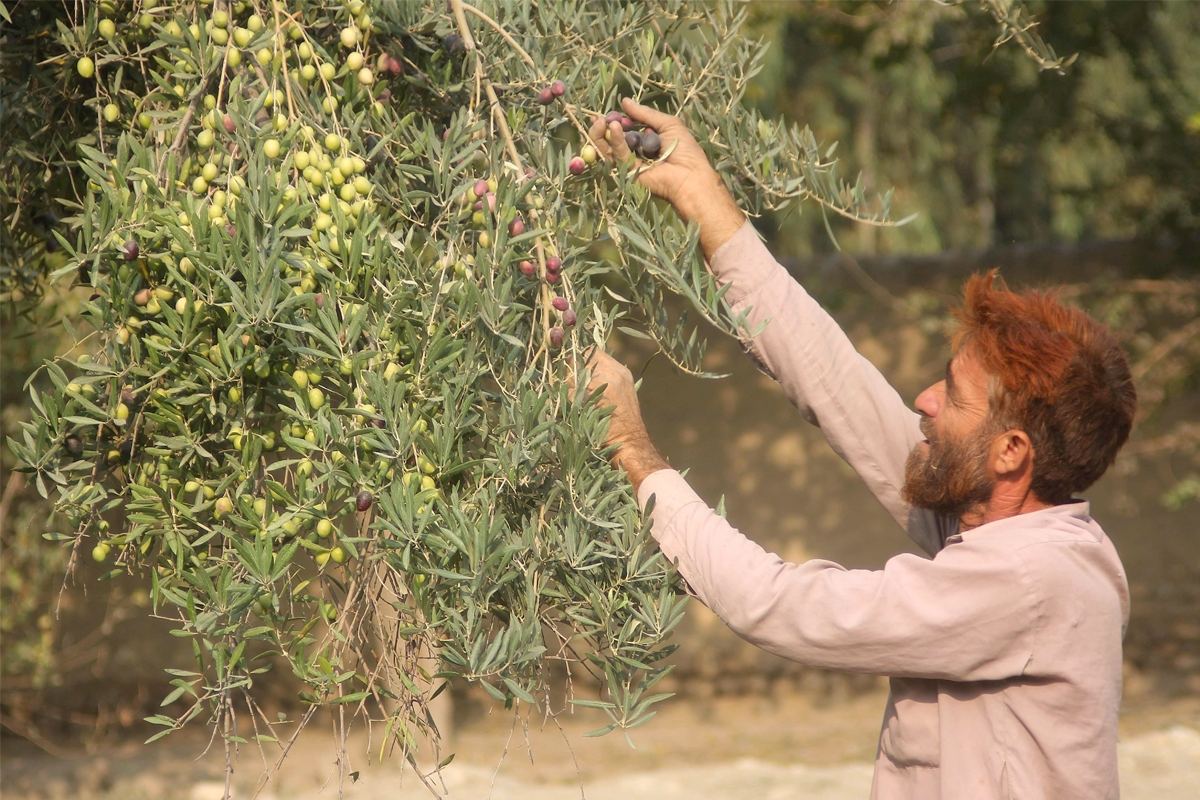
Afghanistan produces organic olive oil in Nangarhar with support from the FAO.
Translated by Qiyas from الجريدة — Original source
In the fields of eastern Afghanistan, where olives fall onto tarps to the chirping of birds, hope rests on a crop capable of withstanding global warming.
Fifteen years ago, Abdullah Orzala planted hundreds of olive trees on his family’s fields in the village of Saydan Arabi in Nangarhar province, known for its mild winters.
Orzala, an aromatic plant expert, told Agence France-Presse in an interview published today: “They are among the most drought-resistant trees.”
In November, the harvest is picked by hand in olive groves grown using organic farming methods.
The olives are immediately cold-pressed at a pilot mill set up in a garden surrounded by traditional mud-brick walls. The mill is locally manufactured, as are the kneading mixer and the manual press.
The oil is sold in natural products stores in Kabul at prices reaching around $17 per kilogram (1.1 liters). These activities provide 16 permanent jobs in two villages.
Stretching along both sides of the road linking the border with Pakistan and Jalalabad, the largest city in eastern Afghanistan, are vast olive groves that make one feel as though they are in Spain or Italy.
The trees, planted about sixty years ago, include varieties from Azerbaijan, Turkey, and Egypt. In 1985, a mill built by the Soviets enabled oil production.
However, successive wars have destroyed 1,300 hectares out of the 3,100 hectares of olive trees whose branches have long been associated with the symbolism of peace.
The Food and Agriculture Organization of the United Nations (FAO) established olive groves covering 381 hectares “to enhance resilience to climate change and provide income opportunities for 389 families.”
In Saydan Arabi, Sani Khan, a 20-year-old employee at Orzala’s field, recounts how residents initially doubted the viability of planting olive trees.
