Abu Dhabi Tests Prospects for Ending Ukraine War and Securing Europe
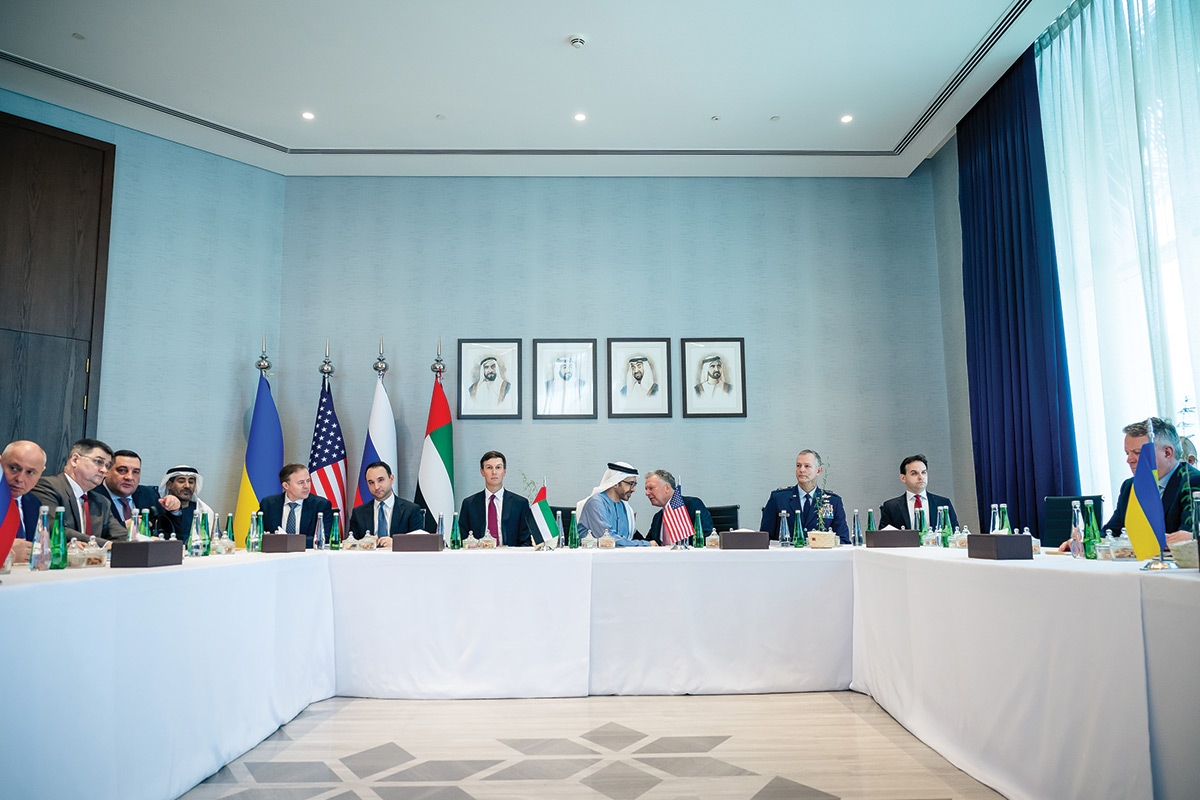
Launch of talks in Abu Dhabi between Russia, Ukraine, and the US, with Emirati and European presence.
Translated by Qiyas from الجريدة — Original source
The UAE capital, Abu Dhabi, witnessed today the launch of tripartite talks, which conclude today, between Russia, the United States, and Ukraine, marking the first direct meeting between the parties in over eight months. The talks were attended by UAE Foreign Minister Sheikh Abdullah bin Zayed, and hosted by US President’s envoys Steve Witkoff and Donald Trump’s son-in-law, Jared Kushner, with European participation.
Amid limited expectations of a diplomatic breakthrough that could end the war, which has lasted more than four years, amid ongoing disagreements over Ukrainian territories, mutual security guarantees, and the structure of the European security system post-war, Ukrainian delegation head Rustem Umerov announced that the parties shifted to a tripartite format comprising Ukraine, the United States, and Russia, following an initial meeting between representatives of Britain, France, Germany, Italy, NATO, and the European Commission, attended by Witkoff and Kushner.
Umerov stated that Kyiv’s priorities include halting hostilities, obtaining reliable post-war security guarantees, achieving economic recovery and development, and taking humanitarian measures. He confirmed that the Ukrainian delegation received a mandate from President Volodymyr Zelenskyy to discuss all issues related to ending the conflict and to work toward progress on a permanent peace.
For his part, Russian delegation head Vladimir Medinsky expressed hope that the meeting would yield progress on the peace track, emphasizing that ending the war serves the interests of both the Russian and Ukrainian peoples, while describing the Russian delegation’s composition as more representative and professional.
On the US side, Kushner called for moving beyond bilateral discussions on ending the war and working to establish new security relations between Russia, Ukraine, and Europe, ensuring long-term stability. He expressed hope that the talks would lead to a new security framework guaranteeing peace for decades, if not centuries, reaffirming that President Trump remains committed to reaching a negotiated settlement ensuring permanent peace and security agreements among the concerned parties.
Witkoff also expressed hope that the talks would contribute to discussing post-war security arrangements, de-escalation, humanitarian issues, and next steps toward a settlement. US European Command Commander General Alexus Grynkewich emphasized the importance of building on previous progress in the tripartite military dialogue and working with both sides to lay the foundation for a lasting peace.
In Moscow, a source from the negotiation team said the talks primarily focus on establishing a new European security system for the post-war period and exploring mechanisms to prevent threats and enhance regional stability, viewing the Ukrainian settlement as part of a broader scope aimed at creating an integrated and indivisible security architecture for the European continent.
Conversely, European Commission President Ursula von der Leyin stressed that any serious discussion on Europe’s security architecture cannot begin before a ceasefire is reached in Ukraine, and that such discussions should involve NATO allies and EU member states.
Concurrently with the talks, a joint statement by the United States, Ukraine, and European parties reaffirmed their commitment to a strong post-war European security architecture and arrangements, emphasizing that any peace agreement must guarantee Ukraine’s territorial integrity and that a strong NATO must remain the cornerstone of common Euro-Atlantic defense.
Russia dominates the construction of nuclear reactors worldwide, according to a recent report on the global nuclear industry’s status, presented today in Berlin.
The annual “Global Nuclear Industry Status Report” stated that the state-owned Rosatom group is the largest supplier of nuclear technology, overseeing the construction of 28 out of 73 plants under construction as of July 1 of last year, including 21 plants outside Russia.
However, the state-owned group’s revenues from its foreign activities have recently declined due to Western sanctions imposed on Russia in connection with its war against Ukraine.
At the same time, the report pointed to close cooperation in some cases between Rosatom and Western companies, particularly strong ties with France.
