Mohamed Aboulwafa: Grand Egyptian Museum displays 57,000 artifacts
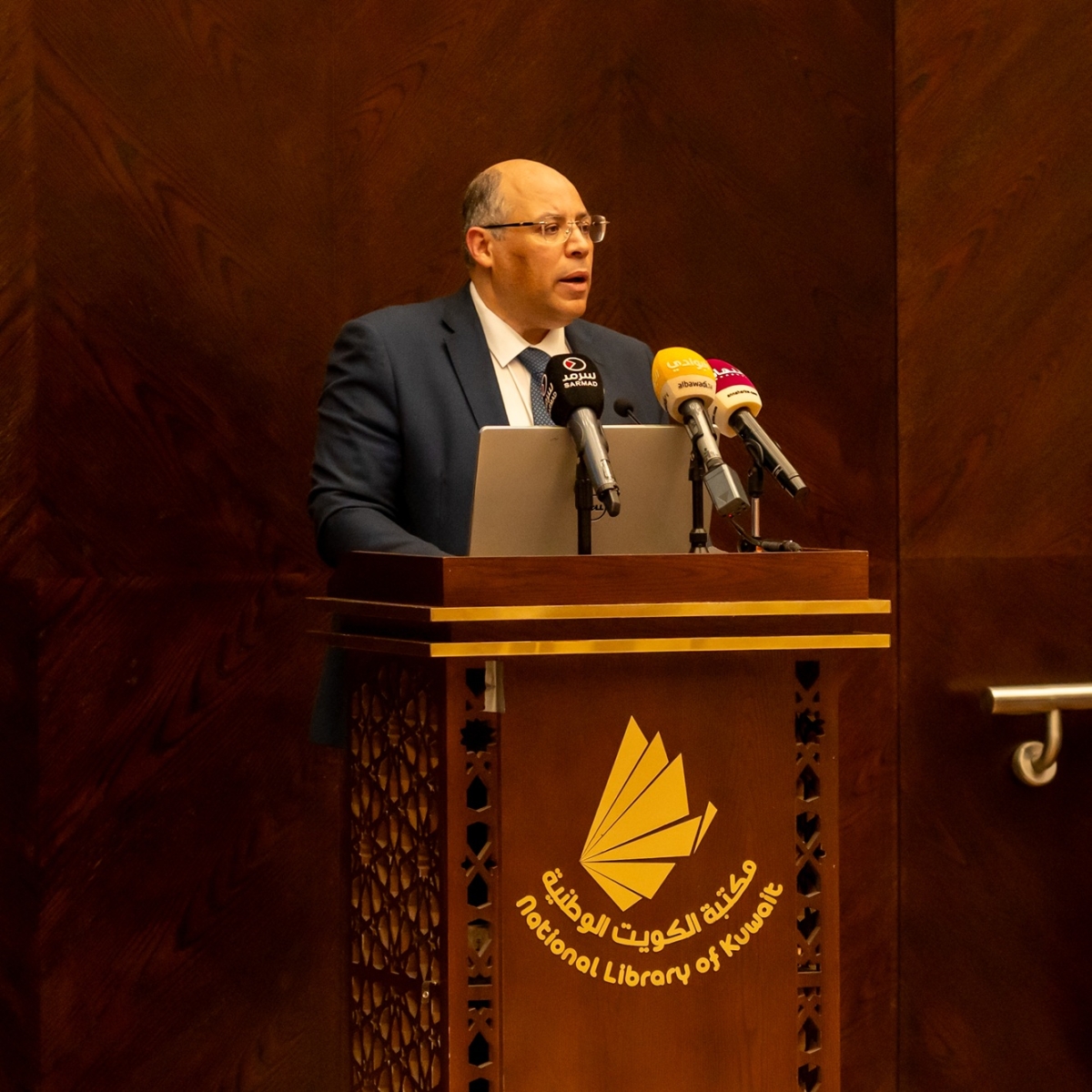
Egyptian Cultural Office in Kuwait hosts an event on the Grand Egyptian Museum, attended by Mohamed Aboulwafa and Sayed Mahfouz
Translated by Qiyas from الجريدة — Original source
The Cultural Office of the Egyptian Embassy in Kuwait, in collaboration with the National Council for Culture, Arts and Letters, hosted an event titled “The Grand Egyptian Museum: A Civilization That Tells a Story and a Future That Reveals Itself” the day before yesterday, marking the first anniversary of the museum’s opening in the capital, Cairo, in early November last year.
During the event, Egyptian Ambassador to Kuwait Mohamed Aboulwafa emphasized that the museum is “a unique civilizational monument that embodies Egypt’s renewed message to humanity, and the message of a civilization that has spanned thousands of years and remains capable of inspiring and contributing.”
He noted that the museum, which spans an area of 490,000 square meters, represents an exceptional civilizational and humanitarian project “through which Egypt has combined the grandeur of the past with the aspirations of the future, presenting the world with a model of how to utilize science, technology, and modern arts to preserve and rediscover human heritage.”
He added that the museum, which displays approximately 57,000 artifacts, including unique and distinctive pieces, “is one of the largest archaeological museums in the world dedicated to a single civilization, housing unique archaeological treasures that allow visitors an extraordinary journey through the history of ancient Egyptian civilization.”
He continued, “Our celebration of this occasion on Kuwaiti soil carries special significance, as Egyptian-Kuwaiti relations have never been merely political and economic; rather, culture, science, education, and the arts have remained among its most important pillars, serving as solid bridges of connection between the two peoples.”
For her part, Aisha Al-Mahmoud, Assistant Secretary-General for Cultural Affairs at the National Council for Culture, Arts and Letters, stated in a similar address that this event underscores that museums are not merely spaces that collect antiquities, but living cultural and intellectual institutions that contribute to preserving human memory and enhancing awareness of civilizational identity.
She added that the Grand Egyptian Museum is a civilizational monument that embodies the antiquity of Egyptian history and reflects the rich human and cultural heritage of Egyptian civilization, whose influence has extended through the ages.
She noted that the accompanying art exhibition brings together creative works by Kuwaiti and Egyptian students, and features cultural performances and intellectual dialogues on antiquities and museums, thereby highlighting the importance of cultural exchange in building bridges of communication between peoples and providing opportunities for younger generations to engage with heritage and draw inspiration from aesthetic and humanistic values.
For his part, Dr. Sayed Mahfouz, Professor of Ancient History and Archaeology at the College of Arts, Kuwait University, presented an overview of the museum’s most significant artifacts, including the Hanging Obelisk (the obelisk of King Ramses II, made of pink granite and weighing 110 tons, divided into sections that were restored and reassembled), the colossal statue of Ramses II (who ruled Egypt for 66 years, from 1279 to 1212 BC, and was the third pharaoh of the 19th Dynasty), as well as 10 statues of King Senusret I, the Grand Staircase in the museum, which features 50 statues of kings, and other displayed treasures.
The event also included an exhibition featuring drawings by Kuwaiti and Egyptian students, as well as Egyptian artistic artifacts, and a dialogue session moderated by Dr. Reem Al-Radaini, Professor of History at Kuwait University, on the importance of the museum and understanding ancient Egyptian civilization, given its significant antiquities and its status as the largest museum dedicated to a single civilization, namely ancient Egyptian civilization.
The design of the Grand Egyptian Museum was inspired by the three pyramids, embodying a comprehensive architectural vision. Its facade, with its overlapping triangular dimensions and precise proportions, reflects the pyramids, according to the Egyptian State Information Service website.
The museum, which features several exhibition halls, was established to become the premier destination for anyone interested in ancient Egyptian heritage. It houses a large number of distinctive artifacts, including the treasures of “the Golden King” Tutankhamun, which are being displayed in their entirety for the first time since the discovery of his tomb in November 1922.
The Grand Egyptian Museum has received numerous international awards, including “Best Project Worldwide 2024” from the International Federation of Consulting Engineers, recognizing it as one of the world’s most prominent architectural projects that combine innovation and advanced engineering. It also won the Versailles Prize in 2024, being named among the most beautiful museums in the world, and obtained eight ISO certifications in the fields of energy, health, occupational safety, environment, and quality.
