Damascus: We need military support from Saudi Arabia and seek to build a regional defense system
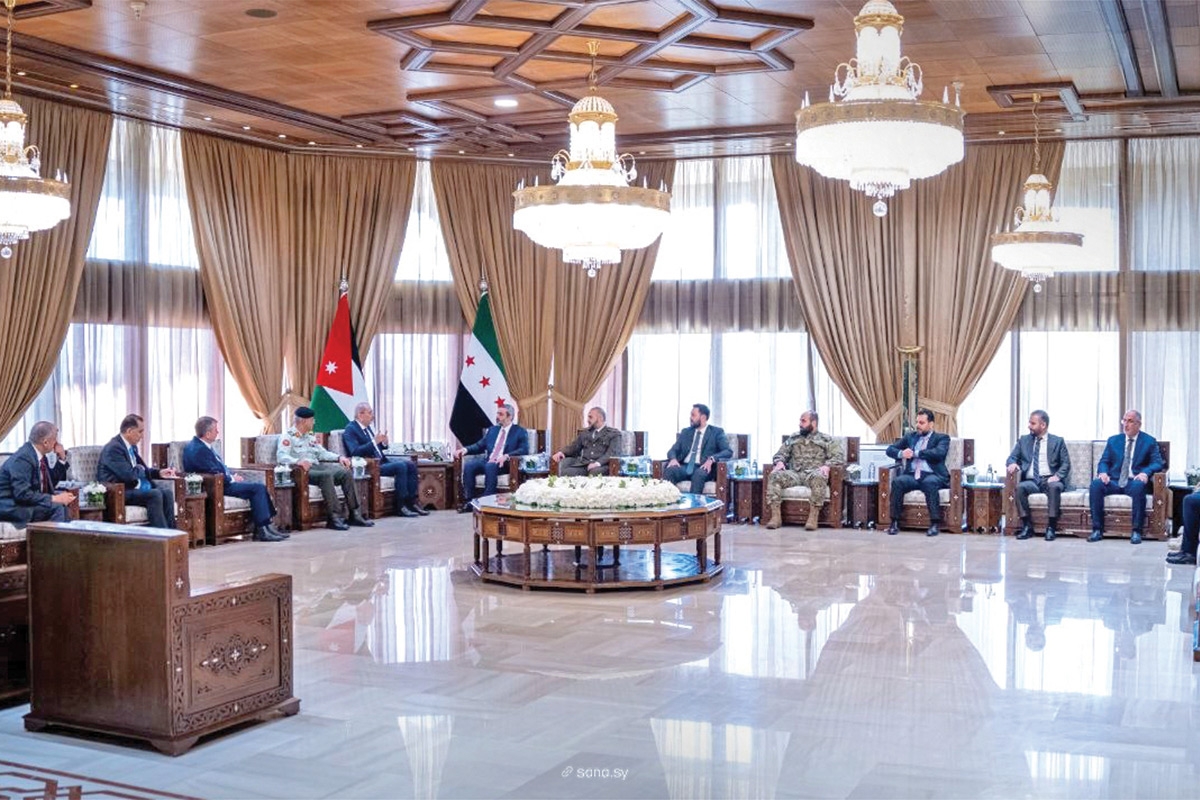
Syrian foreign minister discusses with his Jordanian counterpart the enhancement of security, military, and economic cooperation
Translated by Qiyas from الجريدة — Original source
Syrian Foreign Minister Asaad al-Shaybani and his Jordanian counterpart Ayman Safadi held a meeting in Damascus today, attended by the ministers of defense, chiefs of staff, and directors of the intelligence agencies of both countries, as part of the third session of the Syrian-Jordanian Higher Coordination Council. The meeting focused on enhancing bilateral cooperation, particularly in security, military, and economic fields, and on monitoring the implementation of joint strategic projects.
Al-Shaybani emphasized Syria’s need for military cooperation with Saudi Arabia, highlighting the benefits of leveraging Saudi expertise in defense industries and academic fields. He stressed the effort to build a regional defensive security system that safeguards the security and stability of the region, stating, “We need military cooperation with Saudi Arabia more than any other aspect.”
He clarified that the military cooperation agreement signed between the two countries aims to rebuild the Syrian army and collaborate in the field of defense industries, not to deploy Syrian forces in Yemen, denying any near-term plans in that regard. He affirmed that any step involving the deployment of Syrian military forces abroad would not be carried out in secret.
Al-Shaybani affirmed that Jordan is Syria’s primary partner in terms of tangible benefits, noting that relations between the two countries are based on social and historical ties and shared interests. He stated that “Jordan’s security is an extension of Syria’s security, and vice versa,” describing the strategic partnership between the two countries as more enduring than any obstacle. He confirmed continued coordination in combating smuggling networks and developing cross-border trade.
He revealed that the two countries had signed 35 agreements and memoranda of understanding, with 11 new documents added during the current session, including memoranda of understanding, executive programs, and protocols. He noted that bilateral trade had tripled within one year, reaching $330 million, with indicators suggesting continued growth this year.
He explained that gas has been flowing to Syrian power stations via Jordanian territory since January last year. The two countries are also cooperating through a joint platform for water data, alongside the signing of a new air services agreement.
Among the key new agreements was a rail connectivity memorandum, paving the way for a regional corridor linking Saudi Arabia, Jordan, Syria, and Turkey. Other agreements included a memorandum on cloud seeding in the Yarmouk River basin, a protocol on food security and supply, memoranda on investment and civil aviation, and an executive program for grants and scientific exchange.
Al-Shaybani pointed to an agreement to develop the Jabr-Nusayb border crossing to operate around the clock, with separate lanes for trucks and passengers, and electronic integration with customs systems. He also mentioned the approval of a $47 million project to rehabilitate the international road between the two countries, studies on establishing a joint economic city at the border, updating the free zone, and activating the joint business council.
On the regional front, Al-Shaybani announced Syria’s readiness to transit gas to Lebanon, noting that this file was discussed during a trilateral meeting with the Lebanese side. He also mentioned discussions on supporting Jordan’s food security with surplus Syrian wheat and barley, preparations to launch the “Darb al-Safa” communications project, and an agreement to train 1,450 Syrian employees in a second phase.
For his part, Safadi affirmed that Jordanian-Syrian relations are at their best, stating that Syria’s stability is integral to Jordan’s stability. He emphasized continued cooperation in border security and addressing common challenges, affirming that counter-terrorism is a shared responsibility, as it poses a threat present in various regions.
He expressed regret over the civilian casualties in the Daraa incident, stating that “Syrian blood is as precious to us as Jordanian blood, and the life of a Syrian is as valuable to us as that of a Jordanian,” emphasizing that what unites the two countries and their peoples is stronger than any test or challenge, and that social ties and popular interaction reflect the depth of the bonds between them.
Jafar Hassan reaffirmed the necessity of Israel’s withdrawal from Syrian territories occupied two years ago, stressing the importance of respecting Syria’s sovereignty and stability.
The third session of the Supreme Coordination Council follows the cooperation path launched in May 2025. Its second session, held in Amman last April, saw the participation of around 30 ministers and the signing of agreements and memoranda of understanding. The current session focused on 19 sectors, expanding security, military, and economic cooperation, and transforming joint agreements into practical projects that serve the interests of both countries.
