Washington Moves to Tighten Land and Sea Blockade on Iran
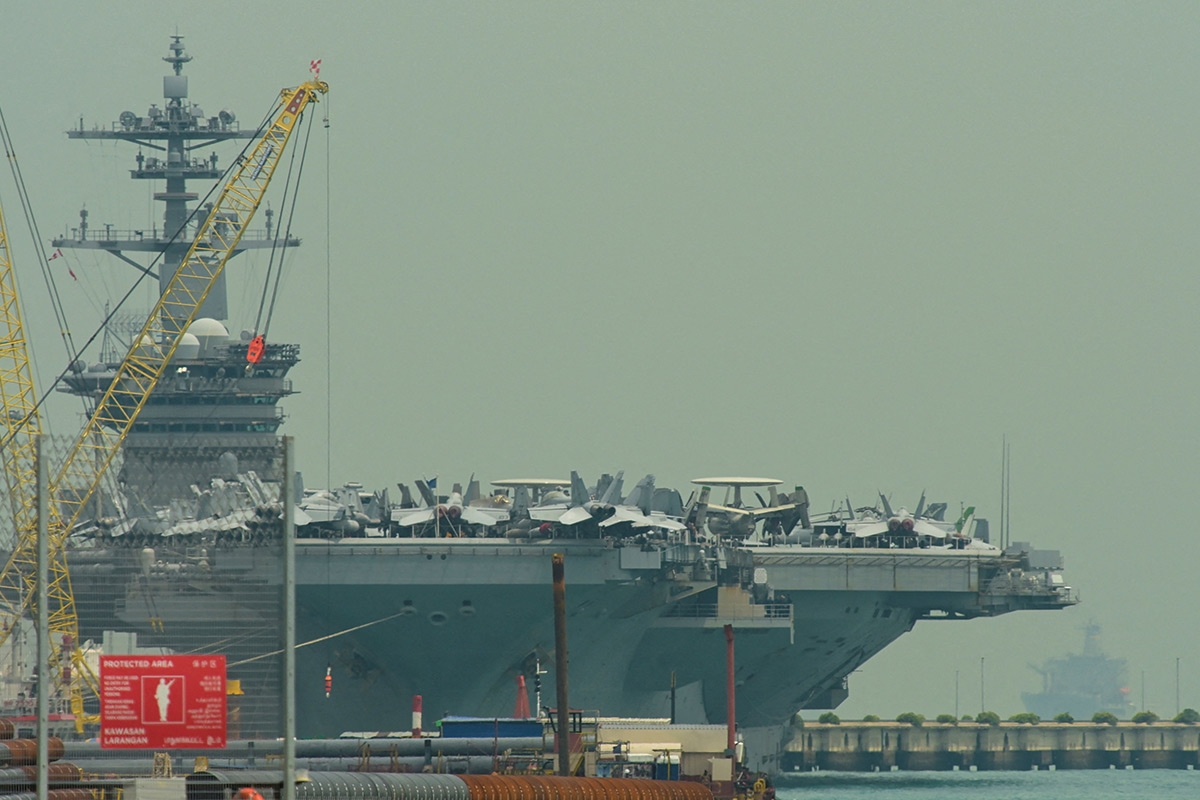
US military forms a force to blockade Iran by land and sea, while Qatar conducts diplomatic mediation with Washington and Tehran to avoid widespread military escalation.
Translated by Qiyas from الجريدة — Original source
As anticipation builds over a decision that U.S. President Donald Trump said he may make within the next two weeks regarding Iran, Reuters reported that the U.S. military intends to form a task force aimed at tightening the economic blockade against Iran by land and sea. This comes amid discussions of new proposals that keep the diplomatic track open for the possibility of reaching an agreement that would spare the region from resuming large-scale military operations, while keeping the military option on the table. This was underscored by the limited strike on Iran’s Qeshm Island late the day before, marking the second such attack in less than two weeks.
U.S. President Trump revealed late Friday night into Saturday that U.S. forces had carried out limited strikes against Iranian air defense systems, while simultaneously noting that communications with Iranians were being conducted through regional intermediaries.
Trump did not specify the location of the U.S. operation or whether it was linked to the strikes reported in Qeshm.
Responding to a question about the message he is sending to Iran, Trump said, “We are talking to them, and we will see how things go.”
This follows his assertion that Washington must decide whether to proceed with additional steps against Iran or “ratify an agreement” with it, emphasizing that he will implement many actions within the next two weeks.
In a development supporting the option of tightening the economic blockade, the U.S. military stated it plans to form a task force to enhance efforts to restrict Iran’s use of land routes and the Caspian Sea, thereby expanding the naval blockade.
Days after a stinging defeat for the Republican Party in the congressional midterm elections, which narrowed the President’s options, the U.S. Wall Street Journal reported that Trump’s advisors are racing to influence his decision on whether to end the war or reignite it.
The newspaper described a clear divide within his administration between a camp pushing for diplomacy and a ceasefire, and another calling for a military operation to improve negotiation terms.
The Wall Street Journal noted that military leaders support continuing operations, while Vice President J.D. Vance and the Presidential Special Envoy, Steve Witkoff, are working on the diplomatic track. It added that Secretary of State Marco Rubio and Treasury Secretary Scott Bessent support the option of tightening the naval blockade and imposing economic sanctions on the Iranian regime until it makes clear concessions on any potential agreement.
As U.S. military reinforcements continue to flow into the region, with a third aircraft carrier expected to arrive in mid-November, the Wall Street Journal reported that an Iranian delegation is heading to the Qatari capital to discuss a potential agreement. Meanwhile, Bloomberg reported that Tehran is considering Qatari proposals on the nuclear file, which it had previously refused to discuss—a development that may indicate a potential openness to reaching an understanding that could end the war.
According to the American newspaper, the proposed agreement includes reducing the duration of preliminary talks from 60 days to two days, as part of efforts to accelerate the process of reaching a mutual understanding between the two sides.
Meanwhile, Axios, citing informed sources, reported that Vance is holding nearly daily communications with Qatari Prime Minister and Foreign Minister Mohammed bin Abdulrahman, Pakistani Army Chief General Asim Munir, and other intermediaries regarding negotiations with Iran, noting that the reported progress has not yet resulted in the announcement of any agreement.
Meanwhile, the Qatari Prime Minister, whose country is currently leading mediation efforts between the Americans and the Iranians, confirmed that these efforts are ongoing to prevent the situation in the region from spiraling out of control.
Ben Abderrahman, who also serves as Foreign Minister, stated, “The US administration’s intentions to find a solution remain intact even after the midterm elections,” noting that Washington’s interest in reaching an agreement has not changed. He added that significant progress has been made and expressed confidence in the possibility of reaching a settlement.
In a message posted on Instagram, he detailed the diplomatic moves he undertook over the past few days, noting that during the last 48 hours, he held separate phone calls with his counterparts from Kuwait, Saudi Arabia, Oman, Egypt, Jordan, Qatar, Cyprus, Turkey, the United Arab Emirates, Tunisia, Iraq, and Pakistan, to discuss the latest regional and international developments and the repercussions of the escalating measures taken by the United States and Israel. He emphasized his country’s legitimate right to defend its sovereignty and the necessity of establishing regional security arrangements without interference from external powers.
Meanwhile, the spokesperson for the Islamic Revolutionary Guard Corps (IRGC), Brigadier General Hossein Habbibi, announced that his forces are prepared to review Iran’s nuclear doctrine if the regime decides to do so, affirming that efforts to extend the range of Iranian missiles are ongoing. He claimed that the IRGC has developed underground complexes for the production and storage of weapons, and that it will unveil a “missile city” this week. Regarding the strikes on Qeshm, Habbibi stated that “Iranian forces fired a number of rounds, and most of the explosions heard were the result of defensive launch operations,” alleging that an American aircraft sustained damage during the launches.
He noted that “restrictions on the range of Iranian missiles have been lifted,” adding, “Our war is asymmetric, and we can strike the enemy at a point they do not expect.”
The Iranian military claimed that its defenses shot down an American MQ-9 drone over the skies of Qeshm Island, while its navy alleged that a fire broke out on an oil tanker that attempted to cross the Strait of Hormuz via an unauthorized route. Meanwhile, reports emerged of several unexplained explosions in Isfahan. The International Maritime Organization reported that the total number of attacks in the strait against ships has reached 130, with 25 sailors killed since the war began.
