Blue Tsunami Paralyzes Iran Strike and Strengthens Economic Stranglehold
The loss of the Republican majority in the US Congress limits Trump's ability to continue the war with Iran, opening the door to negotiations or escalation before Democrats take office.
Translated by Qiyas from الجريدة — Original source
US President Donald Trump suffered a significant political setback as the Republican Party lost its majorities in both the House of Representatives and the Senate in the midterm congressional elections, a result that will impact his overall domestic and foreign policies and place his administration in a more complex equation regarding the management of the war with Iran, between pursuing a diplomatic settlement that ends the confrontation or resorting to new military action to prove that his electoral loss will not diminish his ability to impose his terms.
The loss comes at a time when previous military operations have failed to produce a political agreement that meets US demands, while negotiations continue to face fundamental disagreements over Iran’s nuclear program, its stockpile of enriched uranium, and the conditions for ending the war. The results show that the economic repercussions of the war, particularly rising energy prices and living costs, have become an electoral burden on Republicans, a fact Trump himself acknowledged when he stated that the war with Iran was one of the factors contributing to his party’s loss, even as he maintained the validity of his military decision. This implies that the American voter did not grant the administration a mandate to continue the war.
In an analysis of the results’ repercussions, Dania Al-Arissi, Director of Programs and Chief Analyst at the New Lines Institute for Strategy and Policy, said that the Democrats’ victory would push the Trump administration to work toward a strategy for exiting the war, primarily through diplomatic tools and negotiations. However, she warned that Tehran might also conclude that Trump’s political capacity to continue the military campaign has declined, and thus it would not be compelled to make additional concessions.
This reading places the US administration in a negotiating paradox: the need to end the war is increasing in Washington, but the Iranian side may become less willing to make the concessions necessary to achieve that. The higher the Iranian demands rise, the more difficult it becomes for Trump to present any agreement as a victory, an issue inseparable from his need to contain the repercussions of his electoral defeat and prove that his policy toward Iran will not undermine his presidency, especially since most American observers interpreted the electoral loss from this perspective.
In this context, American political analyst and host of the “Breaking Points” program, Sagar Anjgi, stated that “the failure of efforts to change the regime in Tehran led to a change of regime in Washington.”
Conversely, Trita Parsi, Vice President of the Quincy Institute, warned of the possibility that Trump would respond to his electoral defeat with further escalation, noting that he has shown a pattern of becoming more impulsive when facing humiliation and defeat. He viewed the next two months, before Democrats take over their roles in Congress, as potentially decisive, as the new majority could increase pressure on the administration and restrict funding for additional military operations after that date.
Democratic control does not mean Trump will immediately lose his military powers; the US President retains a wide margin to issue orders for military operations, particularly limited strikes. However, continuing a broad and costly campaign will become more complex as oversight committees and the ability to investigate and pressure financial appropriations shift to the Democrats.
The results may push some hardliners within the administration to demand swift action before the political space narrows. Conversely, the results strengthen the argument of settlement advocates within the administration, as an agreement that lowers energy prices and restores navigation would provide Trump with a political exit.
The repercussions of the results extend beyond Washington, opening an opportunity for Tehran to reassess its negotiating stance by leveraging the domestic pressures facing Trump. At the same time, it places Iran before a more sensitive question: whether to exploit the US president’s weakness to harden its demands and prolong negotiations, or to offer calculated concessions that would help him end the war, thereby avoiding his potential rush into a new military round before Democrats take control of Congress in January.
In Tehran, Speaker of the Parliament Mohammad Bagher Ghalibaf quickly sought to capitalize on the results, asserting that Americans had said “no to war” and affirming Iran’s support for this message. He warned Washington against ignoring the will of the voters, stating that Iranian rejection would be accompanied by what he described as a “nightmare.”
Ghalibaf’s stance reflects an Iranian effort to frame the Republican loss as a popular rejection of continued war, rather than merely an electoral punishment of the administration for its economic and political performance. Nevertheless, Tehran was careful not to convey the belief that a shift in partisan majority would automatically lead to a change in US policy. Iranian Supreme Leader Mojtaba Khamenei warned against the notion that “partisan changes in America can alter its hostility toward Iran,” sending a message that the Iranian leadership does not base its calculations on the possibility that Democrats will abandon the US approach toward Iran.
However, the most critical question concerns how Tehran will translate these positions into negotiations. Iranian hardline tactics may appear attractive as a means to exploit the pressures Trump faces, particularly since the new Democratic majority could investigate the conduct of the war, pressure its funding, and raise the political cost of its continuation. Yet, overplaying this shift could yield the opposite result if the US president believes Iran is attempting to exploit his weakness to impose terms he cannot politically accept, prompting him to launch a new strike to reestablish deterrence and extract concessions by force.
Based on these parameters, three paths emerge for Trump, each with its own political and military calculations.
The first path involves accelerating negotiations to reach an agreement that allows for the end of the war. In this scenario, Trump would not be required to abandon his stated objectives, but rather to secure Iranian concessions that he can market as the result of military and economic pressure. His success, however, depends on Tehran’s willingness to accept a formula that provides the US president with an acceptable exit, without Iran appearing to have made concessions under duress.
The second path relies on using a limited military strike or a new wave of attacks to improve negotiating terms. This option, however, carries significant risks, as Iran’s response could exceed the boundaries of the operation initiated by the Americans, reopening a broad front that targets military bases, navigation, and energy facilities in the Gulf.
The third path is the continuation of indirect confrontation or a state of “no war, no peace,” maintained through blockades, economic pressure, and military threats, while keeping negotiation channels open without offering fundamental concessions. Trump might prefer this option if he fails to secure an agreement he can present as a victory, and simultaneously lacks sufficient political justification for launching a new strike. However, maintaining the status quo does not guarantee a change in Iran’s position, and may leave the president facing a protracted war whose economic and political costs accumulate as Democrats approach their assumption of power.
Thus, the significance of the Republicans’ loss extends beyond narrowing Donald Trump’s room for maneuver; it has also reshaped the balance of pressure between the two sides. As Trump seeks to exit the confrontation without appearing defeated, and Tehran insists on not making concessions under pressure, the nature of the coming phase will be determined: a settlement that preserves each side’s image, or a new military round that reshuffles the cards across the region.
Abdulrahman Al-Sayed (Abdul) officially entered history as the first Muslim elected to the U.S. Senate, after winning Michigan’s seat as a Democrat. Two new candidates also entered the House of Representatives for the first time, while four prominent Muslim representatives retained their seats for a new term.
The two new members are Adam Hamaoui, who won New Jersey’s 12th District, becoming the first Muslim to represent the state in Congress historically, and Daryle Avila Chevalier, who won a seat in New York’s 13th District.
The re-elected members are Rashida Tlaib of Michigan, Ilhan Omar of Minnesota, Andre Carson of Indiana, and Latifah Simon of California.
U.S. President Donald Trump early on opened a confrontation front with the new Democratic majority in Congress, threatening to use his veto power to block any legislation that does not align with his agenda. This signals that the Republicans’ loss of both the House and the Senate will not push him to make concessions, but may instead shift the conflict into a direct confrontation between the White House and the legislative branch.
In an interview with Fox News, Trump expressed surprise at the Republicans’ poor performance, noting that rising fuel prices linked to the war with Iran were among the main factors behind his party’s loss. He quickly affirmed his readiness to confront the Democrats, posting on his platform Truth Social an image of a red hat bearing the word “VETO,” and declaring his willingness to become what he called “Mr. Veto” to strike down laws he deems “crazy” or contrary to his policies.
The U.S. president bets that repeated use of the veto will force Democrats to negotiate with the White House and reach compromises, rather than engage in an open legislative confrontation. Democrats, in turn, can use their majority to launch investigations into the administration’s handling of the war with Iran, exercise oversight over the executive branch, and pressure spending and military appropriations.
In an attempt to show some flexibility, Trump told The New York Times that he is prepared to accept the election results and cooperate with Democrats on shared issues. However, he avoided taking responsibility for the defeat, claiming his party would have won decisively if his name had not been on the ballots.
Democrats’ ability to override a veto remains limited, as it requires a two-thirds majority in both chambers, leaving the coming phase open to a political confrontation that could disrupt both sides’ agendas.
Democrats seized control of the U.S. Congress in the midterm elections, dealing a harsh blow to the Republicans that will place various obstacles before President Donald Trump in the final two years of his second term.
With majorities in both the House and the Senate, Democrats now hold the upper hand in blocking Trump’s legislative agenda, rejecting his appointments to the government and the judiciary, and challenging his stance on the wars in Iran and Ukraine.
The results will open the door to a new phase of divided government in Washington after two years in which the Republican-controlled Congress rarely used its power to check Trump.
The results reflect widespread public anger over the cost of living, tariffs, and the Iran war, which caused oil product prices to soar, dragging Trump’s approval ratings to their lowest levels.
Democrats won seats in Republican strongholds, such as South Carolina, North Carolina, Iowa, Kansas, Ohio, and Maine. In one of the biggest surprises of Election Day, Democratic pediatrician Annie Andrews defeated her Republican opponent, Darlene Graham, who was backed by Trump, in South Carolina.
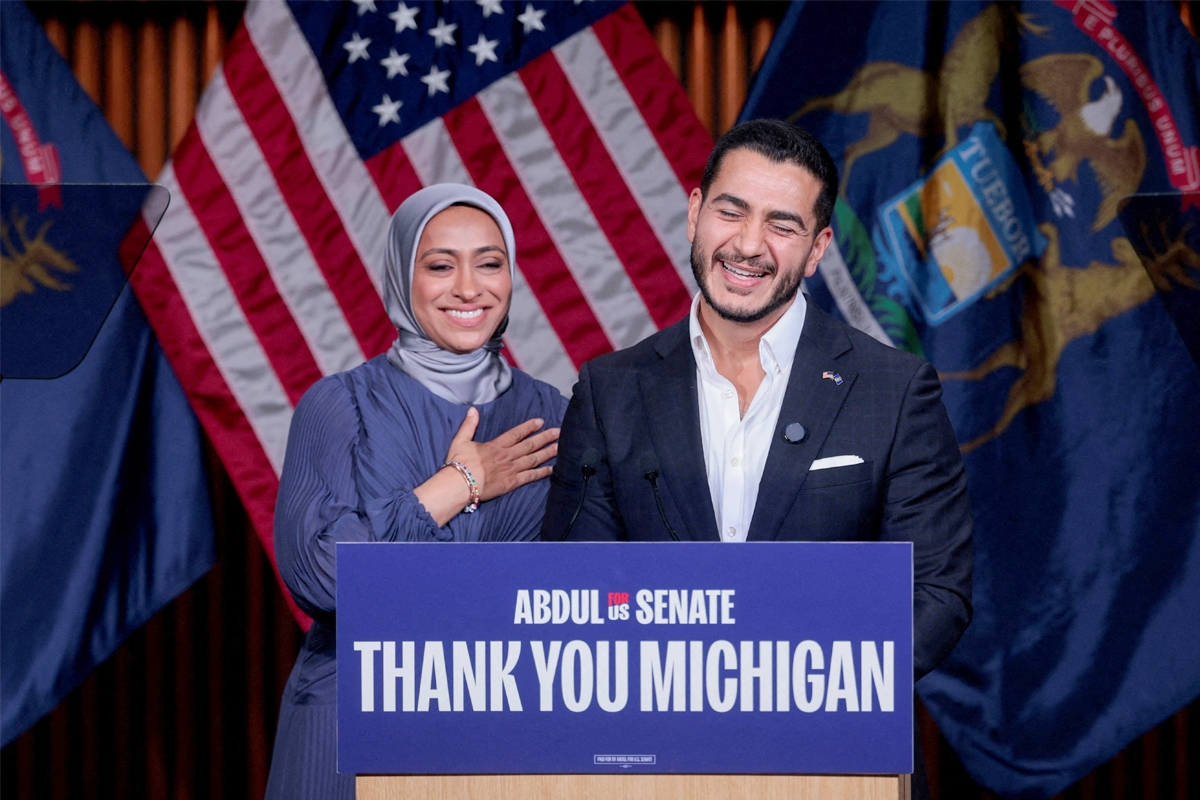
Abdul El-Sayed, who is of Arab descent, defeated former Republican Representative Mike Rogers in Michigan, becoming the first Muslim elected to the U.S. Senate.
El-Sayed said in a speech at his campaign headquarters in Detroit, “We did it!” The victory came despite a sudden setback in his campaign after Democratic Representative Haley Stevens announced her support for the Republican candidate.
Democratic control of Congress will allow the party to proceed with investigations into the Iran war, immigration policies, and reports of corruption in the Trump administration.
Democrats are expected to use their power, once they take their seats in January, to investigate the Trump administration, its family, and its allies, and to pressure for concessions on major legislation.
The Senate, now under Democratic control, could block Trump’s nominees, including any Supreme Court justices if a seat becomes vacant.
House Minority Leader Hakeem Jeffries, who is expected to become Speaker of the House in the new Congress, told supporters, “We will hold accountable those who dragged this country to unprecedented levels of corruption.”
If elected Speaker, Jeffries would be the first Black person to hold the position in the United States. Despite his conciliatory tone, Donald Trump reiterated on social media that he would use his veto power over bills Democrats want to pass, posting an image of a baseball cap with only the word “Veto” written on it.
Current Senate Minority Leader Chuck Schumer said, “We are now witnessing a shift in the Senate map unlike anything we have seen in a generation, and it will change America. Americans voted for change, and now Democrats must deliver it.”
In an unusually conciliatory manner, Trump adopted a reconciliatory tone toward Democrats after the results began to emerge and blamed members of his own Republican Party, suggesting that the outcome was “partly” caused by the war with Iran.
Trump, who spent the campaign period hurling various insults at Democrats, including calling them communists and Islamic extremists, said, “I am fully prepared to accept those results. We will work with Democrats, and as you know, we look forward to cooperating with them. We will likely reach understandings on many issues.”
He added, “But I don’t see it as a targeted blow against me.” At the same time, he warned that he was prepared to use his executive power to veto any legislation Democrats put forward. He said, “They can send me 50 wonderful bills they are enthusiastic about, and I will send them back stamped with a beautiful seal that says: Veto.”
However, the new balance of power could turn Trump into a “lame duck” or significantly curtail his actual authority, as attention shifts to the 2028 presidential race and his potential successors begin competing for influence in preparation for what comes next.
In a post on his platform, Truth Social, he said, “I was not on the ballots, but even if I had been, we would have won by a landslide.”
Later, Trump, who has faced two impeachment proceedings and is the first U.S. president elected after being criminally convicted, stated that he would become a “political analyst” and outline the reasons for the Republicans’ loss.
Reports indicated that the Trump administration prepared a plan to advance its hardline immigration policies through executive orders, similar to what it did during the first 100 days of his second term.
It remains unclear how Trump’s loss of control over Congress will affect the ongoing eight-month conflict between the United States and Iran. Voters have shown they are weary of this conflict, which many say has caused painful increases in fuel prices.
Two sources familiar with the thinking of Gulf states said that some of these countries now believe Trump has more reason than ever to seek a peace agreement, and that the likelihood of another comprehensive attack on Iran has decreased following the midterm elections.
However, Iran may also become emboldened after Trump’s overwhelming electoral defeat.
For Israel, Democratic control of both the House and the Senate could intensify parliamentary oversight of its military operations in Iran, Gaza, and Lebanon, and threaten the long-standing U.S. support it receives in the form of military aid and arms sales.
Prime Minister Benjamin Netanyahu’s opponents, who are seeking his removal, have cited the Democratic victory as evidence that he squandered bipartisan American support for Israel that had endured for generations, as they seek to capitalize on the opportunity to form a government without him.
Trump angered members of Congress, including many Republicans, when he lifted sanctions on Russian diesel and waived penalties on Russian energy just weeks after signing the law imposing those sanctions.
Democratic Representative Gregory Meeks of New York, a candidate to chair the House Foreign Affairs Committee, introduced bipartisan legislation to halt the implementation of Trump’s plan to return Russian diesel to the global market. However, it is unlikely that the midterm elections will change the Trump administration’s position in trilateral peace talks with Russia.
The Kremlin expressed hope that the election results would not affect what it called “Trump’s efforts to bring peace.”
Democrats returned to power with a sweep of Congress and state governorships across the United States following yesterday’s midterm elections, reflecting widespread rejection of President Donald Trump’s political agenda.
Here are some figures that tell the story of this historic night:
Final turnout numbers had not yet been released, but Americans had cast more than 61.7 million votes before Election Day, according to the Election Lab at the University of Florida.
This figure sets a record for early voting in U.S. midterm elections and favors Democrats, who typically vote early more than Republican voters.
Total spending in the 2026 midterm elections reached a record $11.9 billion, significantly higher than the $8.9 billion spent in 2022, according to OpenSecrets, a nonpartisan organization specializing in tracking U.S. political spending.
The 2026 races saw a surge in fundraising for campaigns and the purchase of advertising space, driven by outside spending from so-called “political action committees.”
This outside spending, led by billionaire Elon Musk, a Trump ally, benefited Republicans by a margin of approximately $360 million.
According to OpenSecrets, candidates for the House and Senate spent an unprecedented $3.7 billion from their campaign treasuries, with Democrats outspending Republicans by $800 million.
It had been 94 years since Kansas voters last chose a Democrat to represent them in the U.S. Senate. On Tuesday night, Adam Hamilton unseated the incumbent Republican Senator, Roger Marshall.
Texas also leaned toward the Democratic Party for the first time in decades, as Talarico secured a very surprising victory, winning a Senate seat in the state for the first time since 1988, the year before Talarico was born.
In South Carolina, a break from the usual historical pattern occurred as Senator Darlene Graham, who had been appointed earlier this year to fill the seat of her late brother Lindsey Graham, lost to Democratic candidate Annie Andrews. No Democrat has been elected to the U.S. Senate from South Carolina since 1998.
Exit polls showed that young men and Latino voters, two of the most important groups in Trump’s electoral base, had significantly moved away from the president and his Republican Party.
Latino voters had contributed to Trump’s rise to power in 2016 and played a pivotal role in his 2024 victory.
However, in recent weeks, many Latino voters expressed anger toward Trump, speaking of a sense of betrayal.
This was reflected in NBC News’ Tuesday exit polls, which showed Latino voters supporting Democratic candidates by 62% compared to 35% for Republican candidates.
Support for Trump among young people also declined. NBC News reported that its polls showed voters aged 18 to 29, both men and women, voted for Democrats by 72% compared to 25%. This represents a sharp shift compared to 2024, when young votes were split between Trump and Harris.
The midterm elections held the day before yesterday in the United States ended in a defeat for Republicans, breaking unspoken taboos by paving the way for minority Democrats to win top-tier positions.
Here is a summary of these unprecedented victories:
In the northern state of Minnesota, Peggy Flanagan achieved another notable milestone, becoming the first Native American woman to enter the Senate, having previously served as the state’s lieutenant governor.
This physician, the son of Egyptian immigrants, will be the first Muslim member of the U.S. Senate.
On the other side of the country, California elected Democrat Xavier Becerra as governor, making him the first person of Hispanic descent to lead the most populous U.S. state.
These election results reflect a “broad rejection of hatred and division,” according to Bill Shipley, director of strategy at the civic organization State Voices, speaking to France Press.
The Democratic Socialists of America (DSA) achieved unprecedented historic results in the midterm congressional elections, more than tripling its representation in the House of Representatives. In addition to prominent figures retaining their seats, five new members backed by the movement were elected to Congress.
