Trabzon: The Bride of the North and Capital of Beauty
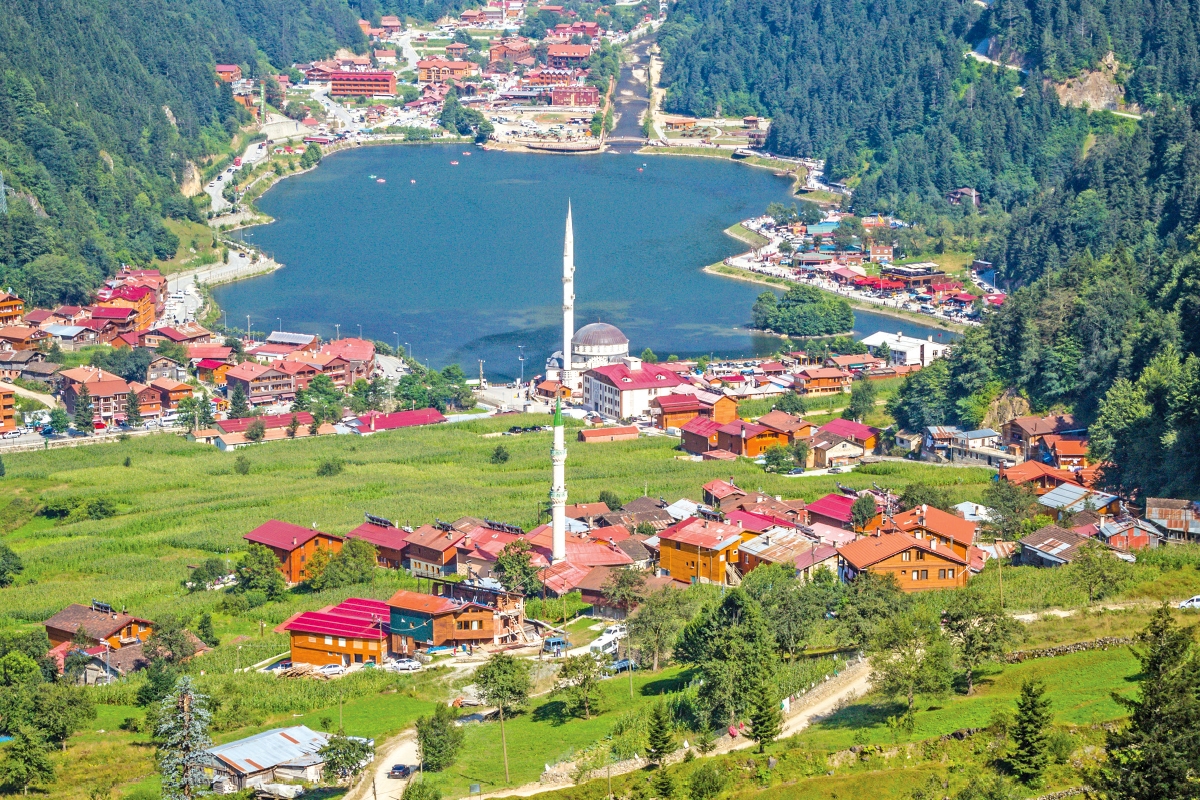
An exploratory journey to Turkish Trabzon showcases its historical, natural, and artisanal landmarks.
Translated by Qiyas from الجريدة — Original source
At the heart of this captivating natural beauty, ancient history pulses in every corner and rocky slope, as castles, museums, monasteries, mosques, shrines, caravanserais, baths, and markets—witnesses to the succession of civilizations—reveal the secrets of a city that has combined the glory of the past with the grandeur of the present, rightfully crowned as a capital of beauty unlike any other place in the world.
While Turkey is one of the world’s most popular holiday destinations, welcoming millions of tourists annually and ranking among the top travel preferences for Gulf countries, Trabzon stands out as the prime destination for those seeking natural beauty, tranquility, entertainment, and shopping.
Our program began with an ascent to Sumela Monastery (Monastery of the Virgin Mary), located in the Maçka district amidst the Tundre forests on a rocky slope of Karaca Dağ Mountain, overlooking the Altındere Valley at an elevation of 1,200 meters above sea level and 300 meters above the valley floor.
Although the initial climb up the mountain was arduous, the journey proved thrilling as we discovered a destination for tourists seeking natural beauty, history, and civilization. Historical accounts indicate that Sumela Monastery was founded by two priests, Barnabas and Sophronius, who came from Athens during the reign of the Eastern Roman Emperor Theodosius the Great (375–395 AD). The monastery continued to function until the 13th century.
Along the path leading to Sumela Monastery lies the Church of Agia Varvara, dating back to the mid-19th century. Its architecture reflects the historical heritage of the region, showcasing features of Eastern Roman and Rum architecture (the Eastern Orthodox Christian community within the Ottoman Empire), and is renowned for its rich cultural and historical background.
From the peak of Karaca Dağ Mountain to the Trabzon Botanical Garden, located near the city center in the Çamlıba neighborhood of Ortahisar, visitors are captivated by its stunning beauty. Spanning an area of 105,000 square meters, the garden houses approximately 516 plant species, including around 21,500 trees, saplings, and shrubs.
While museums are the ideal destinations for exploring the city’s heritage, the Trabzon Museum takes the top spot. Located in the Kostaki Palace, classified as one of the rarest examples of European architecture in Turkey, the museum houses numerous archaeological and ethnographic artifacts.
The famous banker Kostaki Teofilaktos built the palace during the 20th century, specifically between 1898 and 1913.
During the Turkish War of Independence, the palace served as a command headquarters, and Mustafa Kemal Atatürk, the founder of the Republic of Turkey, stayed there during his first visit to Trabzon in 1924.
In 2001, the palace was opened to the public as the Trabzon Museum, containing 3,561 precious artifacts.
Among the city’s historical sites, Alaca Han (the Inn) tops the list of tourist destinations. Located in the Bakırcılar neighborhood, its construction style and architectural elements suggest it dates back to the 18th century.
Just 3 kilometers from the city center lies Boztepe, one of the ideal spots to enjoy a panoramic view of Trabzon from above.
Often referred to as the “Roof of Trabzon,” it offers a magnificent panoramic view, and its observation deck is a popular stop for those wishing to capture stunning landscape photographs.
At the “Roof of Trabzon,” specifically at the foot of Boztepe Mountain, Kızlar Monastery shines within the city’s historical landscape. It was constructed during the Empire of Trebizond and founded during the reign of Alexios III Megas Komnenos.
The monastery is also known as the Monastery of Panagia Theoskepastos. The monastic complex originally consisted of a rock-cut church on the southern side, a chapel at its entrance, and the monks’ cells.
Among nine historical buildings in Turkey bearing the name “Hagia Sophia,” which translates from Greek as “Holy Wisdom,” is the Hagia Sophia Mosque in Trabzon. In Byzantine cities, the main and largest churches were named Hagia Sophia, but after the Ottoman conquest, these churches were converted into mosques.
The Hagia Sophia church in Trabzon was built during the reign of Manuel I Komnenos, between 1238 and 1263, and stands as a beautiful example of late Eastern Roman (Byzantine) architecture.
The church is located within a monastic complex, and to its west stands a bell tower dating back to 1427.
Hagia Sophia is one of the most important examples of late Eastern Roman architecture. The mosque’s frescoes date back to that period and narrate the story of Adam and Eve’s expulsion from Paradise through traditional imagery.
In another significant Ottoman historical site, the journey passes through the Ortaköy neighborhood in the Akçaabat district of Trabzon, distinguished by its unique architectural character that draws attention.
The neighborhood features examples of Ottoman civil architecture and is one of the rare areas that has fully preserved its historical character.
Ortaköy includes historical houses and palaces, cobblestone streets, and fountains. It was designated a protected area in 1988.
Between history and politics stands one of Turkey’s prominent tourist landmarks, the Atatürk Palace, which witnessed a bond of love between the ruler and the people, as Atatürk bequeathed his properties to the Turkish nation.
Mustafa Kemal Atatürk, the founder of the Republic of Turkey, was hosted in this palace during his first visit to Trabzon in 1924.
While Trabzon is renowned for its stunning natural scenery, it also boasts a wealth of handicrafts practiced in small workshops, including silk and linen weaving, production of “beştemal” (traditional towels), cotton weaving, jewelry making, and carpentry.
Kazazlık, a jewelry-making art form, is among the city’s most prominent handicrafts, involving wrapping gold and silver wires around silk threads.
Trabzon’s cuisine is famously characterized by anchovies, its signature ingredient, with 40 different recipes prepared using them. Additionally, hundreds of dishes are made using corn, cabbage, green beans, and hazelnuts.
Local dishes and products include surmeni pide (a type of flatbread), Akçaabat köfte (meatballs), Hemşin sutlaç (rice pudding), as well as fried anchovies, anchovy rice, nettle soup, kaygana (a thin pancake similar to crepes), kuymak (a traditional dish made from mashed corn), cabbage soup, and stuffed cabbage.
Tea is also closely associated with this region, with cultivation concentrated primarily in eastern Trabzon. Residents enjoy tea in copper pots against the backdrop of the deep blue Black Sea stretching out before the sky-blue vistas of this ancient city.
