Eisenkot Camp Faces 'Arab Dilemma' as Netanyahu Maneuvers for Unity Government
Lacking a majority, Netanyahu seeks to form a unity government while Eisenkot opposes it. Jabarin stresses the need for opposition cooperation with Arab parties, and Trump announces a halt to military aid.
Translated by Qiyas from الجريدة — Original source
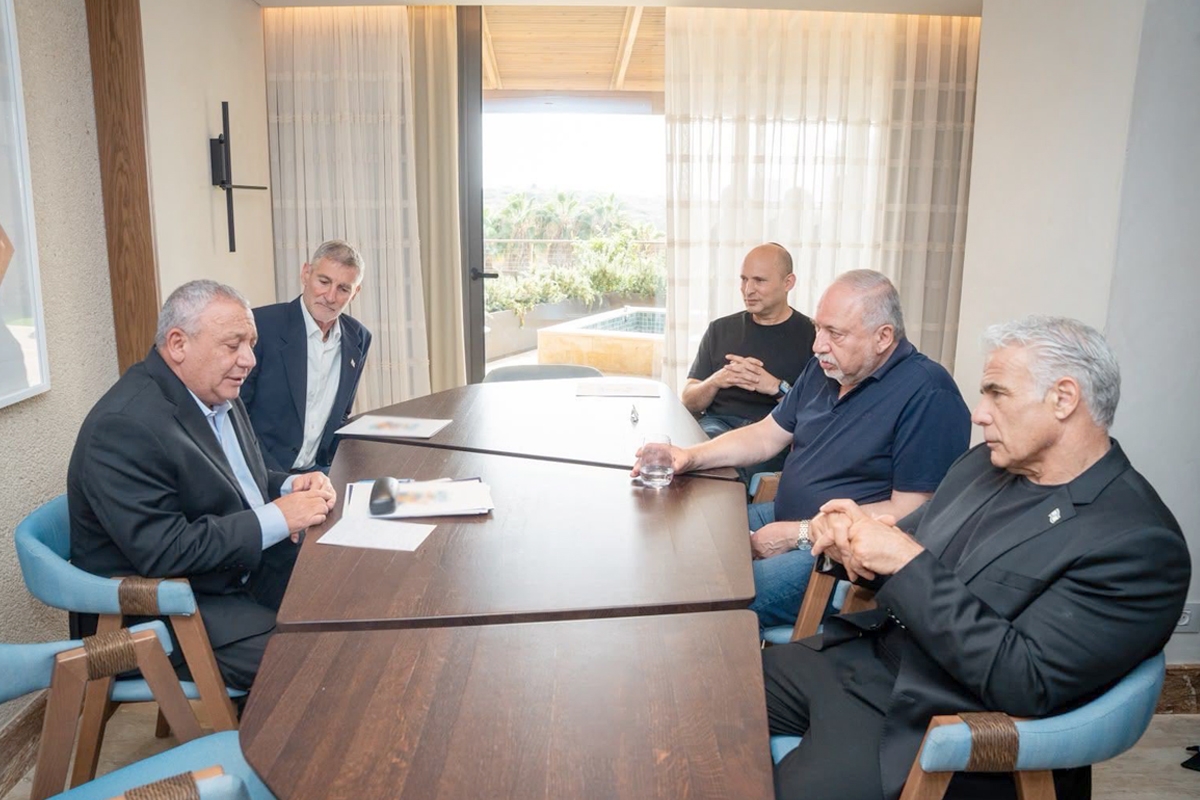
With the exception of the agreement to recommend that President Isaac Herzog task Benny Gantz with forming the next government, the meeting yielded no clear outcomes.
Channel 14 reported that the opposition bloc leaders’ attempt to form a unified front against the right-wing government suffered a major blow, as the coordination meeting ended in less than an hour, participants quickly dispersed, and they avoided appearing together before cameras or issuing a joint statement to the media.
The attendees sought to reach a consensus despite existing disagreements on several issues, although they agreed on the necessity of ousting Benjamin Netanyahu.
The meeting took place against the backdrop of election results that failed to grant either camp the parliamentary majority needed to form a government (61 seats). Netanyahu’s camp secured 53 seats, while the opposition camp obtained 48 seats. The two Arab lists, Joint List and United List, won 19 of the 120 seats in the Knesset.
The core issue is the extent to which the opposition bloc is willing to grant Arab parties a role in the government or cooperate with them, particularly since these parties are prepared to support Gantz to remove Netanyahu from power.
Most opposition bloc members have so far refused to ally with Arab parties, recognizing that such a move could alienate a segment of Jewish voters. Only Golan supports this alliance, while Lieberman strongly opposes it. Gantz’s party appeared to rule out this option without explicitly rejecting it, while the stance of Bennett and Lapid’s “Yesh Atid” party remains unclear.
In this context, Joint List leader Youssef Deeb stated that opposition parties must accept the political reality and cooperate with Arab lawmakers if they are serious about ousting Netanyahu, emphasizing that the opposition lacks a majority to pass legislation without their votes.
He stressed that cooperation does not necessarily mean participating in the government, reaffirming his list’s commitment to issues such as equality, combating crime and violence, demolishing homes, discriminatory policies, and improving budget allocations.
Yesterday evening, Netanyahu announced in a lengthy message on his social media accounts that he was “open to dialogue,” calling for the formation of a broad governing coalition under his leadership.
The opposition bloc, which framed the elections during its campaign as a referendum against Netanyahu, did not issue any public response to his initiative. The Israeli Broadcasting Authority (Kan) reported that Gantz said in a closed meeting that he would not sit in a government led by Netanyahu, adding that if invited by U.S. President Donald Trump, he would attend out of respect, but would emphasize that the matter concerns Israel’s internal affairs and that he would prevent any external interference.
It is customary for the Israeli president to choose the figure who receives the greatest number of party recommendations, taking into account each party’s parliamentary weight.
According to media reports, Netanyahu’s far-right allies, Betzalal Smotrich and Itamar Ben-Gvir, are expected to recommend that the outgoing prime minister be tasked with forming the government, unless a major surprise occurs, as is the case with the ultra-Orthodox Shas party.
Herzog and most party leaders have expressed their desire to avoid reaching a deadlock that could lead to calls for new elections.
Meanwhile, U.S. President Donald Trump stated today that he had reached an agreement with Netanyahu and that Washington would not continue providing military aid to Israel after the end of this year.
Trump said in an interview with Fox News that Israel no longer needs this aid, and that some Democrats and left-wing politicians are using this American funding for Israel as a pretext to criticize Republicans. He added, “Regarding payments to Israel, my colleague and I, Bibi Netanyahu, agreed to provide four billion dollars annually to Israel, and we agreed months ago to halt that.” He further stated, “We have already agreed that we will not pay money to Israel by the end of this year. Now we will assist Israel if it needs help.”
