Research Center contributes to reviving national documents
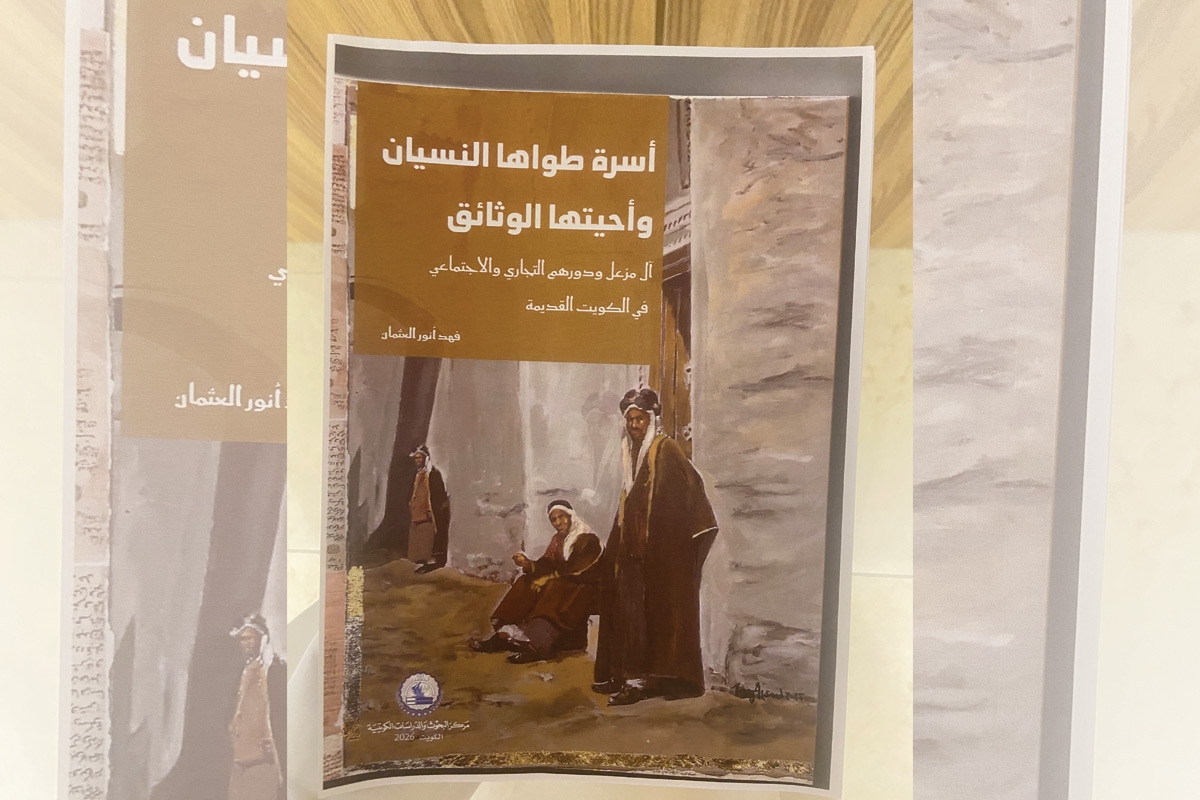
The book 'A Family Forgotten by Time' recovers the commercial history of the Al-Muzayna family through rare documents
Translated by Qiyas from الجريدة — Original source
The book “A Family Swallowed by Oblivion and Revived by Documents,” which covers the history of the Al Muzayna family and their social and commercial role in old Kuwait, comes within the framework of the efforts undertaken by the Kuwait Center for Research and Studies to revive civil documents, which constitute one of the sources for tracing Kuwait’s history, as stated in the foreword by Dr. Abdullah Al-Ghanim. These are documents that modern history did not record.
The book retrieves the commercial and social history of the Al Muzayna family from oblivion, through a family archive compiled by Professor Fahd Anwar Al-Othman.
In this regard, Dr. Faisal Adel Al-Wazan points to the role of Khalifa bin Muzayna, that merchant who maintained his financial stability during the global depression, as well as his son Abdullah, who worked to expand the family’s trade to India and East Africa.
The author, Fahd Anwar Al-Othman, notes that the great-grandfather migrated from Ha’il to Kuwait due to the attractive environment, distinctive maritime location, economic prosperity, and the justice and wisdom known about its rulers. He invested part of his wealth in a family residence and the rest in trade, in partnership with his sons.
What distinguishes the book are the original documents, some of which are published for the first time. They do not merely narrate the story of a family, but document an important aspect of Kuwait’s history. These documents vary between commercial contracts, shipping documents, and mudaraba (profit-sharing) agreements.
Among these documents is a rare record of a Kuwaiti Hajj pilgrimage organized by Saif Al-Dawila, one of the organizers, containing precise details about the journey.
Another document highlights the term “Al-Mashoufa,” referring to a caravan trader, a rare term similar in meaning to “Al-Uqaylat.”
The documents also reveal a wide commercial network of the Al Muzayna family extending from Kuwait to India, Japan, Singapore, Berbera in Somalia, Basra, and Najd.
It is clearly evident from reading the book the value of civil documents, as they represent a primary source that helps fill gaps in Kuwait’s history.
The book comprises five chapters: the first discusses lineage and migration from Ha’il to Kuwait; the second covers the commercial activities of the Al Muzayna family; the third discusses trade and money management through commercial mudaraba; the fourth focuses on Abdullah Al-Khalifa Al-Muzayna; and the fifth presents artifacts and documents of the Al Muzayna family, along with an index of names, groups, places, and institutions.
Among the documents published in the edition is Document No. 105, a commercial letter issued by merchant Ali Al-Humoud Al-Shaie in Bombay on 23 Sha’ban 1351 AH, corresponding to December 11, 1932, addressed to Abdullah bin Khalifa Al-Muzayna in Kuwait. In his letter, he mentions that goods at our end have been stagnant for some time, and he refers to the prices of existing goods, especially fabrics, along with personal greetings to the family.
There is also Document No. 106, a letter from Ali Al-Shaie in Bombay to Abdullah Al-Muzayna in Kuwait, dated 1352 AH / 1933 CE.
The edition includes images of some family artifacts, which reflect an aspect of the commercial environment in Kuwait at the beginning of the 20th century. They represent the tools of work used by members of the Khalifa Al-Muzayna family to manage their commercial activities and organize their daily affairs, serving as physical evidence of an early stage in the development of trade and management methods in old Kuwaiti society.
