"What Does the Critic See in the Novel?" Kuwait-Egypt Seminar Explores Relationship Between Creativity and Criticism
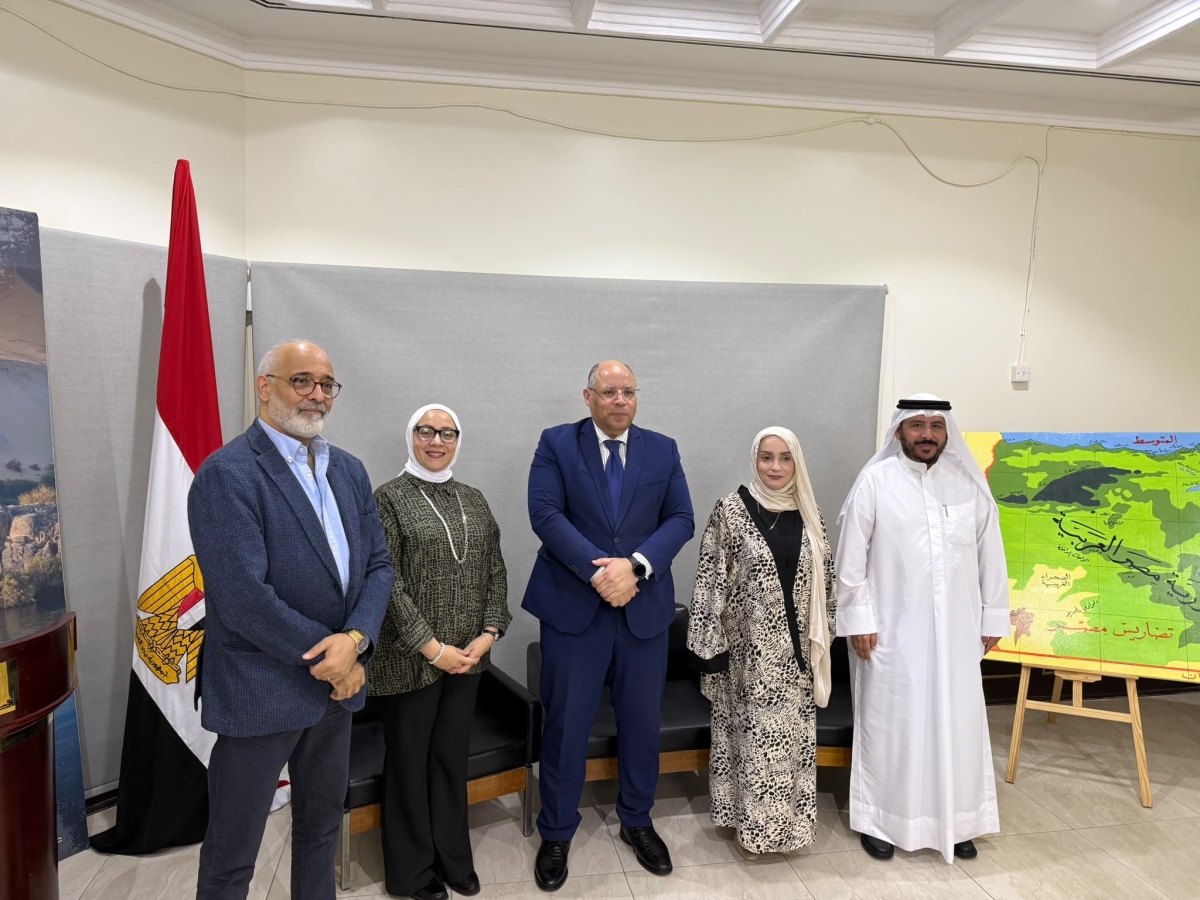
The Egyptian Cultural Office organized a seminar in Kuwait on literary criticism, featuring experts and discussions on artificial intelligence.
Translated by Qiyas from الجريدة — Original source
The Egyptian Cultural Office in Kuwait organized a literary symposium titled “What Does the Critic See in the Novel?.. Between the Reader’s Vision, the Critic’s Tools, and the Writer’s Creativity,” under the patronage and attendance of Egyptian Ambassador Mohamed Abu Al-Wafa.
The symposium is the second event within the activities of the Cultural Salon launched by the Egyptian Cultural Office last September, aiming to provide a space for dialogue and exchange of views among Egyptian and Kuwaiti intellectuals, creators, and all those interested in literary affairs in Kuwait, as well as to discuss contemporary cultural issues.
The symposium featured Dr. Ayman Bakr, Professor of Criticism and Literature at the Gulf University for Science and Technology; Dr. Jehan Al-Damardash, literary critic; and Dr. Barak Al-Qa’ait, critic and writer.
The discussions addressed the nature of the relationship between the writer, the reader, and the critic, as well as the tools of literary criticism in reading narrative texts, and the role of criticism in uncovering the intellectual and aesthetic dimensions and implications of literary works.
The symposium covered several important themes. Al-Qa’ait discussed the difference between critical reading and impressionistic reading, the criteria for distinguishing between the importance of a novel’s subject matter and the quality of its artistic treatment, the role of personal taste in critical judgment, and ways to enhance readers’ critical awareness, thereby helping them move beyond mere engagement with the novel’s events and characters to understanding its artistic structure and implications.
Bakr discussed the role of cultural criticism in uncovering social and intellectual paradigms and power relations within novels, while preserving their artistic specificity. He emphasized the importance of developing an Arabic critical discourse that combines epistemological rigor with the ability to communicate with non-specialist readers, amid the transformations currently affecting Arabic novels in their forms, techniques, and themes.
Al-Damardash focused on an influential fictional character, that of Naguib Mahfouz, to enrich the discussion on novelistic characters, their implications, and their impact on the literary experience.
For his part, Ambassador Abu Al-Wafa, in his intervention, affirmed that the symposium’s title raises an important question about the nature of the relationship between the writer, the reader, and the critic. He noted that the writer presents their literary work through their human experience, culture, imagination, and creativity, while the reader interacts with the text according to their own culture and personal experiences. The critic, meanwhile, seeks through analytical tools to uncover the intellectual, aesthetic, and symbolic dimensions of the literary work. Thus, the critic serves as a partner in discovering the meanings of the literary work and opening new horizons for its understanding and interpretation.
The ambassador highlighted that the importance of this topic is amplified today amid rapid technological transformations, particularly the unprecedented development in artificial intelligence applications, which no longer limit themselves to text analysis but have become capable of producing literary and narrative works and simulating various literary styles.
He posed the question of whether artificial intelligence can become a true creator, or whether it can only simulate creativity without possessing the human experience that gives it depth and spirit. He emphasized the importance of exploring how to harness artificial intelligence to serve human creativity without it becoming a substitute for it.
The symposium witnessed significant discussion and interaction from the attendees, whose interventions and questions enriched the dialogue and added important points to the discussion themes, reflecting interest in issues of literary criticism and its relationship with novelistic creativity, as well as the challenges facing the critical movement amid current cultural and technological transformations.
The discussions yielded a number of important recommendations, foremost among them the emphasis on the necessity for writers to remain open to literary criticism and to benefit from it in developing their creative experience, viewing it as a tool for enhancing and elevating literary work rather than merely passing judgment on it.
The seminar also recommended that critics adhere to scientific and objective critical methodologies and tools, while avoiding subjectivity and personal affiliations that could compromise the integrity and objectivity of literary evaluation.
Furthermore, the discussions underscored the need to encourage relevant cultural and academic institutions to support the Arab critical movement and to develop its methodologies and tools, thereby contributing to the establishment of an Arab critical school rooted in the specificity of Arab culture and its creative experiences, and producing an independent critical perspective. This approach should consciously draw on global critical schools, rather than merely adopting their methodologies and foundations without adapting them to align with our cultural and literary realities.
