Saudi-American Consultations... Riyadh Distinguishes Between Diplomacy and Readiness to Deter
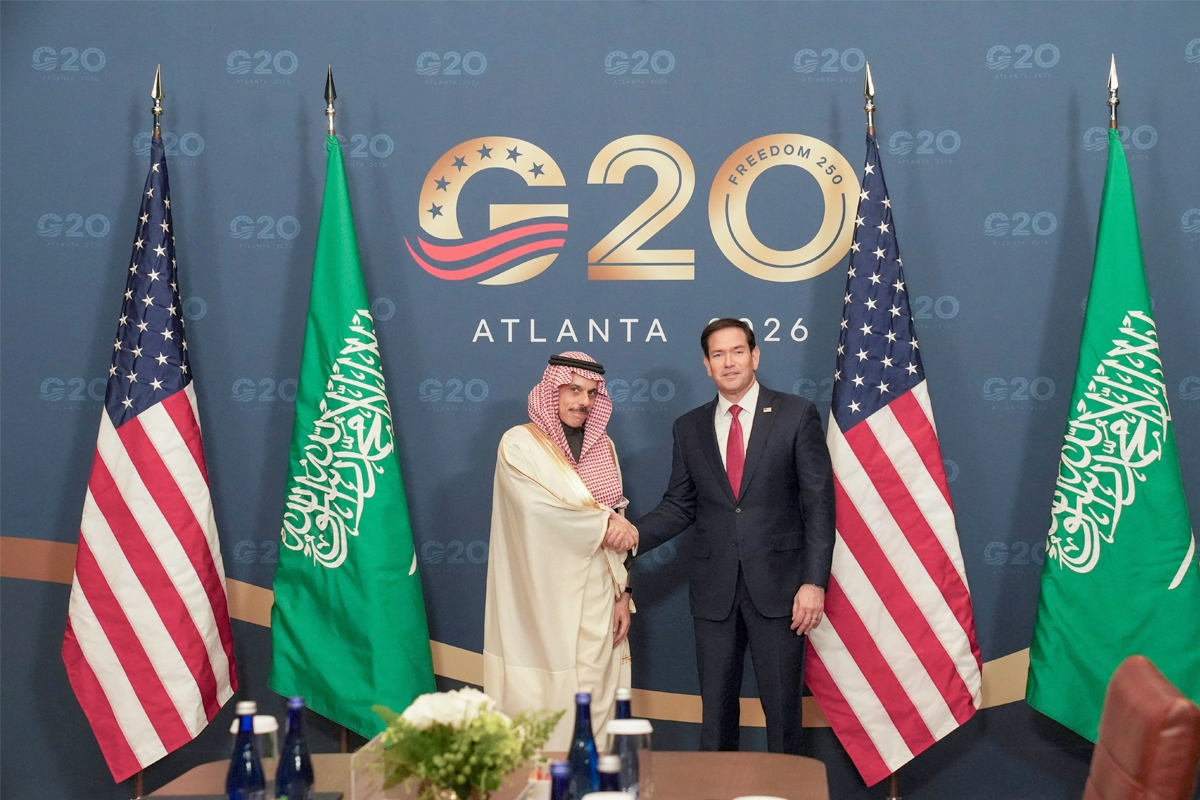
The Saudi Foreign Minister discusses security and political cooperation with his American counterpart, while the Houthis continue to target Saudi Arabia and Yemen.
Translated by Qiyas from الجريدة — Original source
As Houthi militia attacks, allied with Iran, on civilian facilities continued—both within Yemen and in Saudi Arabia—Saudi Foreign Minister Prince Faisal bin Farhan held talks with his American counterpart, Marco Rubio, covering international developments and regional security.
The U.S. State Department stated that Rubio and bin Farhan discussed, on the sidelines of the Group of Twenty foreign ministers’ meeting in Atlanta the day before yesterday, the continuation of cooperation on regional issues, including the situations in Iran, Yemen, and Sudan.
Bin Farhan also discussed developments with international officials, including his Russian counterpart, Sergey Lavrov, on the sidelines of the Atlanta meeting.
Meanwhile, Saudi Deputy Foreign Minister Walid al-Khoreji held consultations with U.S. Assistant Secretary of State Donald Bloom yesterday on the sidelines of the Manama Security Dialogue forum in the Bahraini capital.
In his address to the forum, al-Khoreji emphasized that diplomacy should not be viewed in isolation from readiness for deterrence, noting that Saudi Defense Minister Prince Khalid bin Salman’s visit to Tehran, leading a delegation from the “Mecca Alliance,” aimed to de-escalate tensions, encourage dialogue and diplomatic solutions, and support mediation led by Qatar and Pakistan.
He added that the goal of opening negotiation channels is to prevent a return to military escalation and reach an agreement that ends the crisis and enhances the region’s security and stability, affirming that Riyadh is acting to prevent a new round of fighting while maintaining its capacity to confront threats.
In his speech at the Manama forum, Secretary-General of the Gulf Cooperation Council (GCC) Jassem al-Buaidi condemned Houthi militia attacks on Saudi Arabia since July, including strikes on Mecca and Medina, describing them as violations of the sanctity of holy sites.
For her part, Yemeni Foreign Minister Afrah al-Zoubi called for urgent international action at the forum, stressing that sustainable regional security cannot be achieved without a safe and stable Yemen.
Al-Shaybani affirmed Syria’s support for Yemen in restoring its sovereignty and stability across its entire territory, urging everyone to support the unity and sovereignty of states, and warning that international neglect of challenges, as previously happened with Syria, leads to the transfer of dangers to other regions.
On the ground, the Houthi militia continued its attacks on Saudi Arabia and Yemen. Yesterday, Turki al-Maliki, spokesperson for the coalition supporting legitimacy, announced that air defenses intercepted and destroyed three drones launched by the “terrorist militia” allied with Iran toward the Riyadh area and the southern and eastern regions.
Earlier, al-Maliki announced the interception and destruction of a drone launched by the Houthi militia toward the Mecca region, coinciding with attacks on the Maashiq Presidential Palace and Aden International Airport in Yemen.
The Yemeni Cabinet stressed that targeting the Maashiq Palace for the second time and Aden International Airport for the seventh time, along with an attempt to strike Mecca, reveals an escalatory approach that goes beyond targeting state institutions and civilian facilities to threatening regional security and showing disregard for the sanctity of Islamic holy sites.
Meanwhile, a Yemeni military source reported yesterday that government forces completed control over the strategic Hawshayan mountain range in the Al-Jawf province, north of the country, near the Saudi border.
He added that control over the mountain range came after fierce battles with the Houthis, during which government forces managed to reach the highest peak in the range.
The Al-Jawf Governorate is among Yemen’s strategically important governorates, owing to its land border with Saudi Arabia and its geographic proximity to several other governorates, including the oil-rich governorates of Marib and Hadhramaut.
