Rajji: Lebanon Will No Longer Accept Its Territory Being Used as a Platform to Threaten the Security of Its Arab Brothers
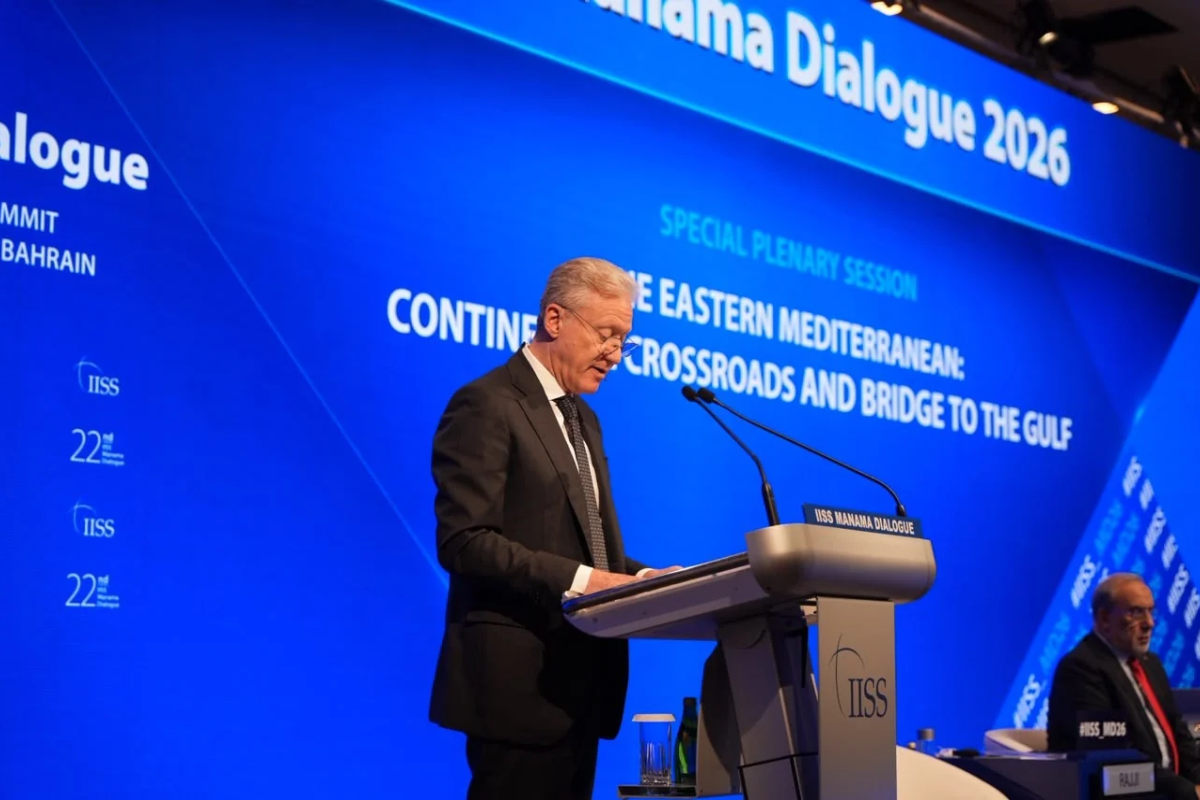
Lebanese Foreign Minister Youssef Rajji affirmed Lebanon's rejection of its territory being used as a platform to threaten the security of Gulf states, and called for support for the Lebanese army.
Translated by Qiyas from الجريدة — Original source
Lebanese Minister of Foreign Affairs and Expatriates Yusuf Raji affirmed on Saturday that Lebanon will no longer accept its territory being used as a platform to threaten the security of its Arab brothers or as a bargaining chip in settlements negotiated outside its borders.
In a statement, the Lebanese Ministry of Foreign Affairs said Raji’s remarks were made during a speech at the 22nd edition of the “Manama Dialogue – Regional Security Summit,” organized by the International Institute for Strategic Studies in the Bahraini capital. He reaffirmed Lebanon’s full solidarity with Bahrain and the Gulf Cooperation Council (GCC) countries “in the face of Iranian aggression and that carried out by armed groups linked to Iran,” rejecting any infringement on their sovereignty, security, and territorial integrity.
Raji warned against threats to navigation security in the Strait of Hormuz, the Bab al-Mandab, and the Red Sea, noting that “the security of the Gulf is no longer separate from the security of the Red Sea, which is linked to the security of the Eastern Mediterranean.”
During a special session on the Eastern Mediterranean titled “Eastern Mediterranean: A Crossroads of Continents and a Bridge to the Gulf,” he stated that “no state has the right to achieve its regional ambitions through armed organizations operating outside state authority,” adding that Lebanon “has experienced over the years the devastating consequences of armed organizations becoming tools of external influence, and Lebanese people have paid heavy prices for wars they did not choose.”
Raji stressed that GCC countries have never been merely economic partners, but have hosted generations of Lebanese and stood by Lebanon during its most difficult periods. He emphasized that “the ties binding Lebanon to its brothers in the Gulf have proven their resilience, even during periods when relations were strained due to interests that Lebanon did not accept to be subordinated to calculations that do not concern us and which we have rejected.”
Raji outlined the path for the Lebanese state to reclaim its authority, recalling government decisions to monopolize weapons within the state and ban the military and security activities of Hezbollah. He noted that these measures “were not a response to external dictates, but stemmed from a firm, sovereign Lebanese conviction, and are not merely political stances or declarations of intent.”
He affirmed that restoring sovereignty in Lebanon also requires the complete withdrawal of the Israeli occupation from occupied Lebanese territories, an end to aggressions, and the implementation of International Resolution 1701.
Raji called on GCC countries to support the Lebanese Army and security institutions and to resume investments, emphasizing that Lebanon “aspires to renew political and strategic partnership, based on the understanding that a sovereign, stable, and prosperous Lebanon is a strategic Arab interest, not just a Lebanese one.”
Concluding his remarks, the Lebanese Foreign Minister said that “the future of our region must not remain hostage to the ambitions of armed militias, the calculations of external powers, or settlements negotiated at the expense of our countries’ sovereignty and our peoples’ interests. Instead, it must be shaped by sovereign, cohesive states that are aware of their interests, united among themselves, and capable of assuming responsibility for their own security, stability, and self-determination.”
On the sidelines of his participation in the 22nd Manama Dialogue, Raji held a series of meetings with Arab and foreign officials, including Bahraini Foreign Minister Abdullatif bin Rashid Al Zayani, Armenian Foreign Affairs Minister Ararat Mirzoyan, German Deputy Minister of Defense Niels Annen, and U.S. Assistant Secretary of State for Near Eastern Affairs Donald Blome. During his meeting with Blome, they discussed the importance of continuing the government’s reform path and the necessity of sustained U.S. support for the Lebanese Army.
