Poland Enters Open Crisis: Struggle for Constitutional Court Leadership and European Direction
Poland faces an unprecedented political and institutional standoff over the leadership of the Constitutional Court, leading to diplomatic resignations and protests.
Translated by Qiyas from الجريدة — Original source
Poland has entered an unprecedented phase of political and institutional confrontation since Donald Tusk assumed the premiership in 2023, as the conflict between his pro-European coalition and the conservative nationalist Law and Justice party has shifted from disputes over judicial reform to a direct struggle for control of the Constitutional Tribunal, accompanied by protests.
The dispute centers on the legacy of the eight years during which Law and Justice governed the country between 2015 and 2023, a period marked by sweeping changes to judicial institutions, particularly the Constitutional Tribunal, which critics within Poland and in the European Union accused the party of subjugating to its political influence. Tusk, a centrist-right figure supportive of European integration, states that his government seeks to restore judicial independence and the rule of law, while the opposition party views these moves as an attempt to seize control of institutions and sideline judges aligned with it.
The crisis escalated after Judge Anna Korwin-Piotrowska, appointed by the current parliament, announced the suspension of Chief Justice Bogdan Witczak and his deputy from their duties, assuming temporary management of the Tribunal. The government accuses Witczak, who was appointed during Law and Justice’s tenure, of obstructing the assumption of office by judges elected by the parliamentary majority, while Witczak refuses to recognize several of these appointments, making the composition of the Tribunal and the legitimacy of its leadership the focal point of the conflict.
Witczak, allied with Law and Justice, described the events as a forcible takeover of the state’s constitutional body, while the Chief Justice referred to it as a “constitutional coup.” In response, Tusk defended his government’s actions as necessary to end what he termed years of illegal practices and to restore the rule of law.
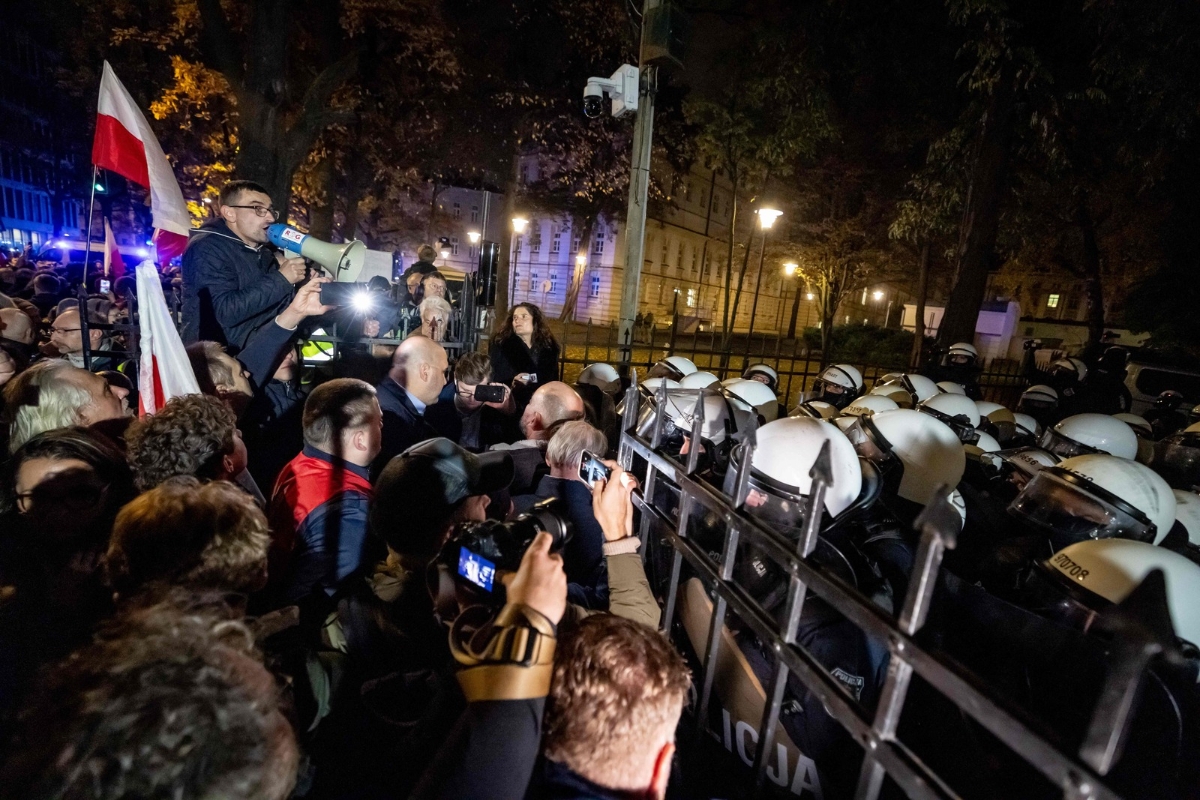
The confrontation spilled onto the streets on Friday evening, after supporters of the party gathered outside the Tribunal in Warsaw. Some attempted to breach security fences and threw projectiles at police, resulting in the detention of three protesters. Police forces were deployed to secure the building and prevent further clashes, while Jarosław Kaczyński and figures from the right and far-right joined the demonstrators.
Witczak cut short his trip to Senegal, returning to Warsaw before heading to the Tribunal to support the detained Chief Justice. He argued that the events threaten the country’s internal security and called for urgent consultations with parliamentary party representatives to find a way out of the crisis.
The fallout from the confrontation extended beyond judicial institutions, as Poland’s ambassadors to China, Jakub Kumoch, and to Romania, Paweł Sokołowski, announced their resignations in protest against what they described as an illegal attempt to seize the Tribunal. Both diplomats belong to the political circle of former President Andrzej Duda, who was allied with Law and Justice. Meanwhile, Foreign Minister Radosław Sikorski rejected the ambassador to China’s stance, stating that he no longer represented the state. Notably, Kumoch submitted his resignation via social media, and Sikorski accepted it through the same platform, bypassing diplomatic conventions.
The domestic crisis coincides with escalating disagreements over Poland’s European future. On October 28, Kaczyński, speaking at the Krems Forum, suggested the possibility of initiating withdrawal negotiations from the European Union if reform efforts failed, while simultaneously proposing a new treaty that would return powers to member states. Although he insisted that withdrawal was not the first option, Tusk viewed the remarks as opening the door to Poland’s exit from the EU. Kaczyński defended his position as a pressure tactic to restructure European institutions and reduce the powers of Brussels.
The confrontation gains significance that transcends partisan divisions, as Poland is a key member of the European Union and NATO, serves as a major hub for the transit of Western aid to Ukraine, and shares borders with Russia, Belarus, and Ukraine.
