'Welcome, Apollo!' Cultural and musical evening at the Writers' Association
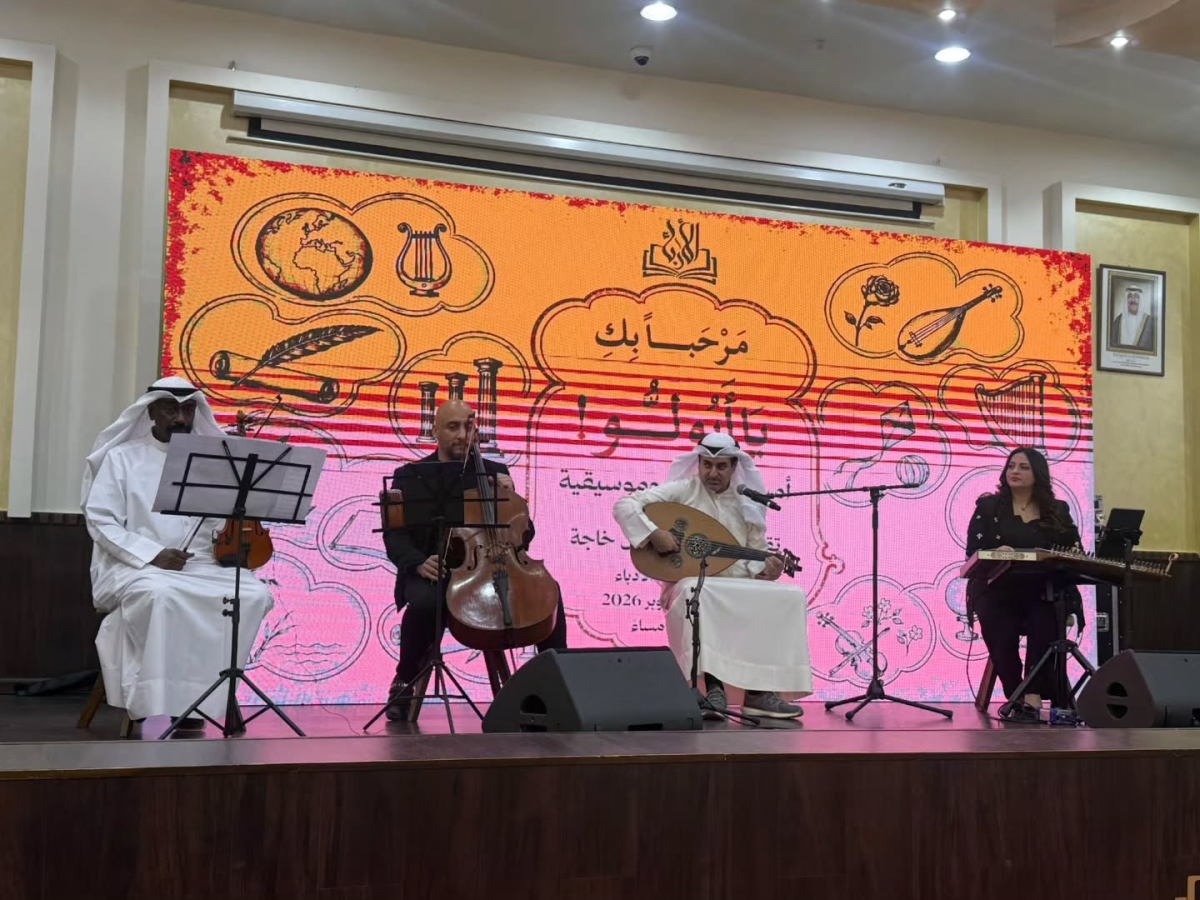
Faisal Khaja presented the history, objectives, and impact of the Apollo Poetry Association on Arabic poetry during an evening event at the Writers' Association.
Translated by Alqyas from Al-Jarida — Original source
Under the title “Welcome, Apollo,” writer and researcher Faisal Khajja presented a cultural and musical evening at the Writers’ Association, centered on highlighting the Apollo poetic movement founded by the Egyptian writer Ahmed Zaki Abu Shadi in 1932. The movement culminated in the launch of Apollo, a monthly literary magazine, which had a short lifespan, ceasing publication after 27 issues, the last of which was the December 1934 edition. Despite its brief existence, the movement’s profound impact transcended its short duration and geographical boundaries, sparking a renewing trend in the content and styles of Arabic poetry, making it more liberated and diverse.
Khajja began by outlining the biography of the movement’s founder, Ahmed Zaki Abu Shadi, detailing his intellectual sources and ambitions. He then discussed the publication of the first issue of Apollo magazine, which featured on its first page a poem by Ahmed Shawqi titled “Export,” consisting of 13 verses. The opening line of the poem, “Welcome, Apollo,” served as the evening’s title and expressed Shawqi’s enthusiasm for the association’s ambition to serve Arabic poetry. Khajja also reviewed Abu Shadi’s editorial statement, in which he expressed his aspiration for the magazine to follow the standards of global poetry magazines and to broaden the themes and ideas of poetry, making them more expressive and impactful. He further examined critic and writer Abbas al-Aqqad’s critique of the magazine’s name, noting al-Aqqad’s preference for “Mercury,” a name rooted in Arab mythology rather than the Greek mythology represented by “Apollo.”
Khajja then presented the Apollo Association’s constitution, comprising nine articles, which collectively demonstrated the founders’ early awareness of the importance of organized administrative work. He subsequently outlined the association’s objectives, centered on three main points, the core of which was “elevating Arabic poetry.” He concluded this section by reviewing the various sections of the magazine, which covered 18 topics, underscoring the association’s and its founders’ commitment to intellectual diversity.
Following Khajja’s presentation, accompanied by a musical ensemble, he performed two songs based on poems by the founders of the Apollo Association. The first was “Ya Habib al-Ruh” (O Beloved of the Soul) by poet Ibrahim Naji, which was later composed and performed by Riyad al-Sunbati. The second song was “Cleopatra,” with lyrics by poet Ali Mahmoud Taha, composed and performed by Mohamed Abdel Wahab in 1944. The ensemble included Mubarak Bakheet on violin, Mohamed Shousha on cello, Marina Majed on qanun, and Ahmed Murad on riq.
