Brazil: Lula wins fourth term, halting right-wing victories
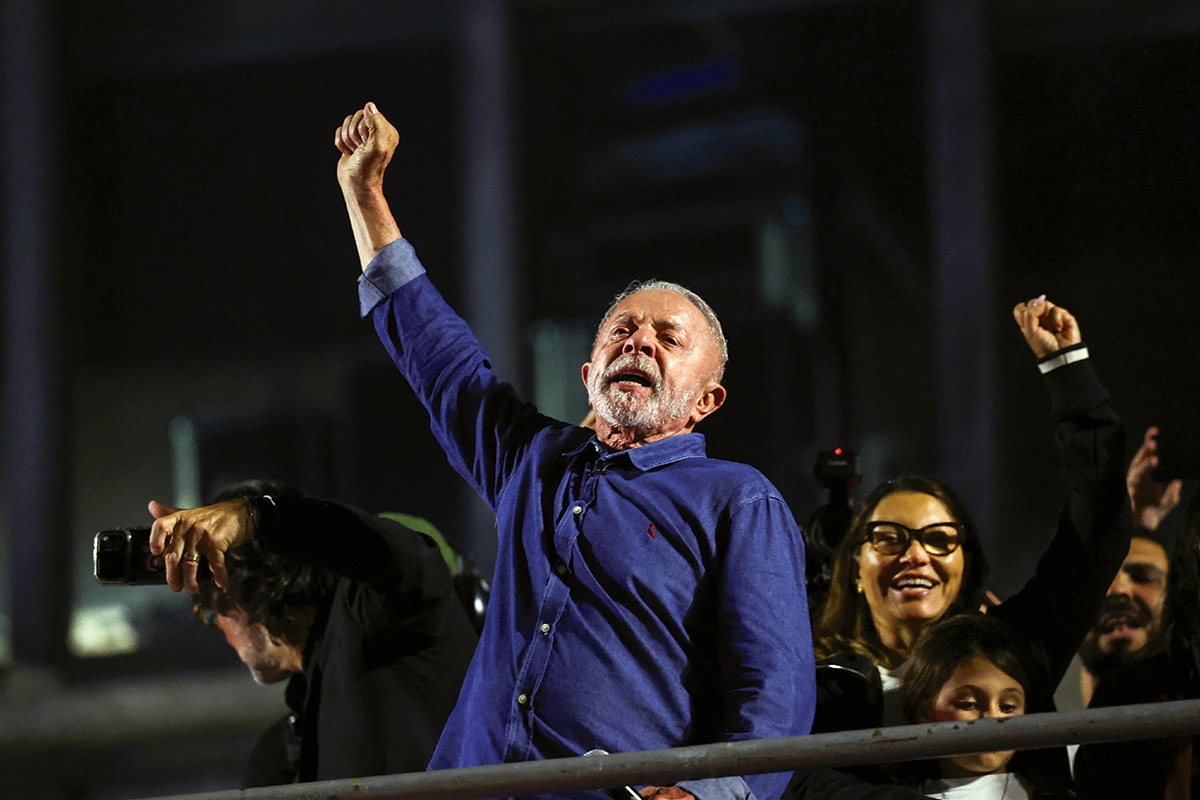
Lula's victory with 48.2% of votes stops the right-wing surge in the region
Translated by Qiyas from الجريدة — Original source
Brazilian President Luiz Inácio Lula da Silva secured a historic victory in his fourth presidential term, defeating his right-wing rival Flavio Bolsonaro, son of former President Jair Bolsonaro. This win halts a streak of consecutive electoral victories for the right in Latin America and keeps the region’s largest country by population and economy out of the conservative camp.
According to official results, Lula, who is approaching his 81st birthday, received approximately 51.8 percent of the vote, compared to 48.2 percent for Bolsonaro. His victory marks the first time since the end of military rule that a candidate has overturned a first-round result in Brazilian elections, restoring the left to a position of contesting the wave of right-wing ascendancy that has swept the region in recent years.
However, the result does not signal the end of this wave, but rather reveals that the conservative shift has not become an inevitable electoral trend. While the presidency has shifted to the right in several countries, including Argentina, Chile, Colombia, and Peru, Brazil has remained a arena capable of producing a different outcome, despite sharp political and social divisions.
Lula’s victory was not easy. Bolsonaro led the first round, benefiting from voter dissatisfaction with the Workers’ Party after years of corruption scandals and rising prices, as well as social and economic changes that made segments of society more receptive to conservative rhetoric.
During his campaign, Lula focused on his record of reducing poverty and expanding social welfare, pledging to support low-income families, improve public services, and reduce working hours. In contrast, Bolsonaro made crime-fighting, privatization, and tax cuts the pillars of his platform, presenting himself as an alternative to the Workers’ Party’s policies.
Analysts believe that higher-than-expected voter turnout contributed to tipping the result in Lula’s favor, along with his campaign’s ability to win back voters who benefited from his social policies during his previous two terms.
Nevertheless, the president-elect faces limited room for maneuver, as conservatives made significant gains in legislative elections, placing his agenda under severe test in parliament. The polarization evident during the campaign, including controversy over extending voting hours by two hours following complaints about transportation difficulties, reflects ongoing political fragmentation and the unresolved nature of political conflict.
Bolsonaro refused to concede defeat, announcing his intention to challenge the election results in protest of the decision to extend voting. However, analysts dismissed the likelihood of the challenge succeeding, noting that the margin of over 4 million votes is difficult to overturn, and that Bolsonaro’s own campaign had requested voting extensions in areas affected by heavy rain.
Meanwhile, Lula’s supporters celebrated in the streets of Brazilian cities, while leaders from various political backgrounds congratulated him, welcoming the result and praising the democratic process. The victory provides a political boost to the regional left, but does not guarantee the restoration of governments that have shifted to the right.
Brazil’s significance in this context stems from its economic and demographic size, its diplomatic weight, its membership in the BRICS group, and its extensive trade relations with China. Its stance affects regional balances and Latin America’s ability to diversify its international relationships.
Lula’s challenge will be to translate his victory into tangible improvements in the economy, security, and living standards, while navigating a parliament that leans conservative. Success in these areas could provide the left with a replicable model, while failure would strengthen the arguments of right-wing forces.
The Argentine presidential elections in 2027 will be a key milestone for monitoring the region’s trajectory, as Javier Milei seeks a second term. The upcoming elections in other countries also warrant close attention to determine whether Lula’s victory marks the beginning of a retreat of the right-wing wave, or whether it is a Brazilian exception in a path still characterized by deep divisions.
