After 80 Years... Computing is Kuwait's Second Chance
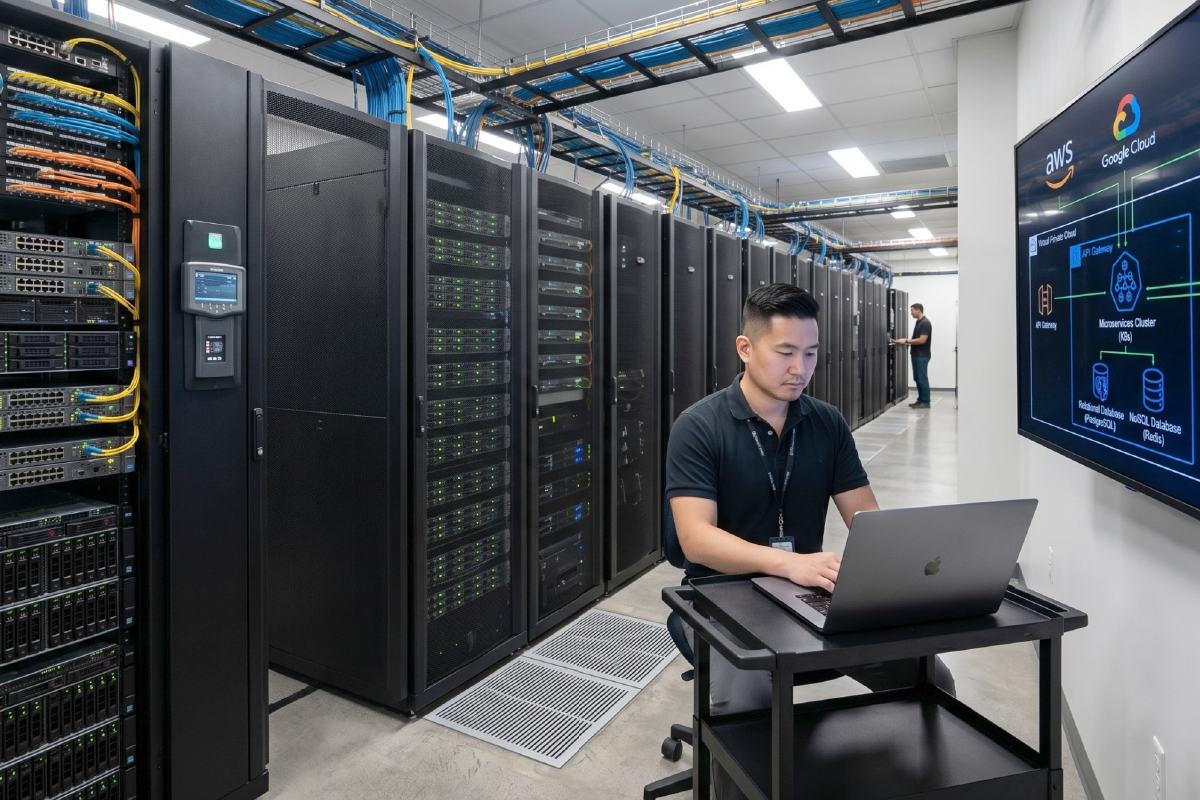
Kuwait invests in AI infrastructure with a focus on energy efficiency.
Translated by Qiyas from الجريدة — Original source
“Computing equals GDP.” With this phrase, the CEO of Nvidia, the maker of artificial intelligence chips, summarized the relationship between computing and the economy. In contrast, the Managing Director of the International Monetary Fund stated that “AI is rapidly becoming a key driver of countries’ advancement or lag in the global economy,” while the McKinsey Institute estimated that the AI revolution will add approximately $13 trillion to global output by 2030.
This revolution arrives as Kuwait completes its 80th year since exporting its first shipment of oil (June 1946). Throughout these decades, the country exported its energy in the form of crude oil, with derivatives accounting for no more than 30 percent of its exports before the commissioning of the Zour refinery. For the first time in its history, Kuwait saw derivatives surpass crude oil exports in 2024, a transformation that took decades to achieve and whose delay resulted in the loss of significant funds.
The chronic fiscal deficit plaguing the state’s general budget, including the current fiscal year 2026/2027 with an estimated deficit of 9.8 billion dinars, further heightens the need to seek opportunities in this new economy to capitalize on them. This deficit is not temporary; the general budget recorded a net deficit of 45.9 billion dinars on 11 occasions over the past 12 fiscal years. Key reasons include the budget’s reliance on a single source of oil revenues, oil’s vulnerability to fluctuations in global market prices, weak non-oil revenues, and the absence of capital projects in their broad sense within expenditure allocations.
Here, the refining equation takes on a new dimension in an emerging economy. Energy appears as the raw material, and computing as its refined derivative. The question arises: Can we learn from the mistakes of the energy experience, attract the added value of this modern industry early on, and make AI data centers a source of additional revenue for the budget?
At the heart of a new economy shaped by the AI revolution, the world’s need for data centers, including specialized AI data centers, is becoming evident. According to the International Energy Agency, these facilities constitute the infrastructure for training and operating AI models. A typical center consumes as much electricity as 100,000 households. The agency expects global data center energy consumption across all types to nearly double from 485 terawatt-hours to 950 terawatt-hours by 2030, with AI-specific centers representing the fastest-growing segment.
Thus, AI data centers reframe the refining equation in digital terms. In this revolution, a market emerges for those who provide infrastructure and energy to these facilities. Research firm Gartner predicts global spending on AI will reach $2.6 trillion in 2026 alone, with more than half allocated to infrastructure. Meanwhile, Deloitte forecasts that capital expenditure on data centers alone will exceed $3 trillion by 2030.
Deloitte links the speed of this growth to the availability of electricity. In the United States, technology companies are building data centers faster than power plants and transmission lines are being constructed, according to Fortune. Since computing relies entirely on electricity, it is natural for “gigawatts” to become a prominent metric of a country’s standing in the economy, alongside the indicators we know today.
In a November 2024 report, McKinsey estimated that generative AI applications alone could generate an annual economic value of between $20 billion and $35 billion for Gulf countries, equivalent to 1.7 to 2.8 percent of their non-oil GDP. In another estimate, the consulting firm Strategy& projected that these gains would reach approximately $12.2 billion annually in Saudi Arabia and $5.3 billion in the UAE by 2030, compared to $1.6 billion in Kuwait.
The Gulf region holds a strategic position in this race, situated between Europe, Asia, and Africa, enabling it to serve these three continents through a market of over 3 billion people. This positioning qualifies the region to supply AI services, driven by its low energy costs.
In practice, Gulf countries have begun leveraging these advantages. In Saudi Arabia, the Saudi Public Investment Fund established Humanain to build data centers and AI infrastructure. The kingdom aims, through this company, to become the world’s third-largest provider of AI infrastructure after the United States and China. Saudi data center capacity rose from 68 megawatts in 2021 to 467 megawatts in the first quarter of 2026, while Humanain alone plans to build 6.6 gigawatts by 2034.
The kingdom’s efforts extended beyond construction to preparing the necessary legislation for the new economic era. In 2025, Saudi Arabia introduced a draft system allowing countries to host their data and services within the kingdom in accordance with their own laws, a concept known as "data embassies."
In the UAE, G42, in partnership with US companies, is building the UAE-US AI Complex in Abu Dhabi with a capacity of 5 gigawatts, the largest of its kind outside the United States. The first phase, with a capacity of 200 megawatts, is expected to begin operations during the current quarter.
Turning to Kuwait, initial steps have been taken. In 2023, Google announced plans to create a cloud region in the country, and in 2025, Microsoft announced its intention to establish a cloud region supporting AI applications. On the policy front, the Central Information Technology Authority (CITA) conducted an assessment last month, in collaboration with the United Nations Development Programme (UNDP), of the country’s AI ecosystem to identify capabilities, gaps, and priorities.
Additionally, in June 2025, Kuwait, represented by the Public Authority for Investment (PAI), joined the AI Infrastructure Partnership established by BlackRock, Microsoft, Emirates MGI, and GIP. This initiative aims to raise $30 billion for investment in AI infrastructure, with Kuwait becoming the first investor to join from outside the founding institutions. This experience could be replicated by other Gulf countries.
Given the above, Kuwait has taken steps toward this new economy. However, the determining factor in realizing its potential is ensuring adequate electricity supply. The Ministry of Electricity has previously announced a plan to add 14 gigawatts by 2031, bringing total production capacity to 33 gigawatts by that year.
This presents both an opportunity and a challenge. Data centers could accelerate the establishment of power plants if an investor commits to a long-term demand that contributes to financing the new excess capacity, or through building additional capacity for projects.
Thus, Kuwait can initiate a new chain of non-oil state revenues, including land leasing, fees, and returns on services provided to investors. These revenues will grow as energy capacity expands to attract investors, alongside the expertise and local businesses that emerge around these projects, adding new value to the local market.
The implications extend beyond economics alone. The shifts in how the Iranian-American crisis has been managed since last February, along with US President Donald Trump’s statement that “there is no need for the Strait of Hormuz,” underscore the need for ties that preserve regional stability and are not based solely on oil barrels.
Among these emerging ties is the growing focus on artificial intelligence. The Washington-based Center for Strategic and International Studies (CSIS) argues that “computing in the Gulf region will bind the United States more closely to the region,” while the US-based Stimson Center contends that “maintaining Washington’s AI supremacy requires interconnected networks of US infrastructure outside the United States.” This aligns with the White House’s July 2025 announcement that the United States is in a race to achieve global AI dominance, as well as Trump’s declaration to prevent China from overtaking the US in this industry and from accessing American technology.
In other words, what will link the United States to the countries of the region is no longer just oil barrels, but rather interests centered on AI superiority, foremost among them data centers.
