From Rote Learning to Innovation: How to Rebuild Kuwaiti Education in the Age of AI to Achieve Sustainable Development?
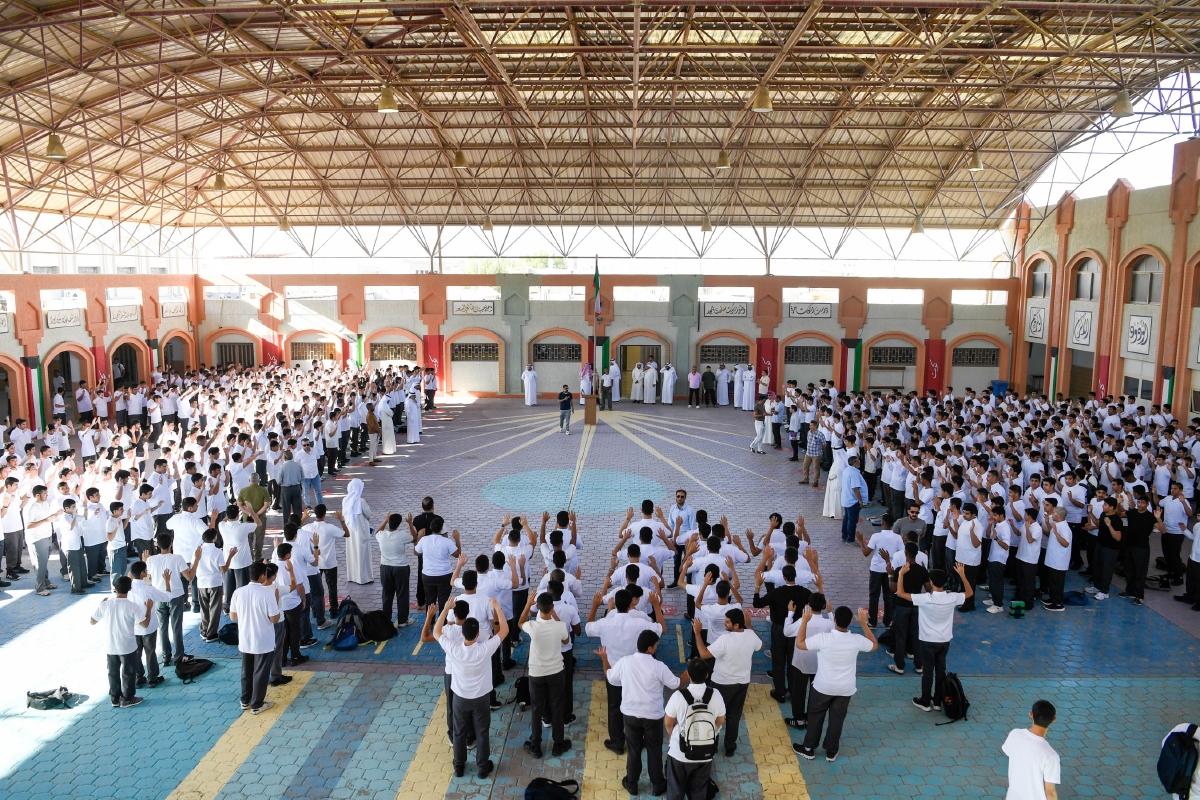
A report on the necessity of integrating artificial intelligence into the Kuwaiti curriculum.
Translated by Qiyas from الجريدة — Original source
Amid the rapid global shift toward a knowledge-based economy and generative artificial intelligence, the question facing educational systems is no longer whether to introduce technology into classrooms, but rather how to integrate it without compromising students’ ability to think, analyze, and create. In Kuwait, where the ambitions of “Vision 2035” intersect with the challenges of a single-resource economy, this question takes on strategic significance; education quality is no longer merely a pedagogical issue, but a developmental imperative for diversifying the economy, boosting productivity, and building a human capital capable of competing and innovating.
Accordingly, we begin with a central hypothesis: if artificial intelligence is integrated into curricula as a tool to enhance thinking rather than replace it, it can become a driver of innovation and sustainable development. Conversely, if students are left dependent on ready-made machine answers, we risk graduating a generation with shallow thinking, incapable of analysis, and unable to innovate or create. Furthermore, introducing AI without losing higher-order skills requires transforming it from a “source of answers” into a “partner in challenge and constructive dialogue.”
Scientifically, rethinking the foundations of Kuwait’s curricula demands a radical shift from rote learning and memorization to empowerment and critical thinking. It is no longer sufficient for students to learn how to use digital tools; they must acquire skills to discover them, guide their development, evaluate their outputs, and detect inherent biases. This necessitates incorporating concepts of artificial intelligence, digital ethics, prompt engineering, and data literacy at early stages, alongside higher-order human skills such as negotiation, leadership, and teamwork. It also requires retraining teachers to become facilitators of thinking rather than mere transmitters of information, and partners in designing interactive learning experiences that leverage AI to foster creativity rather than diminish it.
To achieve this transformation, Kuwait must reconsider the foundations of its educational curriculum design, rather than simply adding AI tools to existing programs. This begins by shifting the focus from memorizing and retrieving information to understanding, analyzing, problem-solving, and creating, and by redesigning assessment methods to measure students’ abilities to think, apply knowledge, and engage in discussion, rather than merely their capacity to produce correct answers. Additionally, foundational AI literacy should be integrated across all stages and disciplines, with an emphasis on the ethics of technology use, while teachers are trained to employ AI in designing more interactive and personalized learning experiences. Most importantly, AI use must become part of the learning process itself, enabling students to learn how to use it to develop their ideas rather than delegating their thinking to machines. In this way, schools and universities in Kuwait will transform from institutions that transmit knowledge into institutions that build the capacity to produce and critically and innovatively apply knowledge.
Economically, education reform is directly linked to the Kuwaiti labor market and the future of jobs. As automation and artificial intelligence advance, traditional data entry, routine, and office tasks are gradually eroding, while demand is rising for AI engineers, data scientists, prompt engineers, architectural engineers, AI agents, cybersecurity specialists, and AI ethics experts.
Accordingly, this transition will compel the Kuwaiti economy to bridge the skills gap between educational outputs and market needs, diversify income sources, and empower youth to move from rentier jobs to knowledge-based and innovative roles. In this context, education is not merely a social service but a high-yield economic investment and a tool for achieving sustainable development. From a sustainability perspective, the aforementioned points are closely and directly linked to Sustainable Development Goal 4 (Quality Education), as well as to the concepts of intergenerational equity, building a knowledge-based society, and fostering responsible innovation.
Thus, the concept of sustainability extends beyond the environmental dimension to encompass the sustainability of minds, capabilities, and institutions. While artificial intelligence can accelerate development, it may also deepen inequalities if not integrated fairly and conscientiously into the educational system. Therefore, this paper seeks to analyze how to reform Kuwait’s educational curricula so that artificial intelligence becomes a tool that enhances students’ capabilities rather than replacing their thinking, while also forecasting its impact on the labor market, available jobs, and roles that will disappear or emerge in the future. Moreover, this paper is not merely an educational proposal but serves as the foundation for a developmental mindset that connects education, economy, innovation, and sustainability, aiming to provide a practical vision for cultivating a Kuwaiti generation capable of thinking, creating, and competing in the age of artificial intelligence.
Based on this, the required transformation in Kuwait’s educational system can be viewed through three interconnected main axes: the current state of integrating artificial intelligence into education, the impact of educational reform on the labor market, and the nature of jobs that will change or emerge in the future.
A field study published in July 2025 indicates a clear knowledge gap in curricula, evidenced by the near-total absence of artificial intelligence topics, concepts, and applications in primary school computer science curricula in Kuwait. This is attributed to three factors: curriculum developers’ limited awareness of the importance of artificial intelligence, the lack of clear directives from the Ministry of Education to integrate these topics, and a shortage of qualified personnel to teach artificial intelligence.
Furthermore, a field study involving 2,889 students from all six educational regions in Kuwait revealed that high school students possess an average level of knowledge and usage. The study describes today’s students as “digital citizens” who interact daily with generative artificial intelligence tools and intelligent learning platforms, either under school guidance or independently outside the classroom. Data shows that 72.9 percent of female teachers in Kuwait have received no training on artificial intelligence.
Consequently, the Ministry of Education has undertaken a rapid strategic initiative by launching a national project in collaboration with Google for Education to enable approximately 40,000 teachers to use artificial intelligence in education. The first cohort of 104 certified teachers, educators, and mentors in the use of artificial intelligence (Gemini Certified Educators) was honored, as part of an ambitious plan targeting the training of 40,000 teachers.
This project also represents a major national strategic initiative, constituting a strategic investment in building the capacities of future generations and preparing them for future demands, thereby enhancing the competitiveness of the education system and supporting the path of sustainable national development. Directives from the Ministry of Education emphasize integrating artificial intelligence technologies into the educational process and developing teachers’ capacities, contributing to improving the quality of educational outcomes and achieving sustainable development goals.
Kuwait University, meanwhile, has transitioned from static traditional learning models to dynamic, personalized, and interactive models thanks to generative AI, focusing on customizing content according to individual learning styles and supporting teachers in designing adaptive curricula that respond to students’ performance in real time.
Regarding skills assessment, the 2025 Coursera Global Skills Report indicated that Kuwait ranks 69th globally in the Skills Index, with low scores in technology (30 percent) and data science (40 percent), reflecting a clear digital skills gap compared to countries such as the UAE (ranked 38th) and Qatar (ranked 40th).
The core objective of the reform is to equip Kuwaiti students to use AI as a tool to enhance their analysis and creativity, not as a substitute for their thinking. This approach aligns with statements from educational leaders affirming that technology is not a replacement for teachers but a tool to empower them. In the labor market, a PwC survey report indicates that 75 percent of employees in the Middle East have used AI in their jobs, with 82 percent reporting improved productivity.
Conversely, studies by the International Labour Organization (ILO) suggest that up to 30 percent of global job tasks may be automated or augmented by AI over the next decade. Consequently, the primary challenge lies fundamentally in the skills gap, as many Kuwaiti youth struggle to transition from education to a labor market requiring advanced digital and analytical skills. Therefore, curriculum reform is crucial to integrate critical thinking, problem-solving, and digital literacy as core competencies rather than optional subjects, which is imperative to bridge this gap.
Broadly speaking, the most significant impact of AI will not manifest through sudden mass layoffs, but through the slow erosion of traditional administrative and clerical jobs, particularly for new graduates. Accordingly, it is predicted that the following jobs are most vulnerable to disappearing over the next 5 to 10 years:
▪ Data entry and administrative assistant roles, as routine tasks are more easily automated than they are currently.
On the other hand, the most in-demand jobs in the future can be preliminarily summarized as follows:
In conclusion, the shift toward AI-driven education in Kuwait is not an option but an absolute necessity for achieving sustainable development. Success requires radical curriculum reform starting from early stages, investment in teacher training, and strong partnerships with the private sector to ensure educational outputs align with market needs. Overall, the goal is not merely to introduce technology, but to redefine the nature of learning to foster a generation capable of critical thinking and adapting to continuous change.
