US Interior Secretary: We Thank Kuwait for Its Contribution to the Desert Storm and Desert Shield Memorial in Washington
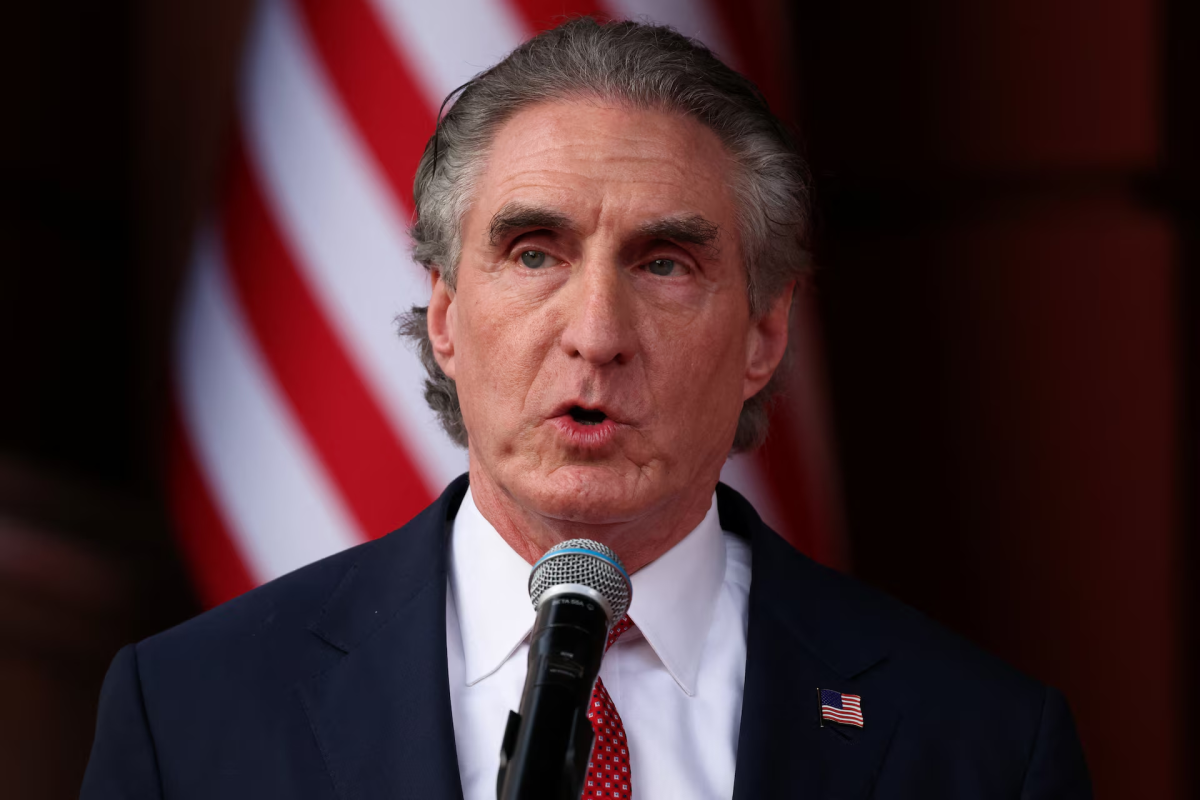
US Interior Secretary thanks Kuwait for supporting a memorial in Washington
Translated by Qiyas from الجريدة — Original source
U.S. Secretary of Homeland Security Doug Burgum expressed his country’s gratitude and appreciation to the State of Kuwait, in particular, for its generous support in contributing to the creation of the memorial to Operations Desert Shield and Desert Storm in the heart of the nation’s capital, Washington, D.C., which honors the sacrifices of U.S. and coalition forces in the 1991 war to liberate Kuwait.
Speaking at the official unveiling ceremony of the memorial at the National Mall in Washington, attended by Kuwait’s Minister of Defense Sheikh Abdullah Ali Al-Salim Al-Sabah, Kuwait’s Ambassador to Washington Sheikhah Al-Zain Al-Sabah, and a large gathering of officials and diplomats from many countries, Burgum said, “It is a day of patriotism, a day of remembrance, a day of gratitude, and also a day of celebration. We are, of course, celebrating the creation of this magnificent and beautiful memorial.”
He added, “We express our gratitude to our friends and allies, many of whom are here today, and especially to the State of Kuwait. Thank you very much to your country for the immense support in building this memorial, which reminds us of how we worked together.”
He noted that the memorial required years of “vision, tireless work, and commitment to overcome the obstacles to realizing this project on the ground, which will immortalize the sacrifices of veterans of Desert Shield and Desert Storm in our nation’s capital and on the grounds of our national memorial.”
He continued, “Today we stand in reflection and reverence for those brave souls who served their country, and for those who lost their lives—whether they fell during combat operations in Desert Storm, symbolized by the wreath on the right, or sacrificed their lives during the Desert Shield phase, symbolized by the wreath on the left.”
He added, “We honor these veterans not merely because they fought, but for the cause they fought for. They fought for freedom, to liberate the people of Kuwait, and to support our friends and allies in the region.”
He highlighted the significance of the memorial’s location in the seating area extending from the Lincoln Memorial, one of the most famous and visited memorials in the world, attracting approximately 40 million visitors annually.
Burgum said, “Memorials—like the one we dedicate today—are a tangible embodiment of our pride and gratitude for all who have served their country and made the greatest sacrifices and demonstrations of dedication. This memorial has now become a national legacy and a trust upon all of us.”
He clarified that the U.S. Department of Homeland Security and the National Park Service will officially assume responsibility for preserving the memorial in perpetuity from its opening day, enabling future generations, decades or centuries from now, to learn about the Americans honored by this important memorial.
The U.S. Secretary continued, “Our responsibility begins today; it does not end with the current dedication ceremony but continues through our commitment to maintaining this memorial, just as we have and continue to do at other sites across the country and on this national ground, the National Mall.”
He praised the creativity of the designers responsible for the memorial, saying, “The designers have exerted tremendous effort in creating this exquisite artistic wall, choosing a type of stone that precisely matches the colors of Kuwait’s sands.
The emblem of two birds of prey is also featured: one is an eagle representing the United States, and the other is a falcon symbolizing the ancient falconry traditions of the Middle East. Both birds soar toward the dawn of a new day.”
For his part, U.S. Secretary of Defense Pete Hegseth, speaking through Under Secretary of Defense for Policy Elbridge Colby at the ceremony, affirmed that this memorial serves as “a sober and necessary reminder of the seriousness with which we must all approach the use of military force.”
He emphasized that the “Desert Storm” operation was a model of this principle, and that the memorial would stand as a testament to it; indeed, he noted that he would likely be able to see it from his office at the Pentagon, serving as a constant personal reminder of this principle.
He pointed out that the “Desert Shield” and “Desert Storm” operations demonstrated the “exceptional impact” of partnerships based on shared interests, forging strong and enduring bonds between the American people and the peoples of Kuwait, the Kingdom of Saudi Arabia, and other partners in the Gulf region.
He said, “We recall when coalition forces were able to seize the initiative, restore Kuwait’s sovereignty and freedom, and deliver a decisive defeat to Iraqi forces… Our shared victory was overwhelming and the result of a sound strategy executed with skill by a force that was competent, ready, and courageous.”
He added that the victory in the “Desert Shield” and “Desert Storm” operations carries a firm truth: “that military force, when used clearly to advance specific political objectives and in cooperation with capable and willing partners, can and will continue to achieve decisive results.”
He considered that “this lesson is not confined to the pages of history; peace and stability in the Gulf region, in the Indo-Pacific, in Europe, and even in our immediate neighborhood are safeguarded only through strength, affirming that this is the core of U.S. President Donald Trump’s approach… ‘achieving peace through strength.’”
He added, “Today, we honor this partnership and say to all who participated in these operations, especially those who made the ultimate sacrifice or were injured during this conflict, as well as their families, ‘We appreciate you and we thank you.’ We hope that this memorial will ensure that this memory remains present in the minds of future generations as well.”
The opening ceremony for the “Desert Shield” and “Desert Storm” memorial was held in a large gathering that included numerous U.S. officials, senior members of the Kuwaiti Embassy in Washington, cultural and political figures, diplomats from many countries, and a large group of veterans and their families.
The celebration included honors for veterans who participated in the “Desert Storm” and “Desert Shield” operations, as well as for the families of soldiers who were killed in them. It also featured a Kuwaiti song about freedom, expressing Kuwait’s gratitude and appreciation for U.S. support in the liberation war.
The memorial is located at the intersection of 23rd Street and Constitution Avenue in a highly significant location in the nation’s capital, symbolically representing the convergence of the gravitas associated with Constitution Avenue and the diplomacy represented by 23rd Street, home to the U.S. Department of State.
It extends from the U.S. Capitol building toward the Lincoln Memorial and the western area, forming a physical and symbolic link between the legislative heart of the country and its foundational ideals and presidential memorials. The street is lined with large federal buildings, most notably the National Archives Building, which houses the “Charters of Freedom” (the Declaration of Independence, the U.S. Constitution, and the Bill of Rights).
