Washington Prepares Militarily and Diplomatically for Escalation Against Iran
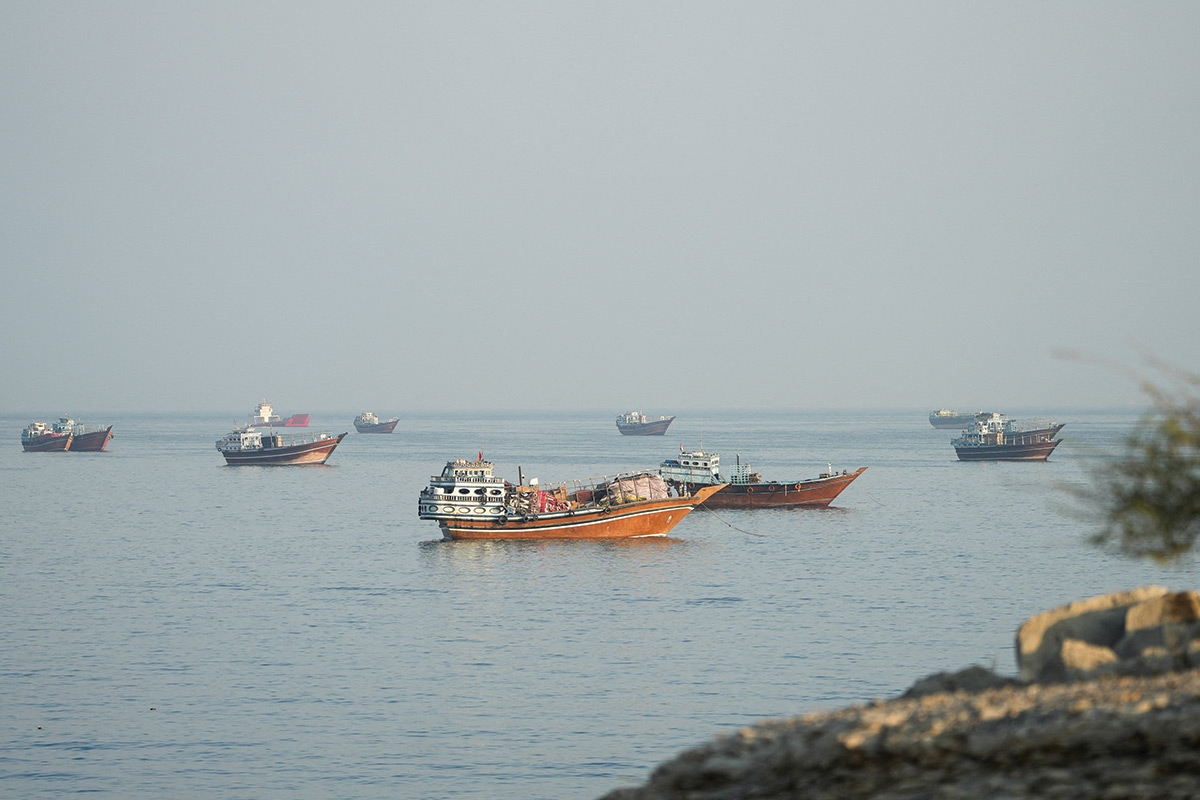
Indications are increasing of a potential resumption of extensive US military strikes against Iran, with intensive combat preparations observed on US ships, coinciding with the launch of a chaotic and urgent evacuation of dozens of diplomats by the US administration.
Translated by Qiyas from الجريدة — Original source
Indications are mounting that the United States may resume its broad military strikes against Iran, as intensive combat preparations are observed aboard U.S. ships, coinciding with the launch of a chaotic and urgent evacuation of dozens of diplomats from the region amid reports of Iranian plans to carry out a campaign of assassinations.
The Wall Street Journal cited U.S. officials stating that American warships in the region are preparing for the possibility of returning to combat, ensuring their readiness should President Donald Trump decide to execute an additional round of attacks against Tehran.
While Trump cast doubt on Iran’s willingness to reach an agreement and hinted at a new military operation on the night of Friday-Saturday, the newspaper reported that its journalists witnessed, during a rare visit to the aircraft carrier George Washington and a guided-missile destroyer in the Arabian Sea, aerial operations and extensive replenishment of the two vessels with ammunition and supplies, including bunker-buster bombs and large numbers of long-range missiles.
This comes as the United States dispatched the aircraft carrier USS Theodore Roosevelt, raising the number of American carriers in the region to three, alongside...
Meanwhile, the U.S. State Department announced it would reduce the number of staff at its embassies in Jordan, Lebanon, Qatar, and the United Arab Emirates due to fears of attacks launched by Iran or its allies, the Houthi rebels in Yemen.
In a move reinforcing implicit preparations for strikes and to avoid retaliatory attacks, the U.S. State Department issued an update to its travel advisory for Israel, warning of an increasing risk of armed attacks by the Houthis and the possibility of a rapid escalation of hostilities at the regional level.
CNN news network quoted a U.S. diplomat as saying that describing the situation as chaotic “does not do justice to what is happening,” clarifying that the financial support provided so far does not fully cover the costs of relocating their families from the region.
Earlier, Axios reported, citing a memo obtained by the outlet dated October 23 and addressed to U.S. Secretary of State Marco Rubio, that U.S. intelligence concluded Iran had “significantly intensified” efforts to target American diplomats and officials in the Middle East and beyond, with lethal plans reaching advanced stages.
In security alerts, the State Department updated travel advisories across the Gulf and the Middle East, including Saudi Arabia, Qatar, the UAE, Iraq, Lebanon, and Israel, urging avoidance of travel to the region.
Earlier, Trump hinted that he might carry out a new, limited round of the “Epic Fury” operation if no agreement is reached with Tehran.
While the Republican president did not specify a date for the start of the attack and questioned whether Washington should seek to end the war quickly or let the conflict gradually fade while maintaining the naval and economic blockade, some anticipated that U.S. strikes would come shortly after the midterm congressional elections on November 3 to avoid further inflating already high energy prices. However, U.S. Ambassador to Turkey Tom Barrack maintained ambiguity and did not rule out an attack at the end of the week.
Observers believe that the nature of any potential US-Israeli strike against Iran will depend on Trump’s objective, whether it is seeking regime change or merely aiming to modify its behavior. If Trump adopts the Israeli view advocating for regime change, strikes are expected to focus on destroying energy infrastructure, particularly in Tehran, targeting Basij forces to cripple protest suppression tools, and destroying “missile cities” using advanced US capabilities.
If the goal is to exert intense military pressure, the campaign may be limited to strikes lasting less than a week, targeting nuclear, missile, and drone facilities, with the aim of inflicting economic and military damage that forces Tehran to back down while preserving the regime.
On the other hand, Iran has shown no signs of concession. Deputy Commander of the Islamic Revolutionary Guard Corps (IRGC), Brigadier General Yadollah Javani, affirmed that Iranian forces are ready to counter any aggression and are waiting for the enemy to commit what he described as a “strategic mistake,” stressing that Iran would become a “grave for invaders” if the enemy attempts ground operations against it.
In this context, Iranian Chief of Staff Ali Abdollahi vowed not to allow US forces to enter Gulf waters even after the war ends.
Reuters reported that senior Iranian officials stated Tehran has drawn up detailed plans to target undersea communication cables in the Gulf in the event of a new attack by the United States and Israel.
One official noted that “if Iran is attacked, there will be no red lines, from undersea cables to military bases, including secret bases.”
Meanwhile, Head of the Judiciary Gholam-Hossein Ajoei described the “current war with Israel as an existential war,” adding that “Israel wants to eliminate Iran, and we also see that the existence of Israel poses a threat to humanity.”
Amid worsening crises resulting from the blockade and sanctions imposed on Iran, and the IRGC’s dominance over decision-making in Tehran, President Masoud Pezeshkian emphasized the need to move beyond the state of “no war, no peace,” stating: “We were conducting negotiations, but cowards ruined everything... I still believe we should move forward and conclude an agreement.”
While Pezeshkian blamed Washington for bearing responsibility for the failure of the Islamabad interim memorandum to end the conflict, TASS reported that the Iranian president will visit Moscow the day after tomorrow to participate in the Gas Exporting Countries Forum summit and meet his Russian counterpart, Vladimir Putin. This will be the second such meeting this month.
This coincided with an Iranian Foreign Ministry source telling Al-Jarida about the outlines of a European diplomatic move adding to efforts by other countries, primarily Turkey and Pakistan, to end the war after weeks of Russian, Pakistani, and Qatari mediation that have not yielded any breakthrough.
The source said there is no complete European initiative, but several ideas could facilitate reaching a minimum agreement on Iran’s nuclear program.
The ideas call for a formula similar to the Cairo agreement between Tehran and the International Atomic Energy Agency (IAEA), under which Iran would allow international inspectors to visit its nuclear facilities, in exchange for Europeans refraining from activating the snapback mechanism in the UN Security Council and working to persuade Washington to join and later expand the understanding.
The source added that Europeans proposed that Iran stop obstructing navigation in the Strait of Hormuz and restore the situation there to what it was before the war, in exchange for signing contracts to purchase Iranian oil and gas.
It was not clarified whether the Europeans had pledged to persuade Trump to lift the sanctions on Iranian ports, should Tehran cease targeting ships transiting the strait.
Turkish Foreign Minister Hakan Fidan announced yesterday, following a regional European meeting in Istanbul that included Turkey, Saudi Arabia, Egypt, Pakistan, France, Germany, Britain, and Italy, that the participants emphasized that dialogue and political solutions are the only way to contain the crisis and avoid triggering a wide regional war.
