Macron's 'unscheduled' visit to Saudi Arabia; Houthis attack Aden and Mukalla airports
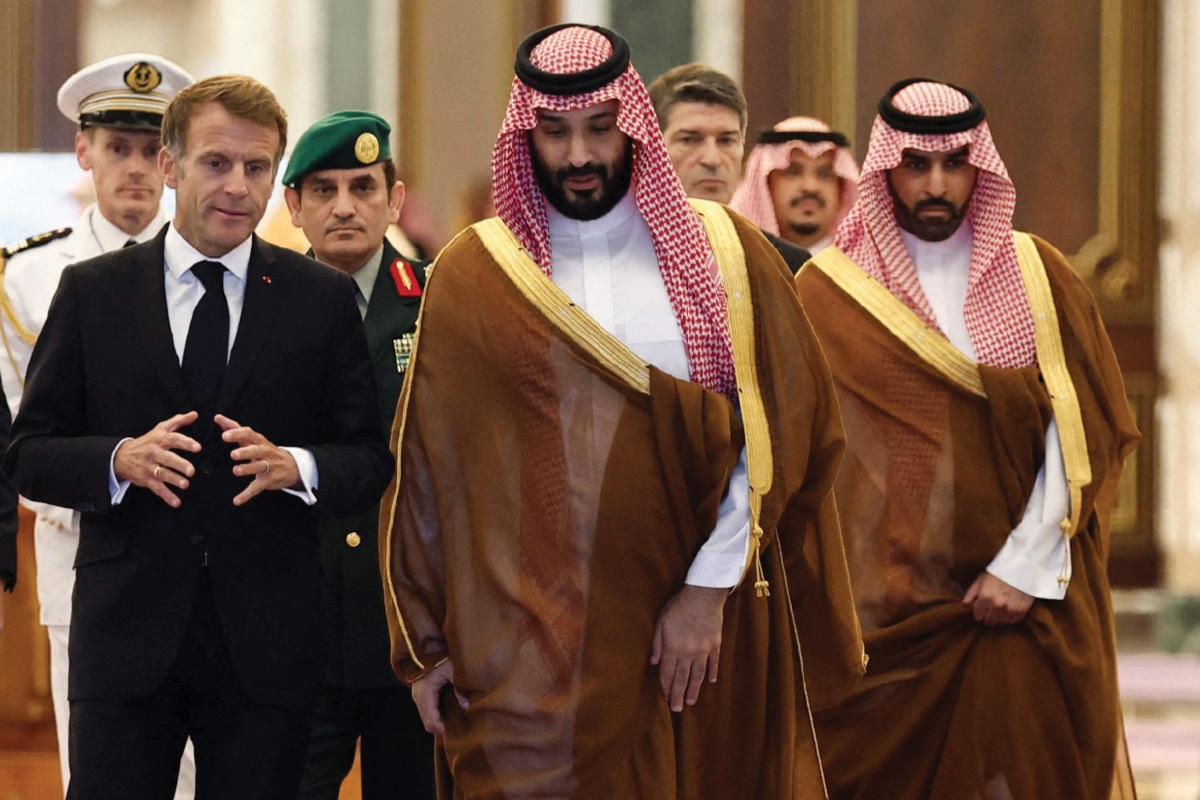
French President Macron visits Saudi Arabia to bolster its security, while Egypt affirms its defense of its borders and denies involvement in Yemen, Iran warns against interference, and Iraq considers closing Houthi offices.
Translated by Qiyas from الجريدة — Original source
Days after France effectively began deploying military assets to protect vital energy facilities in Saudi Arabia, French President Emmanuel Macron made an unscheduled stop in Riyadh during his Gulf tour today, meeting with Crown Prince Mohammed bin Salman to demonstrate solidarity with the Kingdom in the face of Houthi militias allied with Iran.
The Saudi Crown Prince received the French president, who became the first Western head of state to visit the Saudi capital since the escalation of attacks by Iran-aligned Houthi militias earlier this month. The two discussed developments in the region, as well as securing sea lanes and ensuring the stability of energy supplies to global markets.
Before arriving in Riyadh, Macron, at the conclusion of his visit to Qatar, affirmed France’s support for Saudi security. He noted that French personnel and capabilities had been deployed eight days ago to help secure damaged facilities and restore them, adding that France had offered to participate in the rehabilitation and security of Saudi Arabia’s East-West oil pipeline, which was damaged in Houthi attacks.
Macron announced that Riyadh had pledged to provide additional diesel supplies as long as it was “necessary.”
A day after the Turkish government submitted the “Mecca Agreement” to parliament for a vote, a deputy from the ruling Justice and Development Party said today that President Recep Tayyip Erdoğan’s government would present lawmakers with a proposal to deploy military personnel to Saudi Arabia following ratification of the agreement signed between Turkey, Saudi Arabia, and Pakistan on August 7. The deputy clarified that the authorization would be presented to parliament immediately after the bill related to the agreement is ratified.
In Egypt, President Abdel Fattah el-Sisi affirmed that Egypt’s military efforts are aimed at defending Saudi territory and protecting its borders, and do not involve any offensive operations against Yemen. He clarified that this field intervention is limited to fulfilling the defensive duty to protect the Kingdom’s territory or that of any other Arab state that requests such assistance from Egypt.
Speaking on the third day of the Egypt Forum 2026, el-Sisi stated that “the military effort does not extend beyond the borders of Egypt or any sister country whose security and stability Egypt is keen to safeguard.”
He added that standing by Gulf states is an authentic extension of shared Arab national security, describing it as an indivisible whole, and that the stability of Gulf brothers represents a top priority for Egypt from the perspective of its national security.
This coincided with a meeting between Crown Prince Mohammed and Egyptian Foreign Minister Badr Abdelatty, during which he received a written message from el-Sisi to Saudi King Salman. The Saudi Press Agency reported that the Crown Prince discussed “regional developments and coordination of efforts regarding them” with the Egyptian foreign minister.
Meanwhile, Iranian Foreign Minister Abbas Araghchi considered that any intervention by Egypt or any other country in the ongoing war in Yemen would make the situation “more difficult.”
In an interview with Iraq’s official Al-Iraqiya channel, Araghchi said, “Egypt has sufficient experience to avoid being drawn into such a highly complex conflict.”
He added, “We believe that any foreign presence or intervention will only make resolving this issue more difficult,” noting that Egypt had stated it “will not enter Yemen and will not engage in a war against Yemen.”
On the ground, the Yemeni coalition supporting legitimacy intercepted and destroyed five drones launched by the Houthi militia toward Saudi Arabia, targeting Medina and the Eastern Region. This occurred simultaneously with the escalation of attacks by the Iran-aligned militant group on Yemeni airports under the control of the internationally recognized government.
The Houthi aggression extended to Al-Rayyan Airport in the city of Mukalla, with government sources reporting hearing loud explosions and seeing smoke rise after the airport was targeted by ballistic missiles and drones. Initial information indicated that projectiles landed outside the runway and in the vicinity of the adjacent air base, while authorities assessed the damage, without confirming any casualties.
In Iraq, sources told Al-Hadath TV that Prime Minister Ali al-Zidan proposed, during a meeting of the ruling Shia Coordination Framework last Monday, closing Houthi offices in Iraq, emphasizing that the Iraqi government is seriously considering this step amid American pressure.
Iraqi government spokesperson Haider al-Abudi denied the existence of Houthi offices on Iraqi soil, stressing that Iraq will not allow its territory to be used to threaten neighboring countries and will not host any armed group involved in a particular conflict.
